
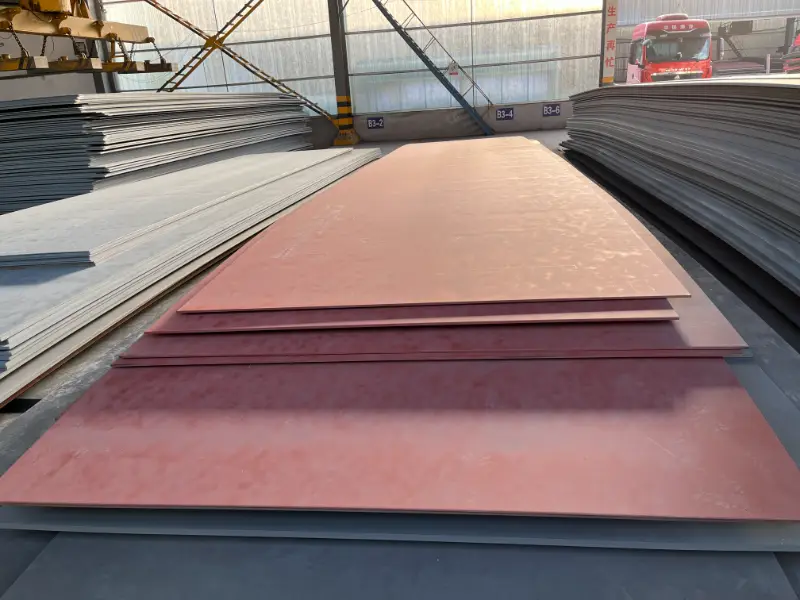
EN 10225 S420G1+QT Offshore Structural Steel Plate
EN 10225 S420G1+QT Offshore Structural Steel Plate - Properties, Equivalents & Applications
Complete datasheet for EN 10225 S420G1+QT offshore structural steel, including chemical composition, mechanical properties, thermal properties, and international equivalents.
Welding, cutting, cold forming (within limits), hot forming (followed by post-forming heat treatment), forging (limited), machining
- Phone : +8618037372205
- Email : [email protected]
- WhatsApp: Contact via Whtsapp
- WeChat: +8618037372205
EN 10225 S420G1+QT Offshore Structural Steel Plate Introduction
EN 10225 Grade S420G1+QT is a weldable structural steel specifically developed for fixed offshore structures. It is supplied in the quenched and tempered (+QT) condition, offering a minimum yield strength of 420 MPa and excellent toughness at low temperatures. The steel provides a balanced combination of high strength, good weldability, and superior resistance to brittle fracture, making it suitable for critical components in harsh marine environments.
Key features include:
- Minimum yield strength of 420 MPa (thickness ≤ 16 mm)
- Tensile strength in the range of 500–700 MPa
- Impact energy guaranteed at -40 °C (≥ 50 J longitudinal)
- Fine-grained structure and low sulfur/phosphorus levels ensuring high ductility and weldability
- Fully killed and treated with aluminium to control grain size and deoxidation
The +QT condition (quenching followed by tempering) refines the microstructure, enhancing strength properties while maintaining sufficient elongation and toughness. This grade is used predominantly in the construction of offshore platforms, jackets, deck components, and other structural elements subjected to static and dynamic loads, fatigue, and low ambient temperatures.
EN 10225 S420G1+QT Offshore Structural Steel Plate Chemical Composition
The chemical composition of S420G1+QT is strictly controlled to achieve the required mechanical properties and weldability. The values below are according to EN 10225 for the heat (ladle) analysis. For product analysis, certain elements may have slightly different limits. The steel is fully killed with aluminium and may contain microalloying elements such as niobium, vanadium, and titanium for grain refinement and precipitation strengthening.
- Maximum carbon content is limited to 0.14% for thicknesses up to 40 mm and 0.16% for thicker plates up to 63 mm, ensuring good weldability.
- Low phosphorus and sulfur levels improve toughness and cleanliness.
- Aluminium total ≥ 0.020% guarantees fine-grain practice.
| Element | Standard Value (max, min as indicated) | Remarks |
|---|---|---|
| C | ≤ 0.14 (thickness ≤ 40 mm) ≤ 0.16 (thickness > 40 mm, ≤ 63 mm) | Max. based on product thickness |
| Si | 0.15 – 0.55 | Silicon range; fully killed |
| Mn | 1.00 – 1.70 | Manganese for strength and toughness |
| P | ≤ 0.020 | Maximum phosphorus content |
| S | ≤ 0.010 | Maximum sulfur content |
| Altot | ≥ 0.020 | Total aluminium; fine grain practice |
| N | ≤ 0.012 | Maximum nitrogen |
| Nb | ≤ 0.05 | Niobium microalloying allowed |
| V | ≤ 0.10 | Vanadium addition allowed |
| Ti | ≤ 0.03 | Titanium addition allowed |
| Cr | ≤ 0.25 | Residual or added |
| Ni | ≤ 0.30 | Residual or added |
| Mo | ≤ 0.10 | Maximum molybdenum |
| Cu | ≤ 0.30 | Maximum copper |
EN 10225 S420G1+QT Offshore Structural Steel Plate Thermal and Electrical Physical Properties
The following physical properties are typical for this type of quenched and tempered structural steel. They are not mandatory requirements of EN 10225 but are representative of S420G1+QT and similar alloy steels. The data are given for guidance in design calculations (thermal stress analysis, heat transfer, etc.). Variation is possible depending on exact composition and heat treatment condition.
- Density is assumed constant within the service temperature range.
- Moduli values are close to those of common constructional steels.
- Thermal expansion coefficient increases slightly with temperature; the value given is an average from 20 °C to 100 °C.
- Thermal conductivity decreases as temperature rises; the value is at room temperature.
| Property | Typical Value | Unit | Test Condition / Remarks |
|---|---|---|---|
| Density (ρ) | 7.85 | g/cm³ | At 20 °C |
| Modulus of elasticity (E) | 210 | GPa | At 20 °C, typical |
| Shear modulus (G) | 81 | GPa | Calculated from E and Poisson's ratio |
| Poisson's ratio (ν) | 0.3 | – | Elastic range, at ambient temperature |
| Thermal expansion coefficient (α) | 11.7 × 10⁻⁶ | 1/K | Average between 20 °C and 100 °C |
| Thermal conductivity (λ) | 50 | W/(m·K) | At 20 °C |
| Specific heat capacity (cp) | 460 | J/(kg·K) | At 20 °C, approximate |
| Electrical resistivity (ρe) | 0.22 × 10⁻⁶ | Ω·m | At 20 °C |
EN 10225 S420G1+QT Offshore Structural Steel Plate Mechanical Properties
Tensile and impact properties are determined on test specimens taken from the material in the +QT delivery condition. The test piece orientation is longitudinal unless otherwise agreed. The yield strength is specified as the upper yield strength (ReH) or the 0.2% proof strength (Rp0.2) for carbon-manganese structural steel. The values apply to plate thicknesses up to 63 mm.
- Yield strength decreases slightly as thickness increases.
- Tensile strength range is independent of thickness within the specified limits.
- Minimum elongation is based on a proportional gauge length (L0 = 5.65√S0).
- Charpy V-notch impact tests are performed at -40 °C, with minimum energy values of 50 J (longitudinal) and 33 J (transverse).
| Property | Standard Required Value | Unit | Test Condition / Remarks |
|---|---|---|---|
| Yield strength ReH (t ≤ 16 mm) | ≥ 420 | MPa | Transverse or longitudinal, RT |
| Yield strength ReH (16 < t ≤ 25 mm) | ≥ 400 | MPa | Transverse or longitudinal, RT |
| Yield strength ReH (25 < t ≤ 40 mm) | ≥ 390 | MPa | Transverse or longitudinal, RT |
| Yield strength ReH (40 < t ≤ 63 mm) | ≥ 380 | MPa | Transverse or longitudinal, RT |
| Tensile strength Rm (all thicknesses) | 500 – 700 | MPa | Transverse or longitudinal, RT |
| Elongation after fracture A (t ≤ 40 mm) | ≥ 19 | % | Longitudinal, L0 = 5.65√S0 |
| Elongation after fracture A (40 < t ≤ 63 mm) | ≥ 18 | % | Longitudinal, L0 = 5.65√S0 |
| Impact energy KV (longitudinal) | ≥ 50 | J | At -40 °C, Charpy V-notch |
| Impact energy KV (transverse) | ≥ 33 | J | At -40 °C, Charpy V-notch |
EN 10225 S420G1+QT Offshore Structural Steel Plate Equivalent Material Standards and Designations
This table lists standards and grades that are technically identical to EN 10225 S420G1+QT. As the standard is adopted nationally across Europe, the designation remains unchanged but the prefix may include the national identifier. The base chemistry, mechanical property requirements, and delivery conditions are fully identical.
| Region / Country | Standard | Designation | Remarks |
|---|---|---|---|
| Europe (CEN) | EN 10225 | S420G1+QT | Original European standard |
| United Kingdom | BS EN 10225 | S420G1+QT | British adoption of EN 10225 |
| Germany | DIN EN 10225 | S420G1+QT | German adoptation; formerly DIN EN 10225 |
| France | NF EN 10225 | S420G1+QT | French adoptation |
| Italy | UNI EN 10225 | S420G1+QT | Italian adoptation |
| Spain | UNE EN 10225 | S420G1+QT | Spanish adoptation |
EN 10225 S420G1+QT Offshore Structural Steel Plate Application Introduction
S420G1+QT is specifically tailored for offshore structural applications where high strength, excellent toughness at sub-zero temperatures, and good weldability are essential. Its technical delivery conditions (EN 10225) are recognized by major offshore operators and classification societies. Typical uses include:
- Fabrication of primary and secondary structural members on fixed offshore platforms
- Construction of jacket and topside structures subjected to high static and dynamic loads
- Critical connections and node joints where fatigue resistance is required
- Deck plates, stiffeners, beams, and columns
- Padeyes, lifting lugs, and structural attachments
Product Applications: Fixed production platforms, Jack-up rig legs and spudcans, Offshore jackets and substructures, Topsides and deck modules, Flare booms and helideck supports, Subsea templates and manifolds, Bridge modules between platforms
Processed into products: Tubular joints and nodes, Girder webs and flanges, Stiffened panels and bulkheads, Piles and pin piles, Lift points and padeyes, Brackets and gusset plates, Base plates and connection plates
Application industries: Oil and gas exploration and production (offshore platforms), Offshore wind energy (foundation structures, transition pieces), Shipbuilding (special structural parts for heavy-lift vessels), Civil engineering (heavy structures, bridges in cold climates – with special approval), Modular construction (offshore living quarters, process modules)
EN 10225 S420G1+QT Offshore Structural Steel Plate Similar / Alternative Steel Grades
The following materials are not fully identical to S420G1+QT but offer comparable strength levels, good toughness, and weldability. They may be considered as alternatives for offshore or structural applications where the exact EN 10225 certification is not mandatory, subject to project specification approval.
| Region / Country | Standard | Designation | Remarks |
|---|---|---|---|
| Europe | EN 10025-3 | S420N / S420NL | Normalized steel with similar min. yield strength; toughness down to -50 °C for NL grade. Not quenched and tempered; use may be limited for components requiring QT treatment. |
| Europe | EN 10025-4 | S420M / S420ML | Thermomechanically rolled; similar yield strength; impact energy at -50 °C for ML. Not quenched and tempered. |
| Norway (offshore) | NORSOK M-120 | Y42 | Offshore structural steel with min. yield 420 MPa; often specified for Norwegian sector. Similar chemical and toughness requirements. |
| USA | API 2Y | Grade 60 | Quenched and tempered offshore steel with min. yield 415 MPa (60 ksi). Similar application but requires reconciliation with EN 10225 requirements. |
| USA | ASTM A572 | Grade 60 (Type 1 or 2) | High-strength low-alloy structural steel with min. yield 415 MPa for general structural use. Not specifically for offshore; impact testing optional. |
Notes:
The quenched and tempered condition (+QT) requires careful control of welding heat input and post-weld heat treatment (PWHT) if applicable. The steel shall be welded in accordance with approved welding procedures, and preheating may be necessary depending on plate thickness and ambient conditions. The material complies with the essential requirements of major classification societies such as DNV, ABS, and LR when produced by an approved manufacturer. For applications requiring through-thickness properties (Z-quality), supplementary testing per EN 10164 may be agreed at the time of order.
- Share



