
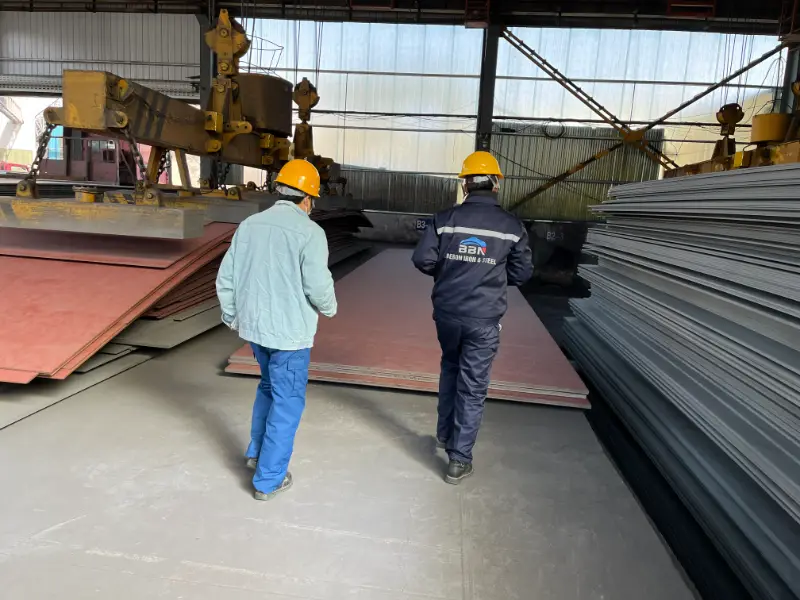
EN10225 S420G2+M Offshore Steel Plate
EN10225 S420G2+M Offshore Steel Plate: High Strength TMCP Steel for Fixed Marine Structures
Comprehensive data sheet for EN10225 Grade S420G2+M thermomechanically rolled offshore structural steel plate: chemical composition, mechanical properties, physical performance, and international equivalents.
Thermomechanically rolled and cooled; suitable for cutting, cold forming, welding (all common processes), and subsequent hot-dip galvanizing if required.
- Phone : +8618037372205
- Email : [email protected]
- WhatsApp: Contact via Whtsapp
- WeChat: +8618037372205
EN10225 S420G2+M Offshore Steel Plate Introduction
EN10225 S420G2+M is a high-strength, weldable structural steel plate specifically designed for fixed offshore structures. It is produced through the thermomechanical controlled process (TMCP) and supplied in the as-rolled plus accelerated cooling condition (designated +M). This grade guarantees a minimum yield strength of 420 MPa at thicknesses up to 63 mm, combined with excellent toughness down to -40 °C. The controlled low carbon equivalent (CEV) ensures outstanding weldability without excessive preheat, while the fine-grain microstructure enhances resistance to brittle fracture and fatigue. The material fulfils stringent requirements for North Sea and other harsh marine environments, featuring tight limits on phosphorus and sulphur and guaranteed through-thickness properties when specified. S420G2+M is used in primary load-bearing members such as platform legs, bracings, nodes, and helideck structures, where structural integrity, longevity, and safety are paramount.
EN10225 S420G2+M Offshore Steel Plate Chemical Composition
Ladle analysis in accordance with EN 10225-1:2019 for S420G2+M. The steel is fully killed and normalized/fine-grain treated. Carbon equivalent (CEV) is controlled to guarantee weldability: CEV max. typically 0.41% for +M condition (t ≤ 63 mm). Microalloying elements such as niobium, vanadium and titanium are added to refine grain size and increase strength through precipitation hardening.
| Element | Value (% max unless range) | Remarks |
|---|---|---|
| Carbon (C) | 0.14 | max |
| Silicon (Si) | 0.55 | max |
| Manganese (Mn) | 1.65 | max |
| Phosphorus (P) | 0.020 | max |
| Sulfur (S) | 0.010 | max |
| Aluminium (Altot) | ≥ 0.015 | total aluminium, min |
| Niobium (Nb) | 0.05 | max |
| Vanadium (V) | 0.10 | max |
| Titanium (Ti) | 0.025 | max |
| Chromium (Cr) | 0.30 | max |
| Nickel (Ni) | 0.70 | max |
| Molybdenum (Mo) | 0.35 | max |
| Copper (Cu) | 0.30 | max |
| Nitrogen (N) | 0.010 | max |
EN10225 S420G2+M Offshore Steel Plate Physical Properties
Typical physical data for low-carbon structural steel. Values may vary slightly depending on exact composition and manufacturing route. Thermal conductivity and heat capacity are average values between 20 °C and 100 °C unless otherwise specified. These properties are essential for design calculations involving thermal loads, heat treatment, and fire safety assessment.
| Property | Typical Value | Unit | Test Condition / Temperature |
|---|---|---|---|
| Density (ρ) | 7850 | kg/m³ | 20 °C |
| Modulus of elasticity (E) | 205 | GPa | 20 °C |
| Shear modulus (G) | 80 | GPa | 20 °C |
| Poisson's ratio (ν) | 0.3 | – | 20 °C |
| Thermal expansion coefficient (α) | 11.7 × 10⁻⁶ | K⁻¹ | 20 – 100 °C |
| Thermal conductivity (λ) | 50 | W/(m·K) | 20 °C |
| Specific heat capacity (cp) | 460 | J/(kg·K) | 20 °C |
| Electrical resistivity (ρe) | 0.15 – 0.25 | µΩ·m | 20 °C |
EN10225 S420G2+M Offshore Steel Plate Mechanical Properties
Tensile and impact properties as per EN 10225-1, valid for thicknesses t ≤ 63 mm. Test specimens are taken in the transverse direction unless otherwise noted. Impact values correspond to the minimum average of three Charpy V-notch tests at -40 °C, with individual values not below 70% of the specified average. Bend test conducted with 180° bend over a former of diameter 3t (t = plate thickness) without cracking.
| Property | Specified Value | Unit | Test Condition |
|---|---|---|---|
| Yield Strength (ReH) | 420 min | MPa | Transverse, t ≤ 63 mm, ambient |
| Tensile Strength (Rm) | 500 – 660 | MPa | Transverse, t ≤ 63 mm, ambient |
| Elongation after fracture (A) | 20 min | % | Transverse, gauge length Lo = 5.65√So |
| Charpy impact energy (KV2) | 27 min (average) | J | Transverse, -40 °C |
| Charpy impact energy (KV2) | 20 min (single) | J | Transverse, -40 °C |
| Bend test (bending angle 180°) | No cracks | – | Former Ø = 3 × t (t ≤ 63 mm) |
EN10225 S420G2+M Offshore Steel Plate Fully Equivalent Material Standards & Replaceable Grades
| Country / Region | Standard | Grade | Remarks |
|---|---|---|---|
| European Union / UK | BS EN 10225-1 | S420G2+M | Identical standard – official UK adoption |
| European Union / Germany | DIN EN 10225-1 | S420G2+M | Identical standard – German adoption |
| European Union / France | NF EN 10225-1 | S420G2+M | Identical standard – French adoption |
| International (Offshore) | API 2W | Grade 50T (TMCP) | Recognized equivalent for fixed offshore structures; yield ≥ 414 MPa, similar toughness, subject to purchaser approval per ISO 19902 |
| International | ISO 19902:2020 | Steel grade 420 TM | ISO fixed steel offshore structures standard; directly references EN 10225 grades, including +M condition |
EN10225 S420G2+M Offshore Steel Plate Application Introduction
EN10225 S420G2+M is specifically developed for the demanding conditions of fixed offshore structures. Its balanced combination of high strength, low-temperature toughness, and excellent weldability permits reliable fabrication of large, heavily loaded components. The +M (thermomechanical) delivery condition ensures a fine-grained microstructure that slows fatigue crack propagation and offers consistent through-thickness properties when supplementary Z-quality is ordered. Design codes such as ISO 19902 and NORSOK N-004 explicitly accept this steel for primary and secondary structure.
Product Applications: Jacket structures (legs, braces, mudmats), Topsides modules and supporting frames, Deck plates and helideck beams, Transition pieces for monopiles or jackets, Conductor guides and wellhead platforms, Flare booms and crane pedestals
Processed into products: Tubular nodes and cast node inserts, Welded box sections and stiffened panels, Heavy splice plates and gusset plates, Brackets and shear keys, Padeyes and trunnions, Foundation pile sleeves and stoppers
Application industries: Offshore oil & gas exploration and production, Offshore wind energy (fixed foundations, transition pieces), Marine civil engineering (jetties, caissons, sea bridges), Shipbuilding (special structural parts)
EN10225 S420G2+M Offshore Steel Plate Similar / Alternative Material Recommendations
| Country / Region | Standard | Grade | Remarks |
|---|---|---|---|
| European Union | EN 10225-1 | S420G1+M | Same strength and rolling process but Charpy impact tested at -20 °C (instead of -40 °C); suitable for less severe low-temperature service |
| European Union | EN 10225-1 | S420G2+N | Normalized condition instead of TMCP; similar mechanical properties, but different CEV limits and potentially thicker dimension range |
| European Union | EN 10225-1 | S460G2+M | Higher strength grade with ReH ≥ 460 MPa; often used when weight savings are critical; similar toughness requirements |
| USA / International | API 2H | Grade 50 (controlled rolled) | Slightly lower minimum yield (345–414 MPa depending on thickness); may be considered with design adjustments |
| Worldwide | EN 10025-4 | S420ML | Thermomechanically rolled structural steel for general construction, not specifically for offshore; can be used in less critical marine items after evaluation of weldability and toughness |
Notes:
Supplementary requirements: When through-thickness properties are demanded, order in +Z15, +Z25 or +Z35 quality to EN 10164.
Preheating: Due to the low carbon equivalent (< 0.41), minimal preheat (typically 50–75 °C) is sufficient for most thicknesses, reducing welding costs.
Post-weld heat treatment: Not normally required for thicknesses up to 63 mm.
Certification: Material supplied with EN 10204 Type 3.1 or 3.2 inspection certificates, including Charpy and tensile results from each heat and plate.
NORSOK compliance: Meets M-120 Y07 material data sheet requirements for grade 420 TM steel.
- Share



