
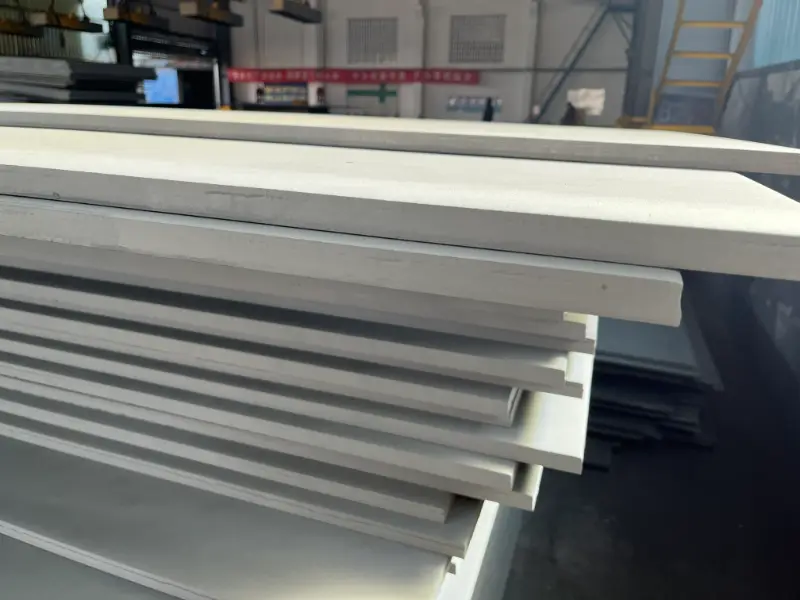
EN10225 S420G1+M Offshore Steel Plate
EN10225 S420G1+M Offshore Steel Plate: Chemical, Mechanical, Physical Properties & Equivalents
Comprehensive data for EN10225 S420G1+M offshore structural steel: chemical composition, tensile, impact, bend tests, thermal and electrical properties, full material equivalents, similar grades, and offshore application guide.
Thermomechanical rolling (TMCP); suitable for hot bending, cold forming (within limits), welding, cutting, and machining
- Phone : +8618037372205
- Email : [email protected]
- WhatsApp: Contact via Whtsapp
- WeChat: +8618037372205
EN10225 S420G1+M Offshore Steel Plate Introduction
EN10225 Grade S420G1+M is a thermomechanically rolled (TMCP) weldable structural steel plate developed for fixed offshore structures. It combines a minimum yield strength of 420 MPa (thickness ≤25 mm) with excellent notch toughness at -40 °C, superior weldability, and good resistance to lamellar tearing. The 'G1' designation indicates a specific set of mechanical and chemical requirements, while '+M' denotes delivery in the as-rolled TMCP condition, which achieves fine grain refinement and high strength without the need for subsequent normalizing or quenching and tempering.
Key features:
- High yield and tensile strength for weight-optimized designs
- Reliable low-temperature impact toughness (KV₂ ≥50 J longitudinal at -40 °C)
- Controlled chemical composition with low carbon equivalent for enhanced weldability
- Improved through-thickness properties (Z-quality options available)
- Compliant with EN 10225:2009 for fixed offshore structures
S420G1+M is primarily used in critical structural components of offshore platforms, jack-up rigs, wind turbine foundations, and other marine constructions where safety, durability, and long service life under harsh environmental conditions are mandatory.
EN10225 S420G1+M Offshore Steel Plate Chemical Composition
The chemical composition of S420G1+M is tightly controlled according to EN 10225 to ensure the right balance of strength, toughness, and weldability. Microalloying elements such as niobium, vanadium, and titanium provide grain refinement and precipitation strengthening. Aluminum is present as a grain refiner and deoxidizer. Calcium may be added for sulfide shape control, improving through-thickness properties. All values are maximum unless a range is specified.
| Element | Standard Value | Remarks |
|---|---|---|
| C | ≤0.14% | Low carbon for weldability |
| Si | ≤0.50% | |
| Mn | 1.00–1.70% | Manganese for strength and toughness |
| P | ≤0.020% | |
| S | ≤0.010% | Low sulfur for cleanliness |
| Cr | ≤0.25% | |
| Ni | ≤0.30% | |
| Mo | ≤0.10% | |
| Cu | ≤0.30% | |
| Al (total) | ≥0.020% | Grain refining |
| N | ≤0.012% | |
| Nb | ≤0.05% | |
| V | ≤0.10% | |
| Ti | ≤0.05% | |
| Nb+V+Ti | ≤0.12% | Sum of microalloying elements |
| Ca* | 0.005–0.05% | Optional for inclusion control |
EN10225 S420G1+M Offshore Steel Plate Thermal and Electrical Physical Properties
The following physical properties are representative for S420G1+M as a low-alloy structural steel. They are not specified in the delivery standard but are needed for engineering design calculations. Values provided are typical for steel with similar composition and processing; minimal variations may occur depending on exact chemistry and final microstructure.
| Property | Typical Value | Unit | Test Condition |
|---|---|---|---|
| Density (ρ) | 7850 | kg/m³ | 20 °C |
| Elastic Modulus (E) | 205 | GPa | 20 °C |
| Shear Modulus (G) | 80 | GPa | 20 °C |
| Poisson's Ratio (ν) | 0.29 | — | 20 °C |
| Thermal Expansion (α) | 11.7 | 10⁻⁶/K | 20–100 °C |
| Thermal Expansion (α) | 12.2 | 10⁻⁶/K | 20–200 °C |
| Thermal Expansion (α) | 12.7 | 10⁻⁶/K | 20–300 °C |
| Thermal Expansion (α) | 13.2 | 10⁻⁶/K | 20–400 °C |
| Thermal Expansion (α) | 13.7 | 10⁻⁶/K | 20–500 °C |
| Thermal Conductivity (λ) | 51 | W/(m·K) | 20 °C |
| Thermal Conductivity (λ) | 50 | W/(m·K) | 100 °C |
| Thermal Conductivity (λ) | 48 | W/(m·K) | 200 °C |
| Thermal Conductivity (λ) | 46 | W/(m·K) | 300 °C |
| Thermal Conductivity (λ) | 42 | W/(m·K) | 400 °C |
| Thermal Conductivity (λ) | 38 | W/(m·K) | 500 °C |
| Specific Heat Capacity (c) | 460 | J/(kg·K) | 20 °C |
| Specific Heat Capacity (c) | 490 | J/(kg·K) | 100 °C |
| Specific Heat Capacity (c) | 520 | J/(kg·K) | 200 °C |
| Specific Heat Capacity (c) | 550 | J/(kg·K) | 300 °C |
| Specific Heat Capacity (c) | 590 | J/(kg·K) | 400 °C |
| Specific Heat Capacity (c) | 630 | J/(kg·K) | 500 °C |
| Electrical Resistivity (ρ_e) | 0.22 | μΩ·m | 20 °C |
| Electrical Resistivity (ρ_e) | 0.29 | μΩ·m | 100 °C |
| Electrical Resistivity (ρ_e) | 0.37 | μΩ·m | 200 °C |
| Electrical Resistivity (ρ_e) | 0.46 | μΩ·m | 300 °C |
| Electrical Resistivity (ρ_e) | 0.56 | μΩ·m | 400 °C |
| Electrical Resistivity (ρ_e) | 0.66 | μΩ·m | 500 °C |
EN10225 S420G1+M Offshore Steel Plate Mechanical Properties
The mechanical properties of S420G1+M are verified by tensile, impact, and bend tests in accordance with EN 10225. Values depend on plate thickness. The steel exhibits a well-defined yield plateau and high tensile strength. Minimum Charpy V-notch impact energies are guaranteed at -40 °C to ensure brittle fracture resistance in cold marine environments. All tests are performed on specimens taken in the transverse or longitudinal direction as specified.
| Property | Required Value | Unit | Test Condition |
|---|---|---|---|
| Yield Strength (ReH) | ≥420 | MPa | Thickness t ≤ 25 mm |
| Yield Strength (ReH) | ≥400 | MPa | Thickness 25 < t ≤ 40 mm |
| Yield Strength (ReH) | ≥390 | MPa | Thickness 40 < t ≤ 63 mm |
| Tensile Strength (Rm) | 500–660 | MPa | Thickness t ≤ 40 mm |
| Tensile Strength (Rm) | 480–640 | MPa | Thickness 40 < t ≤ 63 mm |
| Elongation (A, L₀ = 5.65√S₀) | ≥19 | % | Thickness t ≤ 40 mm, longitudinal |
| Elongation (A, L₀ = 5.65√S₀) | ≥19 | % | Thickness 40 < t ≤ 63 mm, longitudinal |
| Charpy V-notch (KV₂, -40 °C) | ≥50 | J | Thickness t ≤ 63 mm, longitudinal |
| Charpy V-notch (KV₂, -40 °C) | ≥33 | J | Thickness t ≤ 63 mm, transverse |
| Bend Test (180°) | No cracks | — | t ≤ 63 mm, bend diameter = 3t (thickness) |
EN10225 S420G1+M Offshore Steel Plate Full Equivalent Material Standards and Replaceable Grades
| Country/Region | Standard | Grade | Remarks |
|---|---|---|---|
| Europe | EN 10225 | S420G1+M | Thermomechanically rolled offshore steel, identical to the base specification |
| United Kingdom | BS EN 10225 | S420G1+M | Identical to EN 10225, TMCP condition |
EN10225 S420G1+M Offshore Steel Plate Application Introduction
S420G1+M is engineered for demanding offshore environments where safety, long-term durability, and weldability are paramount. It is primarily used in thick-walled welded structures exposed to wave, wind, and corrosion loads. The material can be supplied with improved through-thickness properties (Z-quality) for nodes and tubular joints subjected to high tensile stress in the thickness direction.
Product Applications: Jacket (truss) structures for platforms, Topsides and deck components, Monopile and transition piece foundations for wind turbines, Jack-up rig legs and spud cans, Subsea templates and manifolds, Pile clusters and conductor guides
Processed into products: Tubular joints (X, K, T, Y joints), Stiffened panels and bulkheads, Gusset plates and bracket connections, Flanges and ring stiffeners, Weld neck and structural flanges, Crane pedestals and heavy lifting lugs, Sea fastening elements
Application industries: Offshore oil and gas exploration and production, Offshore wind energy, Marine and shipbuilding (heavy structures), Port and harbor construction, Civil engineering (sea bridges, tidal barriers)
EN10225 S420G1+M Offshore Steel Plate Similar/Close Equivalent Materials
| Country/Region | Standard | Grade | Remarks |
|---|---|---|---|
| Europe | EN 10025-4 | S420ML / S420MLO | Thermomechanically rolled structural steel for general use; impact -50 °C, but offshore-specific requirements (e.g., Z-quality) are not guaranteed |
| USA | ASTM A572 / A709 | Grade 60 (60 ksi ≈ 415 MPa) | 415 MPa yield; no mandatory low-temperature impact testing in basic spec; supplementary Charpy can be ordered |
| USA | API 2W | Grade 50 (345–414 MPa yield) | Offshore structural steel; lower yield range; impact tested; may not reach 420 MPa minimum |
| Japan | JIS G3106 | SM520C | Welding structural steel; yield 355–365 MPa typically; lower strength; impact at 0 °C |
| International | API 2Y | Grade 60 (415 MPa) | Similar strength but different delivery conditions; check toughness requirements |
Notes:
Welding: S420G1+M exhibits excellent weldability with low hydrogen processes (SMAW, GMAW, FCAW, SAW). Preheat and interpass temperatures must be controlled according to the carbon equivalent (typically CEIIW ≤0.43%) and plate thickness. Post-weld heat treatment is generally not required for this TMCP grade.
Corrosion protection: In service, the steel is usually protected by coatings (e.g., three-layer paint systems, thermal spray aluminum) and cathodic protection. The material itself has no enhanced weathering resistance.
Z-quality: For components with high through-thickness loading, order the +Z option (Z15, Z25, Z35) in accordance with EN 10164.
- Share



