
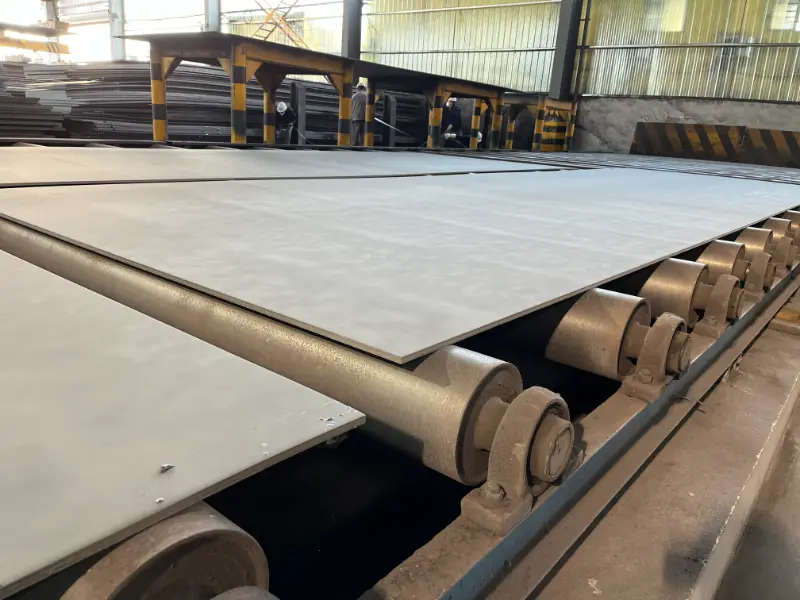
Q235NH Weather Resistant Steel Plate
Q235NH Weather Resistant Steel Plate - GB/T 4171 Atmospheric Corrosion Resistant Structural Steel
Detailed material properties, chemical composition, mechanical and physical characteristics of Q235NH weather resistant steel plate according to China GB/T 4171 standard, ideal for structural applications exposed to atmospheric corrosion.
Hot rolling, normalizing, controlled rolling, thermo-mechanical control process (TMCP), cold forming, welding
- Phone : +8618037372205
- Email : [email protected]
- WhatsApp: Contact via Whtsapp
- WeChat: +8618037372205
Q235NH Weather Resistant Steel Plate Introduction
Q235NH is a low-alloy structural steel grade with improved atmospheric corrosion resistance, specified in GB/T 4171 (Atmospheric corrosion resisting steel). It is designed for welded, bolted, and riveted structures that do not require primary corrosion protection. The steel achieves enhanced weathering properties through additions of copper, chromium, and nickel, forming a dense, self-protecting oxide layer under alternating wet/dry cycles.
- Minimum yield strength of 235 MPa (for thickness ≤16 mm)
- Good weldability and cold forming characteristics
- Suitable for exposed outdoor applications without painting
This grade is widely used in railway vehicles, containers, bridges, and architectural structures.
Q235NH Weather Resistant Steel Plate Chemical Composition
The chemical composition of Q235NH steel is strictly controlled to provide the necessary atmospheric corrosion resistance while maintaining good weldability and mechanical properties. The following values are ladle analysis limits according to GB/T 4171-2008. For product analysis, appropriate tolerances apply.
| Chemical Element | Standard Value (wt. %) | Remarks |
|---|---|---|
| Carbon (C) | ≤ 0.13 | For achieving required strength |
| Silicon (Si) | 0.10 - 0.40 | Deoxidation agent |
| Manganese (Mn) | 0.20 - 0.60 | Enhances strength and toughness |
| Phosphorus (P) | ≤ 0.030 | Kept low for improved corrosion resistance |
| Sulfur (S) | ≤ 0.030 | Kept low to avoid hot shortness |
| Copper (Cu) | 0.25 - 0.55 | Key element for atmospheric corrosion resistance |
| Chromium (Cr) | 0.40 - 0.80 | Enhances passivation and corrosion resistance |
| Nickel (Ni) | ≤ 0.65 | Improves toughness and weathering properties |
| Nitrogen (N) | ≤ 0.012 | For fully killed steel; limits strain ageing |
| Aluminum (Al)⁽ⁱ⁾ | ≥ 0.020 (acid-soluble) | Grain refining; if Al is used |
| Titanium (Ti)⁽ⁱ⁾ | 0.02 - 0.10 | Optional micro-alloy; if used |
| Vanadium (V)⁽ⁱ⁾ | 0.02 - 0.10 | Optional micro-alloy; if used |
| Niobium (Nb)⁽ⁱ⁾ | 0.015 - 0.060 | Optional micro-alloy; if used |
Q235NH Weather Resistant Steel Plate Physical & Thermal Properties
The following physical properties are characteristic values for low-alloy Cr-Cu-Ni weathering steels similar to Q235NH. These data are not mandated by GB/T 4171 and are provided for design reference only. Slight variations may occur depending on exact composition and heat treatment.
| Property | Standard Requirement Value | Unit | Test Condition |
|---|---|---|---|
| Density (ρ) | 7.85 | g/cm³ | At 20 °C |
| Elastic modulus (E) | 210 | GPa | At 20 °C |
| Shear modulus (G) | 81 | GPa | At 20 °C |
| Poisson's ratio (ν) | 0.3 | — | Elastic range |
| Thermal expansion coefficient (α) | 11.7 | 10⁻⁶/K | 20–100 °C |
| Thermal expansion coefficient (α) | 12.5 | 10⁻⁶/K | 20–200 °C |
| Thermal expansion coefficient (α) | 13.2 | 10⁻⁶/K | 20–300 °C |
| Thermal conductivity (λ) | 48 | W/(m·K) | At 20 °C |
| Specific heat capacity (cₚ) | 460 | J/(kg·K) | At 20 °C |
| Electrical resistivity (ρₑ) | 0.22 | µΩ·m | At 20 °C |
Q235NH Weather Resistant Steel Plate Mechanical Properties
The mechanical properties are valid for delivery condition as-rolled, normalized, or normalizing rolled. Tests are carried out on longitudinal test pieces according to GB/T 4171-2008.
- Bend test mandates that no cracks shall form.
- Impact test is not normally required for Q235NH; if agreed, the minimum energy value and temperature must be specified.
| Property | Standard Requirement Value | Unit | Test Condition |
|---|---|---|---|
| Upper yield strength (ReH) | ≥ 235 | MPa | Thickness ≤ 16 mm |
| Upper yield strength (ReH) | ≥ 225 | MPa | Thickness > 16 to 40 mm |
| Upper yield strength (ReH) | ≥ 215 | MPa | Thickness > 40 to 60 mm |
| Upper yield strength (ReH) | ≥ 215 | MPa | Thickness > 60 to 100 mm |
| Tensile strength (Rm) | 360 - 510 | MPa | Thickness ≤ 100 mm |
| Elongation after fracture (A) | ≥ 25 | % | L₀=5.65√S₀; thickness ≤ 16 mm |
| Elongation after fracture (A) | ≥ 24 | % | L₀=5.65√S₀; thickness > 16 to 40 mm |
| Elongation after fracture (A) | ≥ 23 | % | L₀=5.65√S₀; thickness > 40 to 60 mm |
| Elongation after fracture (A) | ≥ 22 | % | L₀=5.65√S₀; thickness > 60 to 100 mm |
| Bend test (180°) | d = 2a | — | Thickness ≤ 16 mm (a = specimen thickness) |
| Bend test (180°) | d = 3a | — | Thickness > 16 to 100 mm |
Q235NH Weather Resistant Steel Plate Fully Equivalent Material Standards & Substitute Grades
| Country/Region | Standard | Grade | Remarks |
|---|---|---|---|
| China | GB/T 4171-2008 | Q235NH | Original grade |
| European Union | EN 10025-5:2019 | S235J0W (1.8958) | Technically equivalent; same yield class and weathering concept |
| International | ISO 4952-2:2021 | S235W | Weathering steel with similar composition and mechanical properties |
| Japan (approximate) | JIS G3114:2015 | SMA400AW | Higher strength but similar corrosion resistance; not a direct substitute |
Q235NH Weather Resistant Steel Plate Application Introduction
Q235NH steel is primarily intended for unpainted outdoor applications where its natural oxide patina provides long-term corrosion protection. It can be used in bare state or with coatings. Typical industries and products include:
Product Applications: Hot-rolled plates and sheets, Cold-formed profiles (L, U, C, Z shapes), Welded structural hollow sections, Prefabricated bridge sections, Weathering steel cladding panels, Shipping container walls and frames
Processed into products: Bridges: main girders, cross beams, stiffeners, splice plates, Railway vehicles: underframes, side walls, roof sheets, corner posts, Containers: corner fittings, side panels, roof bows, door headers, Architecture: load-bearing steelwork, sun screens, louvres, retaining walls, Miscellaneous: pipe supports, lamp posts, guard rails, sign structures, sound barriers
Application industries: Railway transportation (wagons, containers, structural components), Bridge engineering (pedestrian and road bridge girders, decks), Construction & architecture (facades, roofing, sculptures, exposed frameworks), Shipbuilding (superstructures, non-marine structural parts), Power transmission (transmission towers, poles), Agricultural machinery and equipment, Industrial containers and storage tanks (non-pressure)
Q235NH Weather Resistant Steel Plate Similar / Near-Equivalent Weathering Steel Grades
| Country/Region | Standard | Grade | Remarks |
|---|---|---|---|
| China | GB/T 4171 | Q295NH / Q355NH | Higher strength grades in the same standard; can replace Q235NH if higher strength is acceptable |
| USA | ASTM A606 / A606M | Type 2 | Hot-rolled sheet and strip; yield strength similar but corrosion resistance composition differs |
| USA | ASTM A242 / A242M | Type 1 | High strength low alloy structural steel with weathering characteristics; yield ≥ 345 MPa in thin gauges, not exact match |
| Japan | JIS G3114 | SMA490AW | Welded structural weathering steel; higher strength; similar Cu-Cr-Ni approach |
| European Union | EN 10025-5 | S355J2W (1.8965) | Higher strength weathering steel; often an upgrade when strength is the limiting factor |
Notes:
Welding: Q235NH can be welded by all common methods (SMAW, GMAW, SAW, FCAW). Matching weathering electrodes/wires (e.g., AWS A5.1 E7018-W) are recommended to maintain corrosion resistance of the weld. Processing: Hot and cold forming is possible; minimum bending radius should comply with code requirements. Patina formation: Optimal weathering performance requires alternating wet/dry cycles; full patina development may take 2–5 years depending on environment. Delivery condition: Unless otherwise agreed, steel is supplied in as-rolled or normalizing rolled condition, with a surface finish suitable for atmospheric exposure. Inspection documents: Type 2.2 or 3.1 per EN 10204 can be issued upon request.
- Share



