
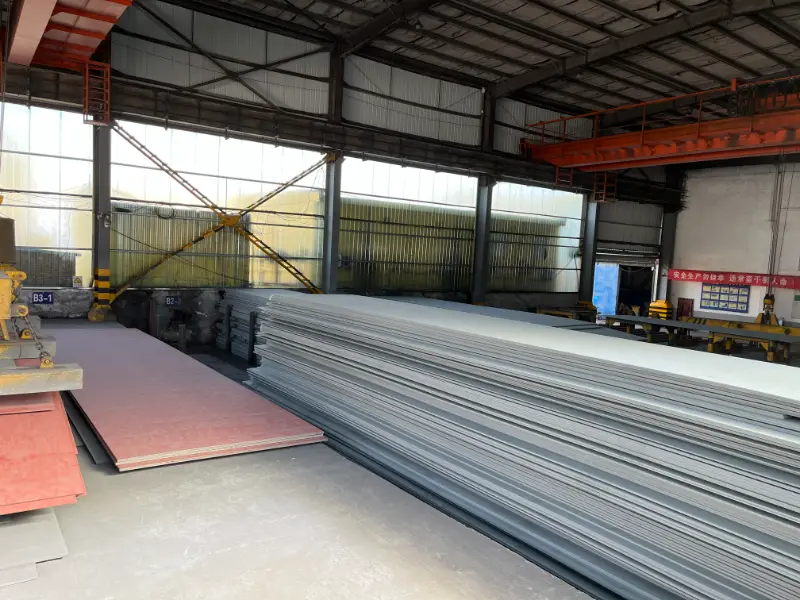
Q265GNH Weather Resistant Steel
Q265GNH Weather Resistant Steel: High Atmospheric Corrosion Resistance Structural Steel to GB/T 4171
Comprehensive material data and properties of Q265GNH weather resistant steel plate according to Chinese standard GB/T 4171. Includes chemical composition, mechanical and physical properties, international equivalents, and application guide.
Hot rolling, controlled rolling, normalizing, medium plate shearing/leveling
- Phone : +8618037372205
- Email : [email protected]
- WhatsApp: Contact via Whtsapp
- WeChat: +8618037372205
Q265GNH Weather Resistant Steel Introduction
Q265GNH is a high phosphorus weather-resistant structural steel grade under Chinese standard GB/T 4171 for atmospheric corrosion resistance. It is designed for structural applications requiring improved resistance to weathering by forming a protective rust layer in alternating wet/dry environments. Main features:
- Minimum yield strength 265 MPa (thickness ≤16 mm)
- Tensile strength 410–560 MPa, good ductility with elongation ≥27%
- Enhanced corrosion resistance via alloying with Cu, Cr, P, Ni, forming an adherent oxide film
- Available as hot-rolled plates, strips, and coils; usually delivered in hot-rolled, controlled-rolled, or normalized condition
- Used in bridges, building structures, containers, railway vehicles, and towers exposed to outdoor atmosphere
Q265GNH Weather Resistant Steel Chemical Composition as per GB/T 4171
Typical ladle analysis for Q265GNH weathering steel. The high phosphorus (P) content is deliberately added to enhance atmospheric corrosion resistance. Copper (Cu), chromium (Cr) and nickel (Ni) also contribute to the formation of a dense, protective patina. Values are maximum unless a range is indicated.
| Chemical Element | Standard Value (%) | Remarks |
|---|---|---|
| C | ≤0.12 | Carbon equivalent limits may apply |
| Si | 0.10 – 0.40 | Deoxidizer and strength contributor |
| Mn | 0.20 – 0.50 | Provides strength and toughness |
| P | 0.07 – 0.12 | Essential for atmospheric corrosion resistance; higher than common structural steels |
| S | ≤0.020 | Low sulfur for weldability and toughness |
| Cu | 0.20 – 0.45 | Key alloying element for patina formation |
| Cr | 0.30 – 0.65 | Enhances corrosion resistance and mechanical properties |
| Ni | ≤0.25 | Improves toughness and corrosion resistance |
Q265GNH Weather Resistant Steel Thermal and Electrical Physical Properties – Typical Reference Values
The following are typical physical property data for Q265GNH weather resistant steel at room temperature unless otherwise stated. These values are not mandatory from the standard, but serve as engineering references for design and simulation. Actual values may vary slightly depending on exact composition and processing.
| Property | Typical Reference Value | Unit | Test Condition / Remarks |
|---|---|---|---|
| Density (ρ) | 7.85 | g/cm³ | At 20 °C |
| Young's modulus (E) | 206 | GPa | At room temperature |
| Shear modulus (G) | 79 | GPa | Calculated from E and ν |
| Poisson's ratio (ν) | 0.3 | – | Typical for steel |
| Thermal expansion coefficient (α) | 12.2 | ×10⁻⁶ /K | Between 20 °C and 100 °C |
| Thermal conductivity (λ) | 45 | W/(m·K) | At 20 °C |
| Specific heat capacity (cp) | 460 | J/(kg·K) | At 20 °C |
| Electrical resistivity (ρe) | 0.18 – 0.22 | µΩ·m | At 20 °C, range depending on alloy content |
Q265GNH Weather Resistant Steel Mechanical Properties – Typical Reference Values per GB/T 4171
Tensile, yield, and elongation properties are thickness dependent. Bending test specified as 180° cold bend. Values shown represent standard requirements for the most common plate thickness ranges. For intermediate thicknesses, refer to the full standard.
| Property | Standard Required Value | Unit | Test Condition / Thickness Range |
|---|---|---|---|
| Yield Strength (ReH) | ≥265 | MPa | thickness ≤16 mm |
| Yield Strength (ReH) | ≥245 | MPa | thickness >16–≤40 mm |
| Yield Strength (ReH) | ≥225 | MPa | thickness >40–≤60 mm |
| Yield Strength (ReH) | ≥215 | MPa | thickness >60–≤80 mm |
| Tensile Strength (Rm) | 410 – 560 | MPa | thickness ≤40 mm |
| Tensile Strength (Rm) | 400 – 550 | MPa | thickness >40–≤60 mm |
| Tensile Strength (Rm) | 390 – 540 | MPa | thickness >60–≤80 mm |
| Elongation after fracture (A) | ≥27 | % | thickness ≤16 mm |
| Elongation after fracture (A) | ≥26 | % | thickness >16–≤40 mm |
| Elongation after fracture (A) | ≥24 | % | thickness >40–≤60 mm |
| Elongation after fracture (A) | ≥23 | % | thickness >60–≤80 mm |
| Bend test – 180° | d=2a | – | thickness ≤16 mm |
| Bend test – 180° | d=3a | – | thickness >16–≤40 mm |
| Bend test – 180° | d=3.5a | – | thickness >40–≤60 mm |
Q265GNH Weather Resistant Steel Exact Equivalent Material Standards and Substitutable Grades
| Country / Region | Standard | Grade | Remarks |
|---|---|---|---|
| China | GB/T 4171 | Q265GNH | Original grade name. No internationally direct equivalent due to specific P, Cu, Cr content. |
Q265GNH Weather Resistant Steel Application Introduction
Q265GNH is widely used in structural applications where unpainted long-term atmospheric corrosion resistance is beneficial. Its medium strength and good ductility make it suitable for a range of fabricated components. Typical industries and products include:
Product Applications: Weather-resistant bridge girders, crossbeams, and stiffeners, Steel structural frames for industrial buildings, Container bodies and chassis, Railway passenger coach & freight wagon body panels, Transmission tower legs and braces, Architectural cladding and sculptures
Processed into products: Welded built-up beams and columns, Bearing plates and connecting gussets, Corner castings for containers, Pressed and bent profiles for wagon side sills, Angle and U-channel sections for tower legs, Shear panels and diaphragm plates
Application industries: Bridge construction, Building and infrastructure, Railway transport, Container manufacturing, Power transmission towers, Landscape and architectural structures
Q265GNH Weather Resistant Steel Similar / Analogous Material Grades Recommended
| Country / Region | Standard | Grade | Remarks |
|---|---|---|---|
| USA | ASTM A588/A588M | Grade A | Weathering steel with higher yield strength (≥345 MPa); composition includes Cr, Cu, Ni but lower P. Suitable for bridges and buildings but not directly interchangeable. |
| EU | EN 10025-5 | S235J2W | Weather resistant steel with minimum yield 235 MPa; no intentional phosphorus addition; impact toughness verified (J0/J2). Good atmospheric corrosion resistance but lower strength. |
| Japan | JIS G3114 | SMA400AW | Weather resistant steel for welded structures, yield ≥235/245 MPa; contains Cu, Cr but lower P. Often used for bridges. |
| Japan | JIS G3125 | SPA-H | High weather resistance hot-rolled steel, yield ≥355 MPa; similar alloying concept but high strength, mainly for railroad rolling stock. |
Notes:
Welding and fabrication considerations:
- The higher phosphorus content (0.07–0.12%) can increase susceptibility to solidification cracking and reduced toughness in heavy sections. Preheating and low-hydrogen welding procedures are recommended.
- When thickness exceeds 30 mm or for dynamically loaded structures, supplementary toughness testing (e.g., KV₂ at 0 °C or -20 °C) can be agreed upon at the time of ordering.
- Weathering steel develops the stable rust layer (patina) only under alternating wet/dry atmospheric conditions; it is not intended for continuous submerged or buried service without coating.
- For aesthetic or rapid patina formation, controlled outdoor exposure or surface pre-treatment can be applied.
- Share



