
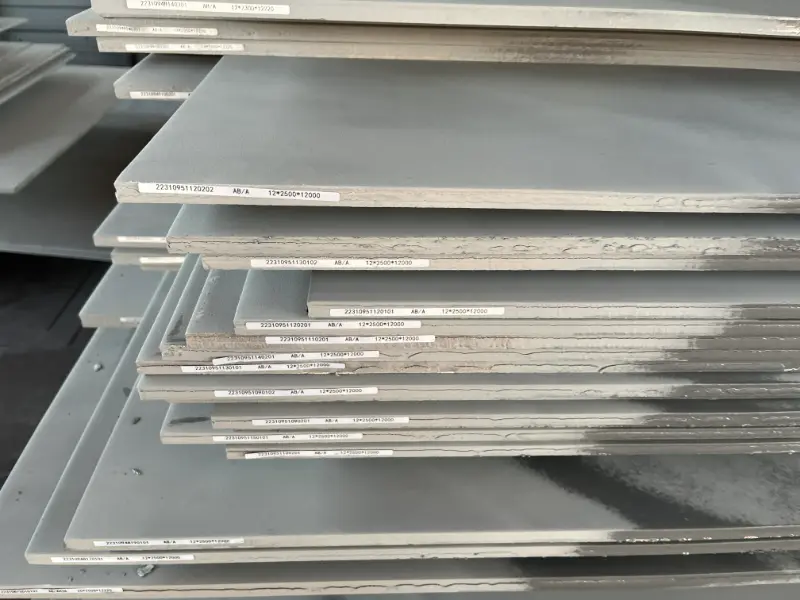
Q355GNH Weather-Resistant Steel Plate
Q355GNH Weather-Resistant Steel Plate: GB/T 4171 High-Strength Atmospheric Corrosion Resistance
Detailed material data for Q355GNH high-weather-resistant structural steel according to GB/T 4171, including chemical composition, mechanical and physical properties, international equivalents, and application guidance.
Hot rolling, controlled rolling, normalizing rolling, cold forming, welding, machining, and oxy-fuel/plasma cutting
- Phone : +8618037372205
- Email : [email protected]
- WhatsApp: Contact via Whtsapp
- WeChat: +8618037372205
Q355GNH Weather-Resistant Steel Plate Introduction
Q355GNH is a high-strength, phosphorus-alloyed weathering steel defined in the Chinese standard GB/T 4171. It offers a minimum yield strength of 355 MPa and belongs to the 'GNH' series, which indicates enhanced atmospheric corrosion resistance through a deliberate addition of phosphorus, copper, chromium, and nickel. The steel develops a stable, adherent patina under cyclic wet/dry conditions, substantially reducing the corrosion rate compared to plain carbon steel. Main characteristics include:
- Good strength–toughness balance
- Excellent weldability with appropriate low-hydrogen procedures
- Self-protecting oxide layer that eliminates the need for painting in many applications
- Cost-effective lifecycle due to reduced maintenance
Q355GNH Weather-Resistant Steel Plate Chemical Composition
The chemical composition is drawn from GB/T 4171 for grade Q355GNH. The steel is phosphorus-bearing (0.07–0.15%) to promote the formation of a dense, protective patina. Copper, chromium, and nickel are added to further enhance corrosion resistance. Microalloying elements such as niobium, vanadium, or titanium may be present individually or in combination to refine grain size and improve mechanical properties.
- Residual elements are strictly controlled to ensure weldability.
- Carbon equivalent (CEV) is typically kept below 0.45% for good weldability.
| Element | Mass fraction (%) | Remarks |
|---|---|---|
| Carbon (C) | ≤0.12 | Ladle analysis |
| Silicon (Si) | 0.20–0.75 | Ladle analysis |
| Manganese (Mn) | ≤1.00 | Ladle analysis |
| Phosphorus (P) | 0.07–0.15 | Essential for patina formation |
| Sulfur (S) | ≤0.020 | Ladle analysis |
| Copper (Cu) | 0.25–0.55 | Enhances atmospheric corrosion resistance |
| Chromium (Cr) | 0.30–1.25 | Promotes protective oxide layer |
| Nickel (Ni) | ≤0.65 | Improves toughness and corrosion resistance |
| Nitrogen (N) | ≤0.012 | Ladle analysis |
| Other microalloys (Nb, V, Ti, etc.) | Individual ≤0.15; sum ≤0.22 | Optional grain-refining additions |
Q355GNH Weather-Resistant Steel Plate Thermal and Electrical Physical Properties
Physical properties are typical for phosphorus-bearing weathering steels and are not directly specified in GB/T 4171. These values are provided for design calculations and reflect the behavior of the material at ambient temperature. They may vary slightly with exact composition and heat treatment history.
- Density is approximated to that of structural carbon steel.
- Elastic constants are measured by dynamic methods.
| Property | Typical value | Unit | Condition / Temperature |
|---|---|---|---|
| Density (ρ) | 7.85 | g/cm³ | 20°C |
| Elastic modulus (E) | 206 | GPa | 20°C |
| Shear modulus (G) | 80 | GPa | 20°C |
| Poisson's ratio (ν) | 0.3 | – | 20°C |
| Thermal expansion coefficient (α) | 12.0 | 10⁻⁶ /K | 20–100°C |
| Thermal expansion coefficient (α) | 12.8 | 10⁻⁶ /K | 20–200°C |
| Thermal expansion coefficient (α) | 13.5 | 10⁻⁶ /K | 20–300°C |
| Thermal conductivity (λ) | 42 | W/(m·K) | 20°C |
| Thermal conductivity (λ) | 40 | W/(m·K) | 100°C |
| Specific heat capacity (cₚ) | 460 | J/(kg·K) | 20–100°C |
| Electrical resistivity (ρₑ) | 0.25 | 10⁻⁶ Ω·m | 20°C |
Q355GNH Weather-Resistant Steel Plate Mechanical Properties
The mechanical properties are specified by GB/T 4171 for thicknesses up to 16 mm. Values may be adjusted for larger thicknesses. Impact energy is determined on Charpy V-notch specimens. The steel demonstrates a good combination of strength and ductility, with a pronounced yield plateau.
- Tensile testing performed at room temperature in longitudinal direction.
- Impact test temperature default 0°C for basic grade (B), with options for -20°C upon special requirement.
| Property | Standard requirement | Unit | Test condition |
|---|---|---|---|
| Yield strength (ReH) | ≥355 | MPa | Thickness ≤16 mm |
| Yield strength (ReH) | ≥345 | MPa | Thickness >16 mm to 40 mm |
| Yield strength (ReH) | ≥335 | MPa | Thickness >40 mm to 63 mm |
| Tensile strength (Rm) | 490–630 | MPa | Room temperature |
| Elongation after fracture (A) | ≥22 | % | Gauge length 5.65√S0, thickness ≤16 mm |
| Elongation after fracture (A) | ≥21 | % | Gauge length 5.65√S0, thickness >16 mm to 40 mm |
| Elongation after fracture (A) | ≥20 | % | Gauge length 5.65√S0, thickness >40 mm to 63 mm |
| Charpy impact (KV2) | ≥27 | J | 0°C, longitudinal, full-size specimen |
| Charpy impact (KV2) | ≥27 | J | -20°C, longitudinal (agreed upon) |
| Bending test (bend angle 180°) | d = a | – | For plates ≤16 mm, d = mandrel diameter, a = plate thickness |
| Bending test (bend angle 180°) | d = 2a | – | For plates >16 mm to 100 mm |
Q355GNH Weather-Resistant Steel Plate Exact Equivalent Standards and Grades for Substitution
| Country / Region | Standard | Grade | Remarks |
|---|---|---|---|
| Europe | EN 10025-5 | S355J2WP (1.8946) | Phosphorus-alloyed weathering steel, identical yield strength and corrosion concept |
| Japan | JIS G 3125 | SPA-H | High weather resistance, typical 355 MPa yield; used extensively in railway vehicles and containers |
| International | ISO 5952-2 | HR355 (Fe 510 B1 KO) | Weathering structural steel with 355 MPa minimum yield, similar composition |
| USA | ASTM A588/A588M | Grade K | High-strength weathering steel, although often P ≤0.15% and corrosion resistance comparable |
Q355GNH Weather-Resistant Steel Plate Application Introduction
Q355GNH is designed for welded, bolted, or riveted structures that are exposed to the atmosphere in the unpainted condition, relying on its self-protecting oxide layer. It is widely used in transportation, energy, and construction industries where lifecycle cost savings and reduced maintenance are critical.
- Proper detailing to avoid water traps accelerates stable patina formation.
- If painting is required, surface preparation must remove loose oxide; paint systems should be compatible with weathering steel.
Product Applications: Weathering steel bridge girders and trusses, Container corner castings and side panels, Railway wagons and locomotive frames, Transmission line poles and lattice towers, Architectural cladding and sculptural elements, HSLA structural members in exposed frameworks, Signage supports and lighting columns
Processed into products: Web and flange plates in welded plate girders, Box sections and hollow structural profiles, Bent and formed channel sections, Bolted and riveted joints, Stiffeners, gussets, and connection plates, Erection pieces and splice plates, Custom flanges for chimneys and stacks, Laser- or plasma-cut brackets and supports
Application industries: Bridge construction, Railway and rolling stock manufacturing, Shipping containers and freight wagons, Power transmission towers and telecommunication structures, Architectural and structural engineering (facades, canopies, sculptures), Industrial chimneys, stacks, and ductwork, Offshore and coastal structures (with additional alloying if needed), Mining and earthmoving equipment
Q355GNH Weather-Resistant Steel Plate Similar / Comparable Alternative Materials
| Country / Region | Standard | Grade | Remarks |
|---|---|---|---|
| China | GB/T 4171 | Q355NH | Weathering steel with lower phosphorus (<0.03%) and higher manganese; improved toughness but slightly less atmospheric resistance without painting |
| USA | ASTM A588/A588M | Grade A / Grade B | 50 ksi (345 MPa) weathering steel, no intentional phosphorus; wide use in bridges; mechanical properties very close |
| Europe | EN 10025-5 | S355J2W (1.8965) | Non-phosphorus weathering steel, similar strength, better toughness, may need thicker sections for equal corrosion allowance |
| India | IS 11587 | Fe 540 WA | Weathering structural steel with 355 MPa yield; chemical approach similar to EN S355J2W |
Notes:
For welded structures, the carbon equivalent (CEV) of Q355GNH is typically below 0.45%, ensuring good cold-cracking resistance with low-hydrogen consumables. Coating-free use is most effective in non-marine, non-industrial environments with frequent drying cycles. In continuously humid or chloride-rich locations, additional corrosion allowance or protective coating is recommended. The standard may be updated; refer to the latest GB/T 4171 revision for certification.
- Share



