
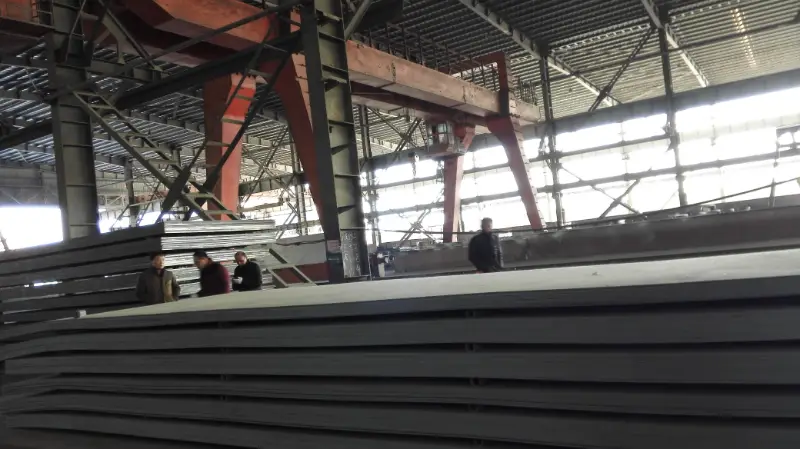
Q295GNH Weather Resistant Steel Plate
Q295GNH Weather Resistant Steel Plate - GB/T 4171 High-Strength Low-Alloy Corrosion-Resistant Structural Steel Data
Comprehensive material data for Q295GNH weather resistant steel plate according to China GB/T 4171 standard. Includes chemical composition, mechanical and thermal properties, equivalent grades and typical applications for structural and architectural engineering.
Hot rolling, controlled rolling, normalizing rolling, welding, cold forming, machining
- Phone : +8618037372205
- Email : [email protected]
- WhatsApp: Contact via Whtsapp
- WeChat: +8618037372205
Q295GNH Weather Resistant Steel Plate Introduction
Q295GNH is a high-strength low-alloy weathering steel grade specified in China standard GB/T 4171 Atmospheric corrosion resisting structural steel. It belongs to the category of 'weathering steels', designed to provide greater resistance to atmospheric corrosion than plain carbon steels by forming a protective rust layer.
- Minimum yield strength 295 MPa in thickness up to 16 mm, good weldability and formability.
- Contains copper, chromium and nickel as key alloying elements that enhance corrosion resistance and improve mechanical properties.
- Suitable for exposed structures, it develops a stable, aesthetically appealing oxide coating that reduces maintenance.
- Typical delivery condition: as-rolled or controlled rolling; can be supplied as plates, sheets, strips, sections and bars.
Q295GNH Weather Resistant Steel Plate Chemical Composition
Chemical composition as per GB/T 4171 standard for Q295GNH. Note: The steel contains intentional additions of Cu, Cr and Ni to improve atmospheric corrosion resistance. Microalloying elements (Nb, V, Ti) are not mandatory but may be present in trace amounts to refine grain size. The maximum limits apply to cast analysis.
| Element | Standard Value (max unless range given) | Remarks |
|---|---|---|
| Carbon (C) | ≤ 0.12 | Main hardening element |
| Silicon (Si) | 0.20 – 0.40 | Deoxidizer, improves strength |
| Manganese (Mn) | 1.00 – 1.50 | Increases strength and toughness |
| Phosphorus (P) | ≤ 0.030 | Undesirable impurity, limited for ductility |
| Sulfur (S) | ≤ 0.030 | Undesirable impurity, limited for hot workability |
| Copper (Cu) | 0.25 – 0.45 | Key element for weather resistance |
| Chromium (Cr) | 0.30 – 0.60 | Enhances corrosion resistance and strength |
| Nickel (Ni) | 0.30 – 0.50 | Improves corrosion resistance and toughness |
Q295GNH Weather Resistant Steel Plate Thermal and Electrical Physical Properties
Typical physical properties for low-alloy weathering steels. These values are not stated in GB/T 4171 but are based on typical measurements for similar structural steels. Slight variations may occur depending on exact composition and processing.
- Density is consistent with common carbon steel.
- Thermal expansion and conductivity are representative for service temperatures up to 200 °C.
- Electrical resistivity is given for room temperature.
| Property | Typical Value | Unit | Test Condition |
|---|---|---|---|
| Density (ρ) | 7.85 | g/cm³ | At 20 °C |
| Elastic Modulus (E) | 200 – 210 | GPa | At 20 °C, tensile |
| Shear Modulus (G) | 80 | GPa | At 20 °C, calculated from E and ν |
| Poisson's Ratio (ν) | 0.30 | – | At 20 °C |
| Thermal Expansion Coefficient (α) | 12.0 | 10⁻⁶/K | Temperature range 20–100 °C |
| Thermal Expansion Coefficient (α) | 12.8 | 10⁻⁶/K | Temperature range 20–200 °C |
| Thermal Conductivity (λ) | 45 – 55 | W/(m·K) | At 20 °C |
| Specific Heat Capacity (cp) | 460 – 480 | J/(kg·K) | At 20 °C |
| Electrical Resistivity (ρ_e) | 0.20 – 0.25 | μΩ·m | At 20 °C |
Q295GNH Weather Resistant Steel Plate Mechanical Properties
Mechanical properties for hot-rolled Q295GNH plates/strips determined on transverse specimens.
- The yield strength and tensile strength vary with thickness.
- Impact test is required at +20 °C with a minimum absorbed energy of 27 J (longitudinal).
- Bend test: 180° bending over a mandrel diameter as specified.
- Elongation values refer to a gauge length of L0=5.65√S0.
| Property | Standard Requirement Value | Unit | Test Condition / Thickness |
|---|---|---|---|
| Yield Strength (ReH) | ≥ 295 | MPa | Thickness ≤ 16 mm |
| Yield Strength (ReH) | ≥ 285 | MPa | Thickness > 16–40 mm |
| Yield Strength (ReH) | ≥ 275 | MPa | Thickness > 40–60 mm |
| Yield Strength (ReH) | ≥ 255 | MPa | Thickness > 60–100 mm |
| Tensile Strength (Rm) | 430 – 560 | MPa | Thickness ≤ 100 mm |
| Elongation (A) | ≥ 24 | % | Thickness ≤ 16 mm, L0=5.65√S0 |
| Elongation (A) | ≥ 23 | % | Thickness > 16–40 mm |
| Elongation (A) | ≥ 23 | % | Thickness > 40–60 mm |
| Elongation (A) | ≥ 22 | % | Thickness > 60–100 mm |
| Impact Energy (KV2) | ≥ 27 | J | Longitudinal, at +20 °C |
| Bend Test (180°, d=mandrel dia.) | d = 2a | – | a = thickness ≤ 16 mm |
| Bend Test (180°, d=mandrel dia.) | d = 3a | – | a = thickness > 16–60 mm |
Q295GNH Weather Resistant Steel Plate Materials with Equivalent or Closely Matching Composition and Properties
| Country/Region | Standard | Grade | Remarks |
|---|---|---|---|
| China | GB/T 4171 | Q295GNH | Base grade, weathering structural steel |
| International | – | – | No direct exact equivalent exists worldwide; see similar materials below. |
Q295GNH Weather Resistant Steel Plate Application Introduction
Q295GNH is specifically designed for structural applications where atmospheric corrosion resistance and reduced maintenance are essential. It is not intended for use in highly acidic or marine-splash environments without additional protective measures. The steel develops a dense, adherent oxide layer that gradually changes from orange-brown to a dark brown patina over time. Hot-dip galvanizing is not recommended because the alloying elements may cause coating adhesion issues. For welding, low hydrogen processes and appropriate consumables (matching or slightly overmatching) are recommended. The material can be supplied in the as-rolled condition or with a pre-rusted surface for rapid patina formation in architectural projects. Suitable processes include bending, shearing, punching, drilling and welding. Preheating may be required for thick sections or low ambient temperatures.
Product Applications: Weather resistant steel plates and sheets in various thicknesses, Hot-rolled wide strips and coils for subsequent processing, Welded beams, columns and structural sections made from plate, Container corner castings and side panels, Tower flanges and pole bodies, Pre-fabricated bridge elements
Processed into products: Bridge girders, trusses and diaphragms, Railway car body frames and end walls, Container corner fittings and door frames, Tower leg angles and tubular members, Architectural facade panels and sun screens, Highway sign posts and signal poles, Welded structural connections and stiffeners, Steel sculptures and outdoor art installations
Application industries: Bridge construction and rehabilitation, Railway rolling stock (wagons, locomotive frames), Shipping container manufacturing, Transmission and telecommunication towers, Architectural cladding and sculptures, Offshore structural components (with appropriate coating), Highway guardrails and signage structures, Steel frame buildings and industrial sheds
Q295GNH Weather Resistant Steel Plate Similar Weathering Steel Grades
| Country/Region | Standard | Grade | Remarks |
|---|---|---|---|
| USA | ASTM A242 / A242M | Type 1 | Similar alloy concept, min. yield strength 345 MPa. Higher strength than Q295GNH. |
| European Union | EN 10025-5 | S235J2W (1.8958) | Yield strength 235 MPa, similar Cu-Cr-Ni content. Lower strength but comparable weather resistance. |
| European Union | EN 10025-5 | S355J2W (1.8965) | Yield strength 355 MPa. Matching atmospheric corrosion resistance, higher strength. |
| Japan | JIS G 3114 | SMA400AW | Min. yield strength 245 MPa for t ≤ 16 mm. Similar weather resistance, slightly lower strength. |
| Japan | JIS G 3114 | SMA400BW | Yield strength 245 MPa (t ≤ 16 mm), with molybdenum addition for further corrosion protection. |
| Germany (historic) | DIN 17100 | WTSt 37-3 (S235J2W) | Old designation for Cu-Cr weathering steel with comparable corrosion resistance. |
Notes:
- The chemical composition is essential for obtaining the desired weather resistance; all values shown are based on GB/T 4171-2008 cast analysis. Minor deviations may occur in product analysis.
- If the material is to be used in continuously wet or submerged conditions, weathering steels may not form the protective oxide layer as intended; supplementary corrosion protection should be considered.
- Bend test requirements apply for plates and strips with nominal thickness up to 60 mm. For thicker plates, negotiable.
- Impact test is mandatory; the value 27 J minimum at +20 °C applies to standard quality. A lower temperature toughness option is not specified for this grade in GB/T 4171.
- Welding consumables should be selected to match the atmospheric corrosion resistance of the base metal (e.g., AWS E7018-W).
- Share



