
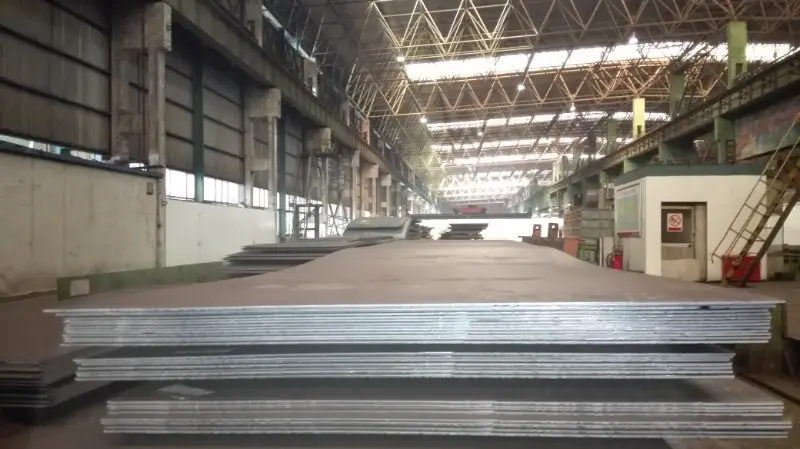
ASTM A517 Grade B (A517GR B) Pressure Vessel & Boiler Steel Plate
ASTM A517 Grade B (A517GR B) High-Strength Pressure Vessel Steel Plate Overview
ASTM A517 Grade B is a high-strength quenched and tempered alloy steel plate for boilers and pressure vessels, offering high yield strength, excellent toughness, and good weldability under controlled conditions.
Hot rolling, quenching and tempering, normalizing (optional), welding, flame cutting, cold forming (with caution)
- Phone : +8618037372205
- Email : [email protected]
- WhatsApp: Contact via Whtsapp
- WeChat: +8618037372205
ASTM A517 Grade B Pressure Vessel & Boiler Steel Plate Introduction
ASTM A517 Grade B (A517GR B) is a high-strength, quenched and tempered alloy steel plate specifically designed for welded pressure vessels and boilers. It belongs to the ASTM A517/A517M standard family. The material delivers a minimum yield strength of 690 MPa (100 ksi) with tensile strength ranging from 795 to 930 MPa, ensuring structural integrity under high-pressure conditions. Its chemical composition includes chromium, molybdenum, vanadium, titanium, and boron, providing deep hardenability and fine grain structure. This grade is delivered in the quenched and tempered condition, meeting strict impact toughness requirements when specified. The steel is widely used in pressure vessels, storage tanks, bridges, and heavy machinery where weight savings and high strength are critical.
ASTM A517 Grade B Pressure Vessel & Boiler Steel Plate Chemical Composition
Chemical composition limits for ASTM A517 Grade B in heat analysis. The addition of chromium, molybdenum, vanadium, titanium, and boron ensures deep hardenability and fine grain structure, contributing to the high strength and toughness of the quenched and tempered plate.
| Chemical Element | Standard Value (max unless range) | Remarks |
|---|---|---|
| Carbon (C) | 0.15 – 0.21 | Heat analysis |
| Manganese (Mn) | 0.80 – 1.10 | Heat analysis |
| Phosphorus (P) | 0.035 | Maximum |
| Sulfur (S) | 0.035 | Maximum |
| Silicon (Si) | 0.15 – 0.35 | Heat analysis |
| Chromium (Cr) | 0.40 – 0.65 | Heat analysis |
| Nickel (Ni) | 0.30 | Maximum |
| Molybdenum (Mo) | 0.15 – 0.25 | Heat analysis |
| Vanadium (V) | 0.03 – 0.08 | Heat analysis |
| Titanium (Ti) | 0.01 – 0.03 | Heat analysis |
| Boron (B) | 0.0005 – 0.005 | Heat analysis |
| Copper (Cu) | 0.35 | Maximum if specified |
ASTM A517 Grade B Pressure Vessel & Boiler Steel Plate Thermal and Electrical Physical Properties
Physical properties for A517 Grade B type steel in quenched and tempered condition. These values are typical reference data for low-alloy high-strength steel at room temperature and may vary slightly with heat treatment. They are not part of the ASTM A517 standard mandatory requirements but are essential for design and processing.
| Property | Typical Value | Unit | Test Condition / Remarks |
|---|---|---|---|
| Density (ρ) | 7.85 | g/cm³ | Room temperature |
| Density (ρ) | 0.284 | lb/in³ | In US customary units |
| Modulus of Elasticity (E) | 205 – 210 | GPa | Room temperature |
| Shear Modulus (G) | 78 – 80 | GPa | Approximately 0.38E |
| Poisson's Ratio (ν) | 0.28 – 0.30 | Room temperature | |
| Thermal Expansion Coefficient (α) | 11.5 – 12.0 | 10⁻⁶/°C | Range 20 – 100 °C |
| Thermal Expansion Coefficient (α) | 12.5 – 13.0 | 10⁻⁶/°C | Range 20 – 200 °C |
| Thermal Conductivity (λ) | 38 – 44 | W/(m·K) | At 100 °C |
| Specific Heat Capacity (cp) | 460 – 490 | J/(kg·K) | At 20 – 100 °C |
| Electrical Resistivity (ρe) | 0.22 – 0.25 | µΩ·m | At 20 °C (approx. 0.000022 – 0.000025 Ω·cm) |
ASTM A517 Grade B Pressure Vessel & Boiler Steel Plate Mechanical Properties
Mechanical properties for ASTM A517 Grade B steel plates in quenched and tempered condition. Values depend on plate thickness; the table lists the minimum required values per ASTM A517/A517M. Tensile tests are performed transverse or longitudinal as per specification. Impact test may be required by purchaser.
| Property | Required Value | Unit | Test Condition / Remarks |
|---|---|---|---|
| Tensile Strength (Rm) | 795 – 930 | MPa | Room temperature, thickness ≤ 2.5 in (63.5 mm) |
| Tensile Strength (Rm) | 115 – 135 | ksi | Equivalent in US customary units |
| Yield Strength (ReH) | ≥ 690 | MPa | 0.2% offset, room temperature |
| Yield Strength (ReH) | ≥ 100 | ksi | Equivalent |
| Elongation (A) | ≥ 16 | % | Gauge length 2 in (50 mm) – rectangular specimen, thickness ≤ 2.5 in |
| Elongation (A) | ≥ 18 | % | Gauge length 8 in (200 mm) – rectangular specimen, thickness ≤ 2.5 in |
| Reduction of Area (Z) | ≥ 35 | % | Round specimen (0.5 in diameter) |
| Reduction of Area (Z) | ≥ 40 | % | Flat specimen (1.5 in wide) |
| Hardness (HBW) | 235 – 293 | HBW | Typical Brinell hardness range for Q&T plates |
| Bend Test (180°) | No cracks | Bend diameter = 2.5t for t ≤ 19 mm; 3t for 19 < t ≤ 51 mm; 4t for 51 < t ≤ 63.5 mm, where t = plate thickness | |
| Charpy V-notch Impact | As agreed | J (ft·lbf) | Test temperature and minimum energy value per purchase order (e.g., ≥ 27 J at -20°C for pressure vessel applications when required) |
ASTM A517 Grade B Pressure Vessel & Boiler Steel Plate Completely Equivalent Material Standards and Substitute Grades
| Country/Region | Standard | Grade | Remarks |
|---|---|---|---|
| United States | ASME SA517/SA517M | SA517 Grade B | Identical to ASTM A517 Gr. B, approved for ASME Boiler and Pressure Vessel Code Section II |
| Europe | EN 10028-6 | P690Q (1.8880) | Similar strength level for pressure vessel, chemistry differs slightly; requires individual verification for substitution |
| Europe | EN 10028-6 | P690QL1 / P690QL2 (1.8888/1.8864) | Closer impact toughness requirements, chemistry adapted; may be considered direct substitution after engineering review |
| Japan | JIS G3128 | SHY685 | High-yield strength steel for pressure vessels, similar tensile properties; verify chemistry and test requirements |
| China | GB/T 713.5 | Q580R (if strength lowered) or Q690R (in new standard if adopted) | Currently no direct 100% equivalent in Chinese pressure vessel standard; Q580R is a lower yield class |
| International | ISO 4950-3 | S690QL similar | High yield strength flat products, correspond to EN 10025-6 rather than pressure vessel standard, but may be used with adaptation |
ASTM A517 Grade B Pressure Vessel & Boiler Steel Plate Application Introduction
ASTM A517 Grade B is engineered for applications demanding high strength, good toughness, and reliability under pressure. It is a preferred choice for weight-sensitive structures and large welded fabrications. The material is delivered in a quenched and tempered condition, enabling high yield strength without excessively heavy sections. Typical service environments include pressure vessels, boilers, and industrial storage where cyclic loads and low-temperature toughness are relevant.
Product Applications: High-pressure spherical and cylindrical storage vessels, Boiler drums and shells, Heat exchangers and condensers, Penstocks and spiral cases for hydroelectric plants, Reactor vessels (non-nuclear, thick-walled), Heavy welded bridge girders and arch segments
Processed into products: Vessel shells, heads, and transition cones, Tube sheets and flanges, Reinforcement pads and nozzles, Support skirts and structural attachments, Welded ribs and stiffeners in bridges, Boom and arm sections for mining shovels (when used as structural grade), Hydraulic cylinder bodies (subject to design code acceptance)
Application industries: Pressure vessel and boiler manufacturing, Oil & gas (storage tanks, separators, high-pressure piping headers), Energy (hydropower penstocks, water turbines, flanges), Bridge construction and heavy civil engineering, Offshore platforms and marine engineering, Mining and heavy earthmoving equipment
ASTM A517 Grade B Pressure Vessel & Boiler Steel Plate Similar or Approximate Substitute Material Recommendations
| Country/Region | Standard | Grade | Remarks |
|---|---|---|---|
| United States | ASTM A517 | Grade A, E, F, H, etc. | Different alloying system but same strength class of quenched & tempered plate; Gr. B has specific Cr-Mo-V-Ti-B balance |
| Europe | EN 10025-6 | S690Q, S690QL | Structural steel (not pressure vessel) with similar strength; weldability and toughness may differ |
| Japan | JIS G3115 | SPV490 | Lower yield strength (≥ 490 MPa), but used in pressure vessels; only substitute if lower strength acceptable |
| China | GB/T 1591 | Q690E / Q690F | High strength low alloy structural steel; not specifically for pressure vessels, requires careful assessment for such service |
| Russia | GOST 5520 | 09G2S (yield ~325 MPa) | Vastly lower strength; not comparable, provided for contrast |
Notes:
Important considerations:
- Welding of A517 Grade B requires strict preheat and interpass temperature control, and often post-weld heat treatment (PWHT) to avoid hydrogen cracking. Low-hydrogen consumables must be used.
- Maximum plate thickness for full mechanical properties under ASTM A517 is 2.5 in (63.5 mm); for thicker plates, supplementary requirements may apply.
- When impact testing is mandated, standard Charpy V-notch values and test temperature must be clearly specified in the purchase order; typical requirements for pressure vessels can be 27 J at -20°C or -40°C.
- The steel shall not be used at temperatures above approximately 370°C (700°F) for extended periods because of potential temper embrittlement.
- For pressure vessel applications under ASME code, refer to ASME SA517 Grade B with identical requirements.
- Share



