
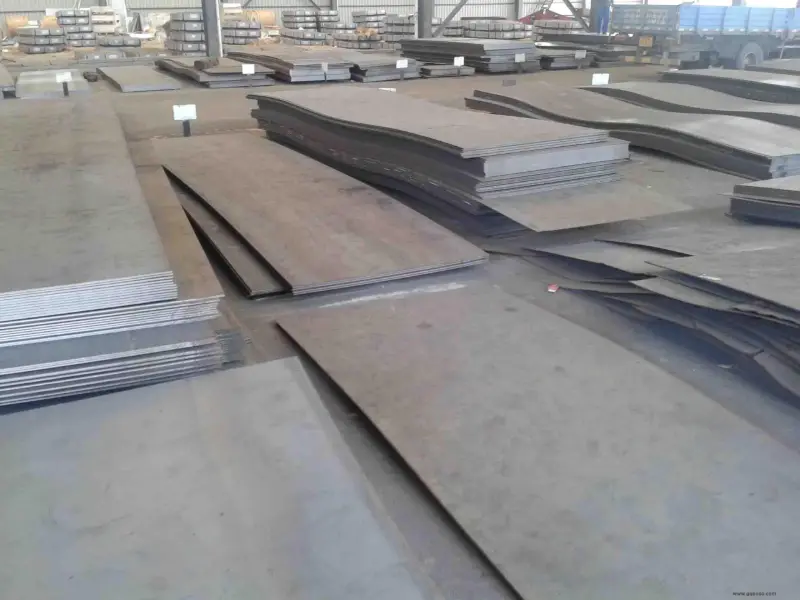
ASTM A517 Grade E High-Strength Quenched & Tempered Boiler & Pressure Vessel Steel Plate
ASTM A517 Grade E High-Strength Quenched & Tempered Boiler & Pressure Vessel Steel Plate
Explore ASTM A517 Grade E (A517GrE) alloy steel for pressure vessels and boilers: chemical composition, mechanical properties at room and elevated temperatures, physical data, equivalent grades, and application guidance. All data based on ASTM A517/A517M standard.
Hot rolling, quenching, tempering, cutting, welding, forming
- Phone : +8618037372205
- Email : [email protected]
- WhatsApp: Contact via Whtsapp
- WeChat: +8618037372205
ASTM A517 Grade E High-Strength Quenched & Tempered Boiler & Pressure Vessel Steel Plate Introduction
ASTM A517 Grade E is a high-strength, quenched and tempered Ni-Cr-Mo alloy steel plate primarily intended for fusion-welded pressure vessels and boilers. It offers a minimum yield strength of 100 ksi (690 MPa) with excellent notch toughness, making it suitable for demanding applications in petrochemical, power generation, and industrial equipment.
- High strength with good weldability after proper preheating.
- Recommended for moderate-temperature service up to about 700°F (370°C).
- Available in plate form with thickness typically up to 2.5 in. (65 mm).
- Delivered in quenched and tempered condition.
ASTM A517 Grade E High-Strength Quenched & Tempered Boiler & Pressure Vessel Steel Plate Chemical Composition
Composition limits as specified in ASTM A517/A517M for Grade E.
- Ni, Cr, and Mo provide hardenability and strength.
- Titanium, vanadium, and boron are grain refiners and enhance toughness.
- Low sulfur and phosphorus ensure cleanliness and weldability.
| Element | Standard Value (max unless range) | Notes |
|---|---|---|
| Carbon (C) | 0.21 | Heat analysis |
| Manganese (Mn) | 0.50 – 0.90 | Heat analysis |
| Phosphorus (P) | 0.035 | Maximum |
| Sulfur (S) | 0.035 | Maximum |
| Silicon (Si) | 0.15 – 0.50 | Heat analysis |
| Nickel (Ni) | 1.15 – 1.55 | Heat analysis |
| Chromium (Cr) | 0.30 – 0.60 | Heat analysis |
| Molybdenum (Mo) | 0.20 – 0.40 | Heat analysis |
| Copper (Cu) | 0.35 | Maximum |
| Titanium (Ti) | 0.04 | Maximum |
| Vanadium (V) | 0.08 | Maximum |
| Boron (B) | 0.005 | Maximum |
ASTM A517 Grade E High-Strength Quenched & Tempered Boiler & Pressure Vessel Steel Plate Thermal & Electrical Physical Properties
Typical values for quenched and tempered Ni-Cr-Mo steel at room temperature and elevated temperatures.
- Density is approximate for alloy steel.
- Thermal expansion and conductivity data are generic for similar Cr-Mo-Ni grades; suitable for engineering calculations.
- Electrical resistivity is typical for low-alloy steel.
| Property | Standard Requirement | Unit | Test Condition |
|---|---|---|---|
| Density (ρ) | 7.85 | g/cm³ | 20 °C |
| Elastic Modulus (E) | 205 | GPa | 20 °C |
| Shear Modulus (G) | 80 | GPa | 20 °C (calculated from E and ν) |
| Poisson's Ratio (ν) | 0.29 – 0.30 | - | 20 °C |
| Thermal Expansion (α) | 11.7 | 10⁻⁶/K | 20 – 100 °C |
| Thermal Expansion (α) | 12.2 | 10⁻⁶/K | 20 – 200 °C |
| Thermal Expansion (α) | 12.8 | 10⁻⁶/K | 20 – 300 °C |
| Thermal Expansion (α) | 13.3 | 10⁻⁶/K | 20 – 400 °C |
| Thermal Expansion (α) | 13.7 | 10⁻⁶/K | 20 – 500 °C |
| Thermal Conductivity (λ) | 42 | W/(m·K) | 100 °C |
| Thermal Conductivity (λ) | 41 | W/(m·K) | 200 °C |
| Thermal Conductivity (λ) | 39 | W/(m·K) | 300 °C |
| Thermal Conductivity (λ) | 37 | W/(m·K) | 400 °C |
| Specific Heat Capacity (cₚ) | 460 | J/(kg·K) | 20 °C |
| Electrical Resistivity (ρₑ) | 0.22 × 10⁻⁶ | Ω·m | 20 °C |
ASTM A517 Grade E High-Strength Quenched & Tempered Boiler & Pressure Vessel Steel Plate Mechanical Properties
Mechanical properties according to ASTM A517/A517M.
- Tensile and yield values apply to longitudinal or transverse specimens depending on plate thickness.
- Elongation depends on specimen type (rectangular vs. round) and gauge length.
- Bend test conducted per A20/A20M; bend diameter depends on thickness and tensile strength.
| Property | Standard Requirement | Unit | Test Condition |
|---|---|---|---|
| Yield Strength (0.2% offset) | ≥ 100 | ksi | At room temperature; all thicknesses |
| Yield Strength (0.2% offset) | ≥ 690 | MPa | At room temperature; all thicknesses |
| Tensile Strength | 115 – 135 | ksi | At room temperature; all thicknesses |
| Tensile Strength | 795 – 930 | MPa | At room temperature; all thicknesses |
| Elongation (200 mm gauge) | ≥ 16 | % | Thickness ≤ 65 mm; rectangular specimen |
| Elongation (50 mm gauge) | ≥ 18 | % | Thickness ≤ 65 mm; rectangular specimen |
| Bend Test (180°) | No cracks; bend diameter = 2.5t | - | t = plate thickness ≤ 3/4 in. (19 mm) |
| Bend Test (180°) | No cracks; bend diameter = 3t | - | t > 3/4 – 1 in. (25.4 mm) |
| Bend Test (180°) | No cracks; bend diameter = 4t | - | t > 1 – 1.5 in. (38.1 mm) |
ASTM A517 Grade E High-Strength Quenched & Tempered Boiler & Pressure Vessel Steel Plate Completely Equivalent Material Standards & Replaceable Grades
| Country/Region | Standard | Grade | Remarks |
|---|---|---|---|
| USA | ASME SA-517/SA-517M | SA-517 Grade E | Identical to ASTM A517 Grade E; pressure vessel code approved |
| -- | -- | No direct EN or ISO equivalent | Similar strength grades exist but with different chemistry (see similar materials) |
ASTM A517 Grade E High-Strength Quenched & Tempered Boiler & Pressure Vessel Steel Plate Application Introduction
ASTM A517 Grade E is engineered for welded pressure equipment requiring high strength and good toughness. It is widely used in the oil & gas, chemical, and power industries.
- Welding requires preheat and post-weld heat treatment (PWHT) to avoid cracking.
- Suitable for operating temperatures up to approximately 700°F (370°C).
- Excellent for thick-walled vessels where weight reduction is critical.
Product Applications: High-pressure boilers and steam drums, Ammonia synthesis converters, Hydrocracker reactors, LPG storage vessels, Thick-walled heat exchangers, High-pressure piping systems
Processed into products: Shell courses and heads, Tube sheets and flanges, Welded nozzles and reinforcements, Manway covers and blind flanges, Structural supports for heavy vessels
Application industries: Oil & Gas (pressure vessels, separators), Petrochemical (reactors, columns, heat exchangers), Power Generation (boilers, steam drums), Chemical Processing (high-pressure storage), Offshore Engineering (platform structural components)
ASTM A517 Grade E High-Strength Quenched & Tempered Boiler & Pressure Vessel Steel Plate Similar/Alternative High-Strength Pressure Vessel Steels
| Country/Region | Standard | Grade | Remarks |
|---|---|---|---|
| Europe | EN 10028-6 | P690Q (1.8880) | Similar high strength (min 690 MPa YS), but base composition differs (Mn-Ni-Cr-Mo); Ni lower. Often used as alternative in pressure vessels. |
| Japan | JIS G3115 | SPV490 | Lower yield strength (min 490 MPa); for less demanding applications; can substitute where design allows reduced strength. |
| China | GB 19189 | 12Cr2Ni1Mo | High-strength Cr-Ni-Mo grade, contains vanadium; approximate replacement for A517 Grade E in some applications, with slight strength/toughness trade-offs. |
| USA | ASTM A543/A543M | Type B Class 2 | Ni-Cr-Mo-V quenched & tempered; yield strength ~100 ksi, but additional vanadium for hardenability; suitable for similar conditions. |
Notes:
Welding considerations: Preheat temperature typically 200–300°F (95–150°C) depending on thickness; interpass temperature maintained. Low-hydrogen processes (SMAW, SAW, GMAW) recommended. Post-weld heat treatment (PWHT) often applied at 1100–1200°F (590–650°C) to relieve stress. Impact testing (Charpy V-notch) may be ordered as a supplementary requirement (S5 in ASTM A20/A20M) for low-temperature service. Plates are ultrasonically inspected per ASTM A435/A435M or A578/A578M if specified.
- Share



