
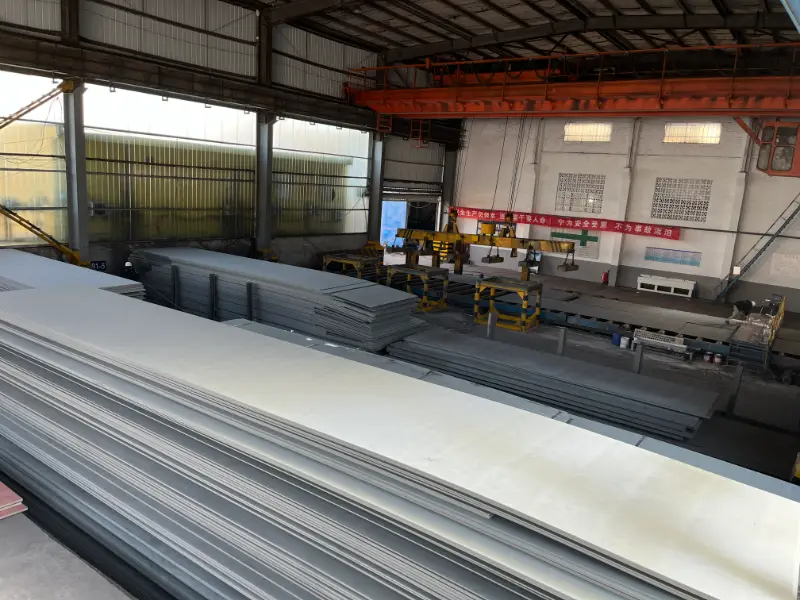
ASTM A517 Grade F Pressure Vessel Steel Plate
ASTM A517 Grade F (A517GR F) – High-Quenched & Tempered Pressure Vessel Steel Plate
Comprehensive material data for ASTM A517 Grade F: chemical composition, mechanical and physical properties, international equivalents, similar alternatives, and application guidelines for this high-strength quenched and tempered alloy steel plate.
Welding, hot forming with subsequent heat treatment, cold bending, shearing, flame cutting, machining
- Phone : +8618037372205
- Email : [email protected]
- WhatsApp: Contact via Whtsapp
- WeChat: +8618037372205
ASTM A517 Grade F Pressure Vessel Steel Plate Introduction
ASTM A517 Grade F is a high-strength, quenched and tempered alloy steel plate intended for welded pressure vessels and boilers. It belongs to the family of boron-treated carbon-manganese-chromium-molybdenum-nickel-vanadium steels, designed to provide a minimum yield strength of 690 MPa (100 ksi) after heat treatment. The material offers excellent toughness, good weldability when proper procedures are followed, and reliable performance at moderate temperatures. Typical applications include layered vessels, storage tanks, and structural components where weight savings and high strength are critical. The grade is characterized by:
- Tensile strength in the range 795–930 MPa (115–135 ksi)
- Good notch toughness at low temperatures under normalized and tempered condition
- Stringent control of boron (0.001–0.005%) to enhance hardenability
- Delivery in the quenched and tempered condition for maximum mechanical properties
ASTM A517 Grade F Pressure Vessel Steel Plate Chemical Composition
Chemical requirements as per ASTM A517/A517M for Grade F. The steel is intentionally alloyed with nickel, chromium, molybdenum, vanadium, and boron to ensure deep hardenability and consistent mechanical properties in heavy sections. Heat analysis values are shown; product analysis tolerances per the standard apply. Cu is residual unless added as an intentional alloy.
| Element | Composition (wt%) | Remarks |
|---|---|---|
| Carbon (C) | 0.10–0.20 | Key strengthening element; controls hardenability |
| Manganese (Mn) | 0.60–1.00 | Deoxidation and strength, improves hardenability |
| Phosphorus (P) | ≤0.035 | Residual element; kept low for toughness |
| Sulfur (S) | ≤0.035 | Residual element; low for ductility and weldability |
| Silicon (Si) | 0.15–0.35 | Deoxidizer, contributes to strength |
| Nickel (Ni) | 0.70–1.00 | Improves toughness and hardenability |
| Chromium (Cr) | 0.40–0.65 | Corrosion resistance and hardenability |
| Molybdenum (Mo) | 0.40–0.60 | Prevents temper embrittlement, high-temperature strength |
| Vanadium (V) | 0.03–0.08 | Grain refinement and precipitation strengthening |
| Copper (Cu) | ≤0.35 | Residual element; adds atmospheric corrosion resistance if present |
| Boron (B) | 0.001–0.005 | Microalloy to significantly increase hardenability |
ASTM A517 Grade F Pressure Vessel Steel Plate Thermal and Electrical Physical Properties
Average physical properties for ASTM A517 Grade F in the quenched and tempered condition. These data are typical reference values from published sources for similar Cr-Mo-V-B steels. Properties may vary with heat treatment and temperature. Values are valid at room temperature unless a temperature range is specified.
| Property | Typical Value | Unit | Test Condition / Temperature |
|---|---|---|---|
| Density (ρ) | 7850 | kg/m³ | 20°C |
| Modulus of elasticity (E) | 205 | GPa | 20°C |
| Shear modulus (G) | 80 | GPa | 20°C |
| Poisson's ratio (ν) | 0.28–0.30 | — | 20°C |
| Mean thermal expansion coefficient (α) | 11.7 | 10⁻⁶/K | 20–100°C |
| Mean thermal expansion coefficient (α) | 12.2 | 10⁻⁶/K | 20–200°C |
| Mean thermal expansion coefficient (α) | 12.8 | 10⁻⁶/K | 20–300°C |
| Mean thermal expansion coefficient (α) | 13.2 | 10⁻⁶/K | 20–400°C |
| Thermal conductivity (λ) | 42 | W/(m·K) | 100°C |
| Thermal conductivity (λ) | 39 | W/(m·K) | 200°C |
| Thermal conductivity (λ) | 36 | W/(m·K) | 300°C |
| Specific heat capacity (cp) | 460 | J/(kg·K) | 20°C |
| Electrical resistivity (ρe) | 0.25 | 10⁻⁶ Ω·m | 20°C |
ASTM A517 Grade F Pressure Vessel Steel Plate Mechanical Properties
Mechanical property requirements according to ASTM A517/A517M for Grade F plates. Values apply in the transverse direction for plates tested in the quenched and tempered condition. Tensile requirements depend on plate thickness; elongation is measured on a 2 in. (50 mm) gauge length. Bend test diameters are per ASTM A20/A20M for plates with a nominal tensile strength of 115 ksi minimum.
| Property | Required Value | Unit | Test Condition / Thickness |
|---|---|---|---|
| Yield Strength (0.2% offset) | ≥ 690 | MPa (min. 100 ksi) | All thicknesses ≤65 mm (2.5 in.) |
| Tensile Strength | 795–930 | MPa (115–135 ksi) | All thicknesses ≤65 mm (2.5 in.) |
| Elongation (in 50 mm) | ≥ 18 | % | Plate thickness ≤20 mm (¾ in.) |
| Elongation (in 50 mm) | ≥ 17 | % | Plate thickness >20 mm to 40 mm (¾–1½ in.) |
| Elongation (in 50 mm) | ≥ 16 | % | Plate thickness >40 mm to 65 mm (1½–2½ in.) |
| Bend Test (180°) – bend diameter | 2 × t | — | Thickness ≤25 mm (1 in.) |
| Bend Test (180°) – bend diameter | 2.5 × t | — | Thickness >25 mm to 40 mm (1–1½ in.) |
| Bend Test (180°) – bend diameter | 3 × t | — | Thickness >40 mm to 65 mm (1½–2½ in.) |
| Impact toughness (Charpy V-notch) | Not mandatory unless agreed; typically ≥27 J at -40°C possible with supplementary requirement | J | Test temperature to be specified; typical for pressure vessels |
ASTM A517 Grade F Pressure Vessel Steel Plate Fully Equivalent Material Standards and Replaceable Grades
| Country/Region | Standard | Grade/Designation | Remarks |
|---|---|---|---|
| USA | ASME SA517/SA517M | Grade F | Identical chemical and mechanical requirements; approved for ASME pressure vessel construction (Section II, Part A) |
ASTM A517 Grade F Pressure Vessel Steel Plate Application Introduction
ASTM A517 Grade F is engineered for pressure-containing parts where high strength-to-weight ratio and good low-temperature toughness are essential. The material is typically used in the quenched and tempered condition and is suitable for welded fabrication when proper welding consumables and procedures are employed. Preheating (typically 100–150°C) and post-weld heat treatment (stress relieving at 595–620°C) are recommended to prevent hydrogen-induced cracking and restore toughness.
Product Applications: Welded pressure vessels and storage tanks, Boiler drums and mud/steam separators, High-pressure gas cylinders and accumulators, Process columns and reactors, Bridges and structural steelwork where high strength is required, Mining dump truck frames and wear plates
Processed into products: Shell courses and heads for pressure vessels, Manway and nozzle reinforcements, Baffles and support rings in boilers, Compact flanges and bolted connectors, Rolled cone sections and transition pieces, Lifting eyes, pad-eyes, and structural brackets
Application industries: Oil & Gas (pressure vessels, separators, skids), Power Generation (boiler drums, headers, steam drums), Chemical & Petrochemical (reactors, high-pressure columns), Mining (haul truck bodies, crusher components), Shipbuilding (reinforcement structures, offshore modules), Heavy Machinery (hydraulic press frames, lifting equipment)
ASTM A517 Grade F Pressure Vessel Steel Plate Similar / Alternative Material Recommendations
| Country/Region | Standard | Grade/Designation | Remarks |
|---|---|---|---|
| USA | ASTM A517/A517M | Grade B | Same standard, different alloy – higher Cr and Mo, no V/B; similar strength but different weldability characteristics |
| USA | ASTM A517/A517M | Grade E | Similar concept with Cr-Mo-Ni alloying but without vanadium; slightly different temper response |
| EU | EN 10028-6 | P690QV (1.8881) | European pressure vessel grade with comparable strength and boron addition; may require revalidation for ASME construction |
| EU | EN 10025-6 | S690QL (1.8928) | Structural grade with 690 MPa min. yield, but lacks specific boiler/pressure vessel approval; suitable for non-code structures |
| China | GB/T 19189 | 07MnMoVR, 12MnNiVR (QP690) | Chinese pressure vessel quenched and tempered steels with similar strength; chemical composition differs, check equivalency for substitution |
Notes:
Notes for usage:
- Plates must be ordered specifying ASTM A517 Grade F with the desired supplementary requirements (e.g., notch toughness testing per S5, ultrasonic examination per S8).
- Welding: Low-hydrogen electrodes (e.g., E11018M, AWS A5.5) or submerged arc wire/flux combinations with matching strength are required. The heat input and interpass temperature should be carefully controlled to avoid degradation of the heat-affected zone.
- Hot forming: When forming above the tempering temperature, the plate must be re-quenched and tempered to restore properties.
- The boron addition sharply increases hardenability; thus, cooling after welding may produce a hardened HAZ, requiring strict preheat and PWHT.
- These plates are not intended for prolonged service above 370°C (700°F) due to possible temper embrittlement.
- Share



