
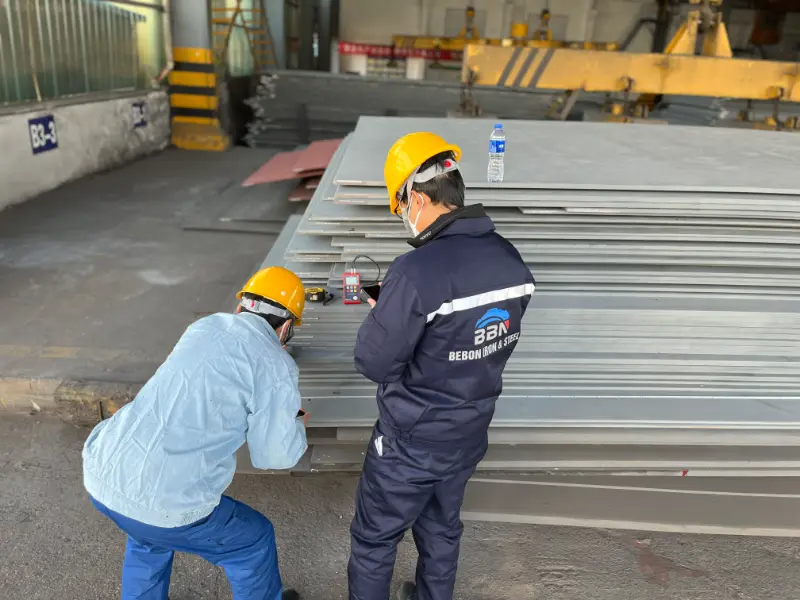
EN 10028-3 P275NL2
EN 10028-3 P275NL2: Normalized Fine-Grain Steel for Pressure Vessels and Boilers
Complete technical profile of P275NL2 steel plate per EN 10028-3, including chemical composition, mechanical properties, physical data, and application guidance.
Normalizing (N); stress relieving (SR) or tempering upon agreement; readily weldable with qualified procedures (preheat may be required); formable by cold or hot working; machinable with conventional methods.
- Phone : +8618037372205
- Email : [email protected]
- WhatsApp: Contact via Whtsapp
- WeChat: +8618037372205
EN 10028-3 P275NL2 Introduction
P275NL2 is a weldable fine-grain normalized steel defined in EN 10028-3, specifically designed for pressure vessel and boiler construction. It offers a minimum yield strength of 275 MPa at room temperature, excellent notch toughness at low temperatures (tested at −40 °C, suffix L2), and good weldability due to controlled carbon equivalent values.
- Base designation: P = pressure purpose, 275 = minimum yield strength in MPa, N = normalized delivery condition, L2 = low-temperature impact energy guaranteed at −40 °C.
- Supplied in normalized condition with fine-grain microstructure achieved by aluminium or other grain-refining elements.
- Suitable for service temperatures down to −40 °C and moderately elevated temperatures up to about 400 °C.
- Widely used in the fabrication of welded pressure vessels, boilers, storage tanks, and heat exchangers.
EN 10028-3 P275NL2 Chemical Composition
The chemical composition of P275NL2 complies with EN 10028-3 for fine-grain normalized steels. Limits are set for carbon, manganese, and micro-alloying elements to ensure the required strength and low-temperature toughness. Aluminium is added as a grain refiner. Carbon equivalent (CEV) restrictions apply depending on thickness to guarantee weldability.
| Chemical Element | Standard Value (wt%) | Remarks |
|---|---|---|
| C | ≤0.18 | Ladle analysis |
| Si | ≤0.40 | |
| Mn | 0.90 – 1.70 | |
| P | ≤0.020 | |
| S | ≤0.010 | |
| Al (total) | ≥0.020 | Grain-refining element |
| N | ≤0.012 | |
| Nb | ≤0.05 | Micro-alloying element |
| V | ≤0.05 | Micro-alloying element |
| Ti | ≤0.03 | |
| Cr | ≤0.30 | |
| Cu | ≤0.30 | |
| Mo | ≤0.08 | |
| Ni | ≤0.50 | |
| Nb+V+Ti | ≤0.12 | When intentionally added, for thickness ≤60 mm |
| CEV | ≤0.40 (t≤16 mm); ≤0.43 (16| Carbon equivalent = C + Mn/6 + (Cr+Mo+V)/5 + (Ni+Cu)/15 | |
EN 10028-3 P275NL2 Physical Properties
Physical properties provided are typical for fine-grain normalized steel at room temperature and elevated temperatures. These values are suitable for engineering calculations but are not part of the mandatory requirements of EN 10028-3. Density, elastic moduli, and thermal conductivity are comparable to those of similar structural steels.
| Property | Typical Value | Unit | Test Condition / Temperature |
|---|---|---|---|
| Density (ρ) | 7.85 | g/cm³ | 20 °C |
| Elastic modulus (E) | 210 | GPa | 20 °C |
| Shear modulus (G) | 81 | GPa | 20 °C |
| Poisson's ratio (ν) | 0.3 | — | 20 °C |
| Thermal expansion (α) | 11.8 | 10⁻⁶/K | 20 – 100 °C |
| Thermal expansion (α) | 12.3 | 10⁻⁶/K | 20 – 200 °C |
| Thermal expansion (α) | 12.9 | 10⁻⁶/K | 20 – 300 °C |
| Thermal expansion (α) | 13.5 | 10⁻⁶/K | 20 – 400 °C |
| Thermal conductivity (λ) | 52 | W/(m·K) | 20 °C |
| Thermal conductivity (λ) | 51 | W/(m·K) | 100 °C |
| Thermal conductivity (λ) | 48 | W/(m·K) | 300 °C |
| Thermal conductivity (λ) | 44 | W/(m·K) | 400 °C |
| Specific heat capacity (c) | 460 | J/(kg·K) | 20 °C |
| Specific heat capacity (c) | 500 | J/(kg·K) | 300 °C |
| Specific heat capacity (c) | 540 | J/(kg·K) | 400 °C |
| Electrical resistivity (ρₑ) | 0.20 | Ω·mm²/m | 20 °C |
EN 10028-3 P275NL2 Mechanical Properties
Mechanical properties are guaranteed at room temperature in the normalized condition. Yield and tensile strengths vary with plate thickness. Impact energy is measured on Charpy V-notch specimens at −40 °C. Elongation is recorded on a gauge length of 5.65√So (A5). Bending tests are performed to the requirements of EN 10028-3, usually with mandrel diameters of 3t to 4t, depending on thickness.
| Property | Standard Required Value | Unit | Test Condition |
|---|---|---|---|
| Yield strength (ReH) | ≥275 | MPa | Thickness t ≤ 16 mm |
| Yield strength (ReH) | ≥265 | MPa | 16 mm < t ≤ 40 mm |
| Yield strength (ReH) | ≥255 | MPa | 40 mm < t ≤ 60 mm |
| Yield strength (ReH) | ≥245 | MPa | 60 mm < t ≤ 100 mm |
| Yield strength (ReH) | ≥225 | MPa | 100 mm < t ≤ 150 mm |
| Tensile strength (Rm) | 370 – 530 | MPa | t ≤ 100 mm |
| Tensile strength (Rm) | 360 – 530 | MPa | 100 mm < t ≤ 150 mm |
| Elongation (A5) | ≥24 | % | t ≤ 16 mm, longitudinal |
| Elongation (A5) | ≥23 | % | 16 mm < t ≤ 40 mm, longitudinal |
| Elongation (A5) | ≥22 | % | 40 mm < t ≤ 100 mm, longitudinal |
| Elongation (A5) | ≥21 | % | 100 mm < t ≤ 150 mm, longitudinal |
| Impact energy (KV2) | ≥27 (min. average) | J | −40 °C, longitudinal, t ≤ 60 mm |
| Impact energy (KV2) | ≥27 (min. average) | J | −40 °C, longitudinal, 60 mm < t ≤ 100 mm |
| Impact energy (KV2) | ≥20 (min. individual) | J | −40 °C, longitudinal, all thicknesses |
| Bend test | No cracks | Mandrel d = 3t (t ≤ 12 mm), d = 4t (t > 12 mm) until 180° |
EN 10028-3 P275NL2 Completely Equivalent Material Standards and Replaceable Grades
| Country / Region | Standard | Grade | Remarks |
|---|---|---|---|
| European Union / Germany | DIN EN 10028-3 | P275NL2 | Identical to EN 10028-3 |
| France | NF EN 10028-3 | P275NL2 | Identical to EN 10028-3 |
| United Kingdom | BS EN 10028-3 | P275NL2 | Identical to EN 10028-3 |
| Italy | UNI EN 10028-3 | P275NL2 | Identical to EN 10028-3 |
| Spain | UNE EN 10028-3 | P275NL2 | Identical to EN 10028-3 |
| International | ISO 9328-3 | P275NL2 | Technically identical |
EN 10028-3 P275NL2 Application Introduction
P275NL2 is widely employed in welded pressure equipment operating at temperatures from −40 °C up to approximately 400 °C. Its fine-grain structure and guaranteed impact toughness make it suitable for cryogenic and low-temperature services. The steel is commonly formed into shells, heads, and flanges, and is compatible with all standard arc welding processes when appropriate consumables and preheating are used. Post-weld heat treatment (stress relieving) may be applied to reduce residual stresses.
Product Applications: Pressure vessels (horizontal and vertical), Steam boilers and steam drums, Heat exchangers (shell-and-tube, plate), Storage tanks for low-temperature liquids, Process columns and reactors, Liquefied gas storage and transport vessels, Autoclaves and industrial digesters
Processed into products: Cylindrical and spherical shells, Elliptical and hemispherical heads, Nozzles and manway forgings, Weld-on flanges and blind flanges, Stiffening rings and support saddles, Tube plates (tubesheets), Partition plates and baffles, Piping components (elbows, tees, reducers)
Application industries: Oil and gas processing, Petrochemical and chemical plants, Power generation (thermal and nuclear), Industrial boiler manufacturing, Heat exchanger and condenser fabrication, Shipbuilding (LPG/chemical tankers), Pressure equipment engineering (ASME/PED)
EN 10028-3 P275NL2 Similar or Alternative Materials for Reference
| Country / Region | Standard | Grade | Remarks |
|---|---|---|---|
| EU | EN 10028-3 | P275NH | Normalized, impact at −20 °C, otherwise similar base composition |
| EU | EN 10028-3 | P275NL1 | Normalized, impact at −20 °C; lower low-temperature toughness requirement |
| EU | EN 10028-3 | P355NL2 | Higher strength grade (min. 355 MPa), same L2 low-temperature toughness |
| USA | ASTM A516 / ASME SA516 | Grade 60 | Similar strength level (min. 260 MPa yield), but may not have mandatory fine-grain practice; toughness option requires supplementary requirement |
| USA | ASTM A516 | Grade 65 | Slightly higher strength, similar weldability, low-temp. toughness available upon agreement |
| Japan | JIS G3118 | SGV410 | Carbon-manganese steel for pressure vessels, yield 225 MPa, not directly equivalent; lower low-temperature capability |
| China | GB/T 713 | Q245R | Yield 245 MPa for pressure vessels, normalized; comparable but different low-temp. impact specification |
Notes:
Welding considerations: Low-hydrogen processes (SMAW, SAW, GMAW) are recommended. Preheat temperatures between 100 °C and 150 °C may be applied depending on plate thickness and carbon equivalent. Post-weld heat treatment (PWHT) temperatures are typically 580–620 °C with controlled cooling.
Certification: Plates are supplied with inspection certificate 3.1 per EN 10204. Additional testing, such as ultrasonic examination (EN 10160) or simulated PWHT mechanical testing, can be agreed upon at the time of order.
Pressure Equipment Directive (PED): P275NL2 is approved for use under PED 2014/68/EU and can be supplied with relevant material approvals.
- Share



