
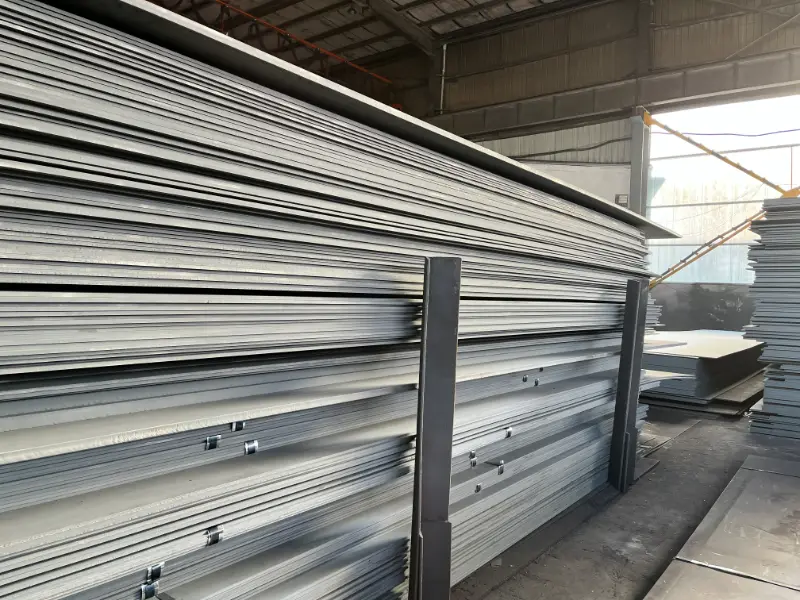
EN10028-3 P275N Pressure Vessel Steel Plate
EN10028-3 P275N Pressure Vessel Steel Plate - Normalized Fine Grain Weldable Steel
Comprehensive material data for EN10028-3 P275N steel plate: chemical composition, mechanical properties, thermal & electrical characteristics, international equivalents, and application guidance.
Hot rolling followed by normalizing; can be cold formed, welded, and machined using conventional methods.
- Phone : +8618037372205
- Email : [email protected]
- WhatsApp: Contact via Whtsapp
- WeChat: +8618037372205
EN10028-3 P275N Pressure Vessel Steel Plate Introduction
EN10028-3 P275N is a normalized fine-grain pressure vessel steel designed for elevated temperature service. It belongs to the P275 grade family and is characterized by a minimum yield strength of 275 MPa in thicknesses up to 16 mm. Key features:
- Excellent weldability due to low carbon content and controlled microalloying (Al, Nb, Ti, V).
- Good toughness down to -20°C, with guaranteed impact energy of 27 J.
- Fine grain structure achieved through normalizing heat treatment, ensuring uniform mechanical properties.
- High resistance to brittle fracture and good formability.
The steel is widely used in the fabrication of pressure vessels, boilers, heat exchangers, and storage tanks operating at moderate temperatures. It complies with European standard EN 10028-3:2017 and is supplied in the normalized condition (designation 'N').
EN10028-3 P275N Pressure Vessel Steel Plate Chemical Composition
Ladle analysis limits according to EN 10028-3 for steel grade P275N. Microalloying elements (Nb, V, Ti) are controlled to ensure fine grain size and high strength. The sum of Nb+V+Ti shall not exceed 0.12%. Aluminum is added as a grain refiner (Al total ≥ 0.020%).
- Low sulfur and phosphorus levels improve toughness and weldability.
- CEV (Carbon Equivalent Value) is typically limited to 0.40% max based on agreement.
| Element | Standard Value (max unless range given) | Remark |
|---|---|---|
| Carbon (C) | ≤0.18 | For thickness ≤ 16 mm; may be reduced for thicker plates |
| Silicon (Si) | ≤0.40 | |
| Manganese (Mn) | 0.70 – 1.50 | |
| Phosphorus (P) | ≤0.025 | |
| Sulfur (S) | ≤0.010 | |
| Aluminum (Al total) | ≥0.020 | Grain refining element |
| Nitrogen (N) | ≤0.012 | Combined with Al to form AlN precipitates |
| Chromium (Cr) | ≤0.30 | Residual; not intentionally added |
| Copper (Cu) | ≤0.30 | Residual |
| Molybdenum (Mo) | ≤0.10 | Residual |
| Nickel (Ni) | ≤0.30 | Residual |
| Niobium (Nb) | ≤0.05 | Microalloy; sum Nb+V+Ti ≤ 0.12 |
| Titanium (Ti) | ≤0.03 | Microalloy |
| Vanadium (V) | ≤0.05 | Microalloy |
| Niobium+Vanadium+Titanium (Nb+V+Ti) | ≤0.12 | Combined restriction |
EN10028-3 P275N Pressure Vessel Steel Plate Thermal and Electrical Physical Properties
Physical properties at room temperature (20°C) unless stated otherwise. These values are typical for normalized carbon‑manganese steel and are not mandated by EN 10028-3. They are provided for design calculations. Properties change with temperature; values at elevated temperatures should be obtained from relevant pressure vessel design codes (e.g., EN 13445).
| Property | Typical Value | Unit | Condition / Remark |
|---|---|---|---|
| Density (ρ) | 7.85 | g/cm³ | at 20°C |
| Elastic Modulus (E) | 210 | GPa | at 20°C |
| Shear Modulus (G) | 81 | GPa | at 20°C |
| Poisson's Ratio (ν) | 0.3 | — | within elastic range |
| Thermal Expansion Coefficient (α) | 12.3 | 10⁻⁶/K | between 20°C and 100°C |
| Thermal Expansion Coefficient (α) | 13.1 | 10⁻⁶/K | between 20°C and 200°C |
| Thermal Expansion Coefficient (α) | 13.9 | 10⁻⁶/K | between 20°C and 300°C |
| Thermal Conductivity (λ) | 51 | W/(m·K) | at 20°C |
| Thermal Conductivity (λ) | 47 | W/(m·K) | at 200°C |
| Thermal Conductivity (λ) | 43 | W/(m·K) | at 400°C |
| Specific Heat Capacity (cp) | 460 | J/(kg·K) | at 20°C |
| Electrical Resistivity (ρe) | 0.22 | µΩ·m | at 20°C |
EN10028-3 P275N Pressure Vessel Steel Plate Mechanical Properties
Tensile testing according to EN 10028-3, sampled transverse to the rolling direction. Values depend on product thickness. Impact testing is mandatory: KV at -20°C, average of 3 specimens ≥ 27 J, single value ≥ 19 J.
- For thicknesses > 60 mm, properties may be agreed upon at time of order.
- Bending tests are generally not included; when required, a 180° bend (3t for thickness ≤ 60 mm) is typical.
| Property | Standard Requirement | Unit | Test Condition |
|---|---|---|---|
| Yield Strength (ReH) | ≥275 | MPa | Thickness ≤ 16 mm |
| Yield Strength (ReH) | ≥265 | MPa | 16 < t ≤ 40 mm |
| Yield Strength (ReH) | ≥255 | MPa | 40 < t ≤ 60 mm |
| Yield Strength (ReH) | ≥245 | MPa | 60 < t ≤ 100 mm |
| Tensile Strength (Rm) | 390 – 510 | MPa | Thickness ≤ 16 mm |
| Tensile Strength (Rm) | 390 – 510 | MPa | 16 < t ≤ 40 mm |
| Tensile Strength (Rm) | 390 – 510 | MPa | 40 < t ≤ 60 mm |
| Tensile Strength (Rm) | 380 – 510 | MPa | 60 < t ≤ 100 mm |
| Elongation (A) | ≥24 | % | Thickness ≤ 16 mm, gauge length L0 = 5.65√S0 |
| Elongation (A) | ≥23 | % | 16 < t ≤ 40 mm |
| Elongation (A) | ≥22 | % | 40 < t ≤ 60 mm |
| Elongation (A) | ≥21 | % | 60 < t ≤ 100 mm |
| Impact Energy (KV) at -20°C | ≥27 (average) | J | Transverse, V‑notch; individual min 19 J |
| Bend Test | 180° bend, d=3t | — | If required, for thickness ≤ 60 mm |
EN10028-3 P275N Pressure Vessel Steel Plate Exact Equivalent Material Standards and Substitute Grades
| Country/Region | Standard | Grade | Remarks |
|---|---|---|---|
| EU | EN 10028-3 | P275N | Base grade |
| Germany | DIN EN 10028-3 | P275N | Adopted EN |
| UK | BS EN 10028-3 | P275N | Adopted EN |
| France | NF EN 10028-3 | P275N | Adopted EN |
| Italy | UNI EN 10028-3 | P275N | Adopted EN |
| Spain | UNE EN 10028-3 | P275N | Adopted EN |
| International | ISO 9328-2 | P275NH / P275N | Harmonized; identical requirements |
EN10028-3 P275N Pressure Vessel Steel Plate Application Introduction
P275N steel plate is engineered for pressure-containing components operating at temperatures up to around 400°C. Its fine grain structure and guaranteed toughness make it suitable for both ambient and sub-zero conditions (down to -20°C).
- Commonly used for welded fabrication of vessels, tanks, and piping.
- Can be formed by rolling, bending, and flanging without loss of properties after normalizing.
- Welding procedures should respect preheat and interpass temperatures consistent with the CEV and thickness.
Product Applications: Pressure vessels (vertical, horizontal, spherical), Boiler drums and shells, Heat exchanger shells and channels, Process columns and towers, LPG and ammonia storage tanks, Autoclaves and digesters, Penstocks and hydraulic cylinders
Processed into products: Cylindrical shells and courses, Dished and elliptical heads, Flanges and bolted connections (when forgings are produced from plate), Nozzle necks and reinforcement pads, Stiffening rings and support brackets, Baffle plates and tube sheets (if thickness permits), Dished ends (by spinning or pressing)
Application industries: Oil & Gas (refining, petrochemicals, gas processing), Power Generation (fossil fuel boilers, heat recovery steam generators), Chemical Industry (reactors, columns, storage spheres), Fertilizer and Pharmaceutical Plants, Water Treatment and Desalination, Shipbuilding (LPG tanks, auxiliary pressure vessels)
EN10028-3 P275N Pressure Vessel Steel Plate Similar/Alternative Materials for Comparison
| Country/Region | Standard | Grade | Remarks |
|---|---|---|---|
| USA | ASTM A516 / A516M | Grade 60 | Similar yield and tensile; thickness-dependent values; impact temperature may differ |
| Japan | JIS G3115 | SPV235 | Comparable strength; Nb/V microalloyed; typically normalized |
| China | GB 713 | Q245R | Similar but slightly lower tensile range; often not fully killing specified |
| India | IS 2062 / IS 2041 | E275B / R260 (with impact) | Structural/boiler grades; not identical but can substitute in less demanding service |
| South Korea | KS D 3521 | SPV235 | Essentially equivalent to JIS G3115 SPV235 |
Notes:
Delivery conditions: Plates are supplied in the normalized state (heated to approximately 900–950°C and air cooled). Hydrogen induced cracking (HIC) resistance may be ordered as an additional option (HIC‑tested per NACE TM0284). Post-weld heat treatment (PWHT) simulation tests can be agreed upon to verify properties after stress relieving. Thickness tolerances according to EN 10029. Ultrasonic testing is usually performed per EN 10160 (class S2/E2) unless otherwise agreed.
- Share



