
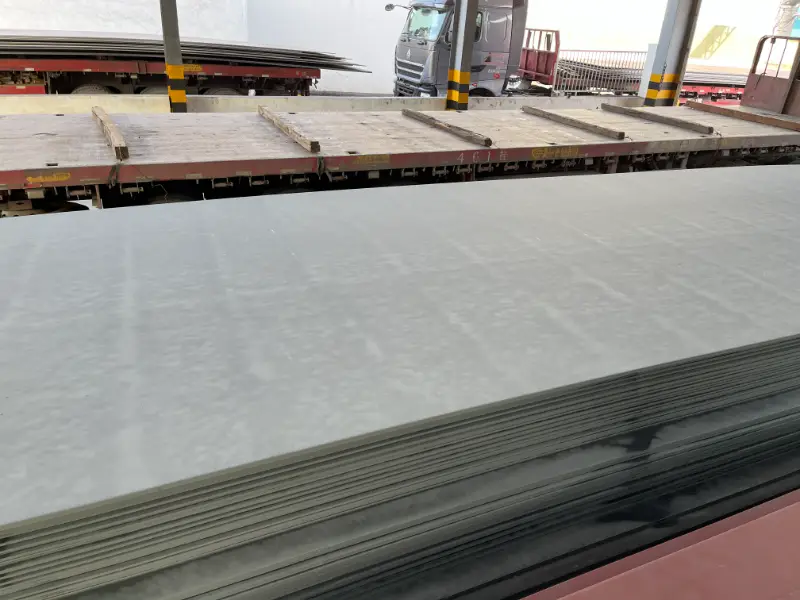
P460NL2 Pressure Vessel Steel
EN10028-3 P460NL2: High-Strength Normalized Steel for Low-Temperature Pressure Vessels
Comprehensive material data for P460NL2 steel plate according to EN 10028-3. Includes chemical composition, mechanical properties at elevated and low temperatures, thermal and electrical properties, international equivalents, and detailed application guidance for pressure vessel and boiler construction.
Hot rolling, normalizing, stress relieving, hot forming, welding (all common methods with appropriate preheat and PWHT)
- Phone : +8618037372205
- Email : [email protected]
- WhatsApp: Contact via Whtsapp
- WeChat: +8618037372205
P460NL2 Pressure Vessel Steel Introduction
EN10028-3 P460NL2 is a normalized fine-grain structural steel specifically designed for pressure vessels and boilers operating at low temperatures. It belongs to the P460 series under European standard EN 10028-3, which covers weldable fine grain steels for pressure purposes. The 'N' denotes normalized delivery condition, 'L2' indicates guaranteed impact toughness down to -50 °C. This material offers a minimum yield strength of 460 MPa for thicknesses up to 16 mm, with excellent weldability and resistance to brittle fracture. It is widely used in the petrochemical, power generation, and cryogenic storage industries. The steel is fully killed and contains aluminum as a grain refiner, ensuring fine austenitic grain size and good through-thickness properties.
P460NL2 Pressure Vessel Steel Chemical Composition
The chemical composition of P460NL2 is controlled to ensure good weldability, low-temperature toughness, and strength. Elements are based on heat analysis according to EN 10028-3. The steel is fully killed and fine grain treated with aluminum. All values are maximum unless a range is given.
| Element | Content (%) | Remarks |
|---|---|---|
| Carbon (C) | ≤ 0.20 | Max. 0.20% for thickness ≤ 16 mm; for thicker plates, the max. may be lower (e.g., 0.22%) but standard allows 0.20 as general limit. |
| Silicon (Si) | ≤ 0.60 | Silicon mainly for deoxidation. |
| Manganese (Mn) | 1.10 - 1.70 | Required for strength and toughness. |
| Phosphorus (P) | ≤ 0.025 | Low phosphorus for improved toughness and weldability. |
| Sulfur (S) | ≤ 0.015 | Low sulfur for enhanced through-thickness properties. |
| Aluminum (Al, total) | ≥ 0.020 | Minimum aluminum ensures fine grain practice. Acid-soluble Al typically ≥ 0.015%. |
| Nitrogen (N) | ≤ 0.025 | Controlled for aging resistance. With sufficient Al, nitrogen is bound. |
| Chromium (Cr) | ≤ 0.30 | Residual element, not added intentionally. |
| Copper (Cu) | ≤ 0.70 | May be present from scrap; limited to avoid hot shortness. |
| Molybdenum (Mo) | ≤ 0.10 | Residual element. |
| Niobium (Nb) | ≤ 0.05 | Microalloying for grain refinement (optional). |
| Nickel (Ni) | ≤ 0.80 | May be present, enhances toughness but limited here. |
| Titanium (Ti) | ≤ 0.03 | Optional microalloying. |
| Vanadium (V) | ≤ 0.20 | Optional microalloying, improves strength. |
| Iron (Fe) | Balance | Remainder |
P460NL2 Pressure Vessel Steel Typical Physical Properties for Reference
The following physical properties are typical for low-alloy normalized carbon-manganese steels similar to P460NL2. These values are not part of EN 10028-3 but are supplied for engineering calculations. They are indicative at room temperature unless a temperature range is specified.
| Property | Typical Value | Unit | Condition/Test Details |
|---|---|---|---|
| Density (ρ) | 7.85 | g/cm³ | At 20 °C |
| Modulus of Elasticity (E) | 210 | GPa | At 20 °C |
| Shear Modulus (G) | 81 | GPa | Calculated from E and ν |
| Poisson's Ratio (ν) | 0.30 | — | Room temperature |
| Thermal Expansion (α) 20-100 °C | 11.1 × 10⁻⁶ | K⁻¹ | Linear coefficient |
| Thermal Expansion (α) 20-200 °C | 12.1 × 10⁻⁶ | K⁻¹ | Linear coefficient |
| Thermal Expansion (α) 20-300 °C | 12.9 × 10⁻⁶ | K⁻¹ | Linear coefficient |
| Thermal Expansion (α) 20-400 °C | 13.5 × 10⁻⁶ | K⁻¹ | Linear coefficient |
| Thermal Conductivity (λ) | 40 - 50 | W/(m·K) | At 20 °C; reduces with increasing temperature |
| Specific Heat Capacity (cₚ) | 460 | J/(kg·K) | At 20 °C; increases with temperature |
| Electrical Resistivity (ρₑ) | 0.25 × 10⁻⁶ | Ω·m | At 20 °C (indicative for comparable steels) |
P460NL2 Pressure Vessel Steel Mechanical Properties
The mechanical properties of P460NL2 are dependent on product thickness. The steel must meet minimum yield and tensile strength values in the normalized condition. Impact testing is mandatory at -50 °C with minimum 27 J average on transverse Charpy-V specimens. Properties apply to flat products perpendicular to rolling direction unless otherwise stated. Values are per EN 10028-3.
| Property | Required Value | Unit | Test Condition / Thickness |
|---|---|---|---|
| Yield Strength (ReH) | ≥ 460 | MPa | Thickness ≤ 16 mm |
| Yield Strength (ReH) | ≥ 445 | MPa | 16 < t ≤ 40 mm |
| Yield Strength (ReH) | ≥ 430 | MPa | 40 < t ≤ 60 mm |
| Tensile Strength (Rm) | 570 - 730 | MPa | Thickness ≤ 60 mm |
| Tensile Strength (Rm) | 570 - 720 | MPa | 60 < t ≤ 100 mm (informative, check standard for exact range) |
| Elongation after fracture (A, Lo=5.65√So) | ≥ 17 | % | Thickness ≤ 60 mm, longitudinal |
| Elongation after fracture (A) | ≥ 17 | % | Thickness ≤ 60 mm, transverse (if not specified, longitudinal is default; but EN gives values for transverse as well) |
| Impact energy (KV) at -50 °C | ≥ 27 (average of three), 19 min. individual | J | Transverse Charpy-V, thickness ≥ 6 mm. For sub-size specimens, minimum values are proportional. |
| Bend test (mandrel diameter, d) | d = 3a (for thickness ≤ 16 mm) | mm | Bending angle 180°; a = thickness of test piece. No cracks allowed. |
| Bend test (mandrel diameter, d) | d = 4a (for 16 < t ≤ 30 mm) | mm | 180° bend |
P460NL2 Pressure Vessel Steel Fully Equivalent Material Standards and Substitute Grades
| Country / Region | Standard | Grade | Remarks |
|---|---|---|---|
| Europe | EN 10028-3 | P460NL2 | Original standard and grade. |
| Germany | DIN EN 10028-3 (incorporating former DIN 17102 StE460 TM?) | P460NL2 | Identical to EN; formerly StE 460 TM had similar properties but different delivery condition. |
| United Kingdom | BS EN 10028-3 | P460NL2 | Identical adoption; earlier BS 1501-224 Gr. 460 may correspond to P460NL1/NL2 range. |
| France | NF EN 10028-3 | P460NL2 | Direct adoption. |
| ISO | ISO 9328-3 (Steel products for pressure purposes – Weldable fine grain steels) | P460NL2 | ISO 9328-3 includes a similar grade, but the exact equivalence should be confirmed with the standard edition; often cross-referenced. |
P460NL2 Pressure Vessel Steel Application Introduction
P460NL2 is extensively employed in welded pressure vessels, boilers, and heat exchangers that require high strength combined with excellent low-temperature toughness. Its fine-grain normalized microstructure ensures reliable performance under static and cyclic loading down to -50 °C. Key applications span the energy, petrochemical, and cryogenic sectors. Below are typical industries, end products, and specific components fabricated from this steel.
Product Applications: Pressure vessels for LPG, ammonia, propylene, Low-temperature storage tanks (down to -50 °C), Boilers and steam drums, Heat exchangers and condensers, Reactors and columns in chemical plants, Pipeline fittings and flanges for low-temperature service, Offshore platform nodal joints and heavy-walled components
Processed into products: Vessel shells, heads, and flanges, Nozzle forgings and reinforcement pads, Tube plates for heat exchangers, Support skirts and saddles for vertical/horizontal vessels, Separator internals and baffle plates, Cryogenic pipe spools and elbows, Wind turbine tower flanges and transition pieces (where toughness at low ambient temperature is required)
Application industries: Oil & Gas (onshore and offshore), Petrochemical and chemical processing, Power generation (conventional thermal, nuclear components with exception of reactor core), Cryogenic storage and transportation, Renewable energy (hydrogen storage, CCS), Heavy machinery and structural engineering
P460NL2 Pressure Vessel Steel Similar or Closely Related Materials
| Country / Region | Standard | Grade | Remarks |
|---|---|---|---|
| Europe | EN 10028-3 | P460NL1 | Impact tested at -40 °C; slightly lower toughness requirement, otherwise same strength. Suitable for less severe low-temperature service. |
| Europe | EN 10028-3 | P460N | Normalized but with impact at 0 °C or -20 °C. For ambient or moderate low temperatures. |
| USA | ASTM A537 / A537M | Class 2 | Heat-treated carbon-silicon-manganese steel for pressure vessels. Yield strength min. 415 MPa for ≤ 65mm. Not fully equivalent in strength (typically 60-65 ksi) but can be discussed. Requires careful comparison of toughness at -50°C. |
| USA | ASTM A516 / A516M | Grade 70 | Standard carbon steel for moderate temperatures. Yield strength ~260 MPa, significantly lower strength; not a direct substitute but same application field with thicker sections. |
| Japan | JIS G3118 | SGV480 | Similar to A516 Gr.70, lower strength. Not recommended without re-engineering. |
| China | GB/T 3531 | 06Ni9DR? | Not directly comparable; 9%Ni steel for cryogenic but much higher nickel. For -50°C, GB/T 19189 07MnMoVR or 07MnNiDR could be considered, but different alloy systems. |
Notes:
- Welding: P460NL2 is readily weldable by all common processes (SMAW, SAW, GMAW, FCAW). Preheat and interpass temperature typically 100–200 °C depending on thickness; post-weld heat treatment (PWHT) may be required for heavy sections (usually 1–2 h at 530–580 °C). Stress relief heat treatment (SR) is performed at 530–580 °C with controlled cooling.
- Forming: Hot and cold forming permissible; cold forming above 5% strain should be followed by stress relieving if service is in creep range or if specified by code. Hot forming temperature 850–1000 °C, followed by normalizing if below the final rolling temperature.
- Testing and certification: According to EN 10204, inspection certificate 3.1 or 3.2 is typical. Ultrasonic testing to EN 10160 or equivalent is often specified for plates. Impact tests at -50 °C are mandatory; simulated PWHT condition testing may be agreed.
- Additional options: The standard allows ordering with improved properties for through-thickness (Z-quality) per EN 10164, with a restriction on sulfur content and inclusion shape control.
- For design temperatures above 500 °C, the hot strength values should be taken from the standard annex or from elevated temperature tensile tests.
- Share



