
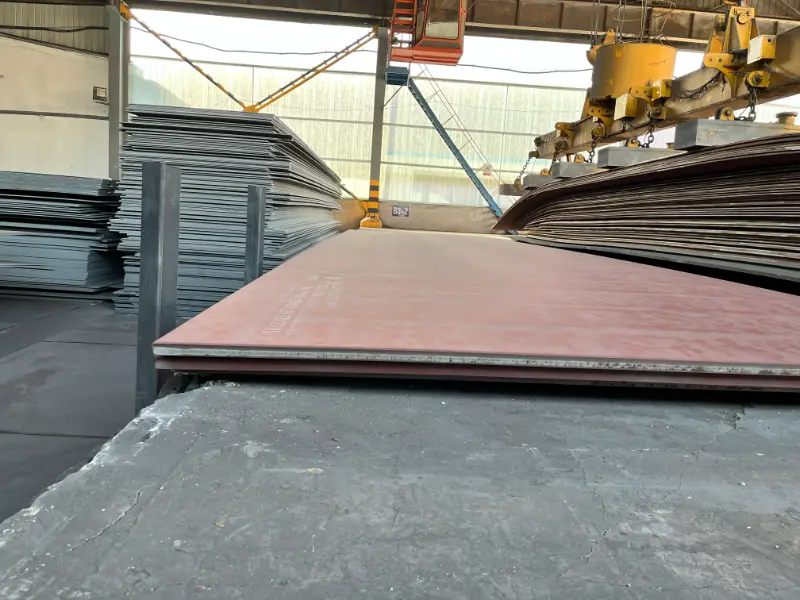
EN 10028-3 P460NL1: Normalized Fine Grain Pressure Vessel Steel
EN 10028-3 P460NL1: Normalized Fine Grain Pressure Vessel Steel - Grade Guide
Comprehensive data sheet for EN 10028-3 P460NL1 normalized fine grain steel used in pressure vessels and boilers. Includes chemical composition, mechanical and physical properties, international equivalents, and application guidance.
Hot rolling, normalizing, welding, cold forming (restricted), machining
- Phone : +8618037372205
- Email : [email protected]
- WhatsApp: Contact via Whtsapp
- WeChat: +8618037372205
EN 10028-3 P460NL1: Normalized Fine Grain Pressure Vessel Steel Introduction
EN 10028-3 P460NL1 is a weldable fine-grain structural steel with a minimum yield strength of 460 MPa, supplied in the normalized condition. It is specifically designed for pressure-containing applications at elevated temperatures and low-temperature service down to -40°C (designation 'L1'). The steel offers an excellent combination of strength, toughness, and weldability, thanks to a controlled chemical composition with microalloying elements (Nb, V, Ti) that ensure fine grain size. It is widely used in the fabrication of boilers, pressure vessels, and chemical reactors where safety and reliability are critical. The material meets the requirements of European standard EN 10028-3, which harmonizes technical delivery conditions for flat products made of steels for pressure purposes.
EN 10028-3 P460NL1: Normalized Fine Grain Pressure Vessel Steel Chemical Composition
The chemical composition is tightly controlled to achieve the required mechanical properties and weldability. Microalloying elements (Nb, V, Ti) are added to refine the grain size. Maximum carbon equivalent (CEV) values apply based on product thickness to ensure good weldability without preheating.
- CEV = C + Mn/6 + (Cr+Mo+V)/5 + (Ni+Cu)/15.
- For thickness ≤ 63 mm: CEV ≤ 0.53
- For thickness 63 < t ≤ 100 mm: CEV ≤ 0.55
| Element | Standard Value (wt%) | Remarks |
|---|---|---|
| Carbon (C) | ≤ 0.20 | |
| Silicon (Si) | ≤ 0.60 | |
| Manganese (Mn) | 1.10 – 1.70 | |
| Phosphorus (P) | ≤ 0.025 | |
| Sulfur (S) | ≤ 0.015 | |
| Aluminium (Al)total | ≥ 0.020 | Minimum for fine grain practice |
| Nitrogen (N) | ≤ 0.025 | |
| Chromium (Cr) | ≤ 0.30 | |
| Copper (Cu) | ≤ 0.70 | |
| Molybdenum (Mo) | ≤ 0.10 | |
| Niobium (Nb) | ≤ 0.05 | |
| Nickel (Ni) | ≤ 0.80 | |
| Titanium (Ti) | ≤ 0.05 | |
| Vanadium (V) | ≤ 0.20 | |
| Nb+V+Ti | ≤ 0.22 | Sum of microalloying elements |
EN 10028-3 P460NL1: Normalized Fine Grain Pressure Vessel Steel Physical, Thermal and Electrical Properties
The values listed below are typical for normalized P460NL1 steel at room temperature unless a temperature range is indicated. They are provided for design and engineering calculations and may vary slightly depending on actual composition and heat treatment condition. Data are based on general properties of similar low-alloy fine grain steels. Always refer to manufacturer's certified data for critical applications.
| Property | Typical Value | Unit | Condition / Temperature |
|---|---|---|---|
| Density (ρ) | 7.85 | g/cm³ | 20°C |
| Modulus of Elasticity (E) | 210 | GPa | 20°C |
| Shear Modulus (G) | 81 | GPa | 20°C (calculated from E and ν) |
| Poisson's Ratio (ν) | 0.3 | — | 20°C |
| Thermal Expansion Coefficient (α) | 11.1 × 10⁻⁶ | K⁻¹ | 20 – 100°C |
| Thermal Expansion Coefficient (α) | 12.2 × 10⁻⁶ | K⁻¹ | 20 – 200°C |
| Thermal Expansion Coefficient (α) | 12.8 × 10⁻⁶ | K⁻¹ | 20 – 300°C |
| Thermal Conductivity (λ) | 52 | W/(m·K) | 20°C |
| Thermal Conductivity (λ) | 48 | W/(m·K) | 200°C |
| Thermal Conductivity (λ) | 43 | W/(m·K) | 400°C |
| Specific Heat Capacity (c) | 460 | J/(kg·K) | 20 – 100°C |
| Specific Heat Capacity (c) | 520 | J/(kg·K) | 200°C |
| Specific Heat Capacity (c) | 580 | J/(kg·K) | 400°C |
| Electrical Resistivity (ρₑ) | 0.23 | μΩ·m | 20°C |
EN 10028-3 P460NL1: Normalized Fine Grain Pressure Vessel Steel Mechanical Properties
Mechanical properties are verified at ambient temperature on transverse test pieces unless otherwise specified. The steel exhibits good ductility and a guaranteed minimum impact energy at -40°C (L1 designation). Requirements apply for product thicknesses up to 100 mm. Bending test is mandatory to assess formability. All values are minimum unless a range is given.
| Property | Standard Requirement | Unit | Test Condition / Remarks |
|---|---|---|---|
| Yield Strength (ReH) | 460 | MPa | Thickness ≤ 16 mm; transverse |
| Yield Strength (ReH) | 445 | MPa | 16 < t ≤ 40 mm; transverse |
| Yield Strength (ReH) | 430 | MPa | 40 < t ≤ 60 mm; transverse |
| Yield Strength (ReH) | 400 | MPa | 60 < t ≤ 100 mm; transverse |
| Tensile Strength (Rm) | 550 – 730 | MPa | Thickness ≤ 60 mm; transverse |
| Tensile Strength (Rm) | 500 – 680 | MPa | 60 < t ≤ 100 mm; transverse |
| Elongation (A) | 17 | % | Gauge length L₀ = 5.65√S₀; transverse, t ≤ 100 mm |
| Impact Energy (KV₂) | ≥ 27 | J | At -40°C; longitudinal, V-notch, average of 3 tests |
| Bend Test | d = 3t (bend angle 180°) | — | Thickness ≤ 16 mm; no cracks |
| Bend Test | d = 4t (bend angle 180°) | — | 16 < t ≤ 100 mm; no cracks |
EN 10028-3 P460NL1: Normalized Fine Grain Pressure Vessel Steel Exactly Equivalent Material Standards and Substitutable Grades
| Country/Region | Standard | Grade | Remarks |
|---|---|---|---|
| European Union | EN 10028-3 | P460NL1 | Original standard; normalized delivery condition |
| International (ISO) | ISO 9328-2 | P460NL1 | Identical technical requirements |
| Germany | DIN EN 10028-3 | P460NL1 | Adopted EN standard |
| United Kingdom | BS EN 10028-3 | P460NL1 | Adopted EN standard |
| France | NF EN 10028-3 | P460NL1 | Adopted EN standard |
| Italy | UNI EN 10028-3 | P460NL1 | Adopted EN standard |
| Spain | UNE EN 10028-3 | P460NL1 | Adopted EN standard |
| USA (ASME) | ASME SA/EN 10028-3 | P460NL1 | ASME acceptance of EN material; requires conformance to ASME Section II - Part A |
EN 10028-3 P460NL1: Normalized Fine Grain Pressure Vessel Steel Application Introduction
EN 10028-3 P460NL1 is engineered for demanding pressure vessel and boiler fabrication. Its high strength permits reduced wall thickness, which lowers weight and welding cost, while its excellent low-temperature toughness ensures structural integrity in cryogenic conditions down to -40°C. The material can be processed by common workshop techniques, but attention must be paid to welding procedures and heat input to avoid grain coarsening in the HAZ.
Product Applications: High-pressure reactors and autoclaves, Boiler drums and steam generators, Heat exchanger shells and channels, Pressure vessels for liquefied gases (e.g., LPG, ammonia), Columns and distillation towers, Pipeline scrubbers and knock-out drums, Large diameter welded pipe for high-pressure service
Processed into products: Cylindrical shell courses and formed heads (elliptical, torispherical, hemispherical), Tube sheets and flanges for heat exchangers, Nozzle reinforcements and insert plates, Baffle and support plates, Welded branch connections, Manway covers and blind flanges, Stiffening rings, Base plates and lifting lugs
Application industries: Oil & Gas (onshore and offshore), Chemical and Petrochemical, Power Generation (conventional and nuclear), Industrial Gas (storage and transport), Pharmaceuticals and Biotechnology, Water Treatment and Desalination, Shipbuilding (LPG/chemical tankers)
EN 10028-3 P460NL1: Normalized Fine Grain Pressure Vessel Steel Similar or Closely Related Alternative Materials
The following steels are not identical but may be considered as alternatives after careful engineering assessment of strength level, toughness temperature, and code acceptance. Substitution requires recalculations and possibly revalidation of the pressure equipment design.
| Country/Region | Standard | Grade | Remarks |
|---|---|---|---|
| EU | EN 10028-3 | P460NL2 | Lower impact temperature (-50°C); otherwise same strength. |
| EU | EN 10028-3 | P460N | Impact at -20°C; less restrictive for moderate low-temperature service. |
| EU | EN 10028-3 | P355NL1 | Lower yield strength (355 MPa); may be used where design allows reduced strength; same -40°C toughness. |
| USA | ASTM A537 / ASME SA537 | Class 2 | Normalized; yield strength ~415 MPa (below P460NL1); impact test at -34°C (close to -40°C). Requires thickness and CEV reconciliation. |
| Japan | JIS G3115 | SPV490 | Yield strength ~490 MPa; similar concept for pressure vessels; chemical composition and toughness verification needed. |
Notes:
Welding recommendations: Use low-hydrogen processes (SMAW with basic electrodes, SAW, GMAW). Preheat typically 100–150°C depending on thickness and carbon equivalent. Post-weld heat treatment (PWHT) is often mandatory for pressure vessel codes; follow EN 13445 or ASME VIII requirements.
Inspection and testing: Ultrasonic testing according to EN 10160 for internal soundness; Charpy V-notch impact tests at -40°C are mandatory; elevated temperature tensile properties may be subject to agreement.
Certification: Material shall be supplied with inspection certificate 3.1 according to EN 10204.
Alternative sizes: Plates above 100 mm thickness are not covered by EN 10028-3; for heavier sections, consult your supplier for specially designed chemistry and heat treatment.
- Share



