
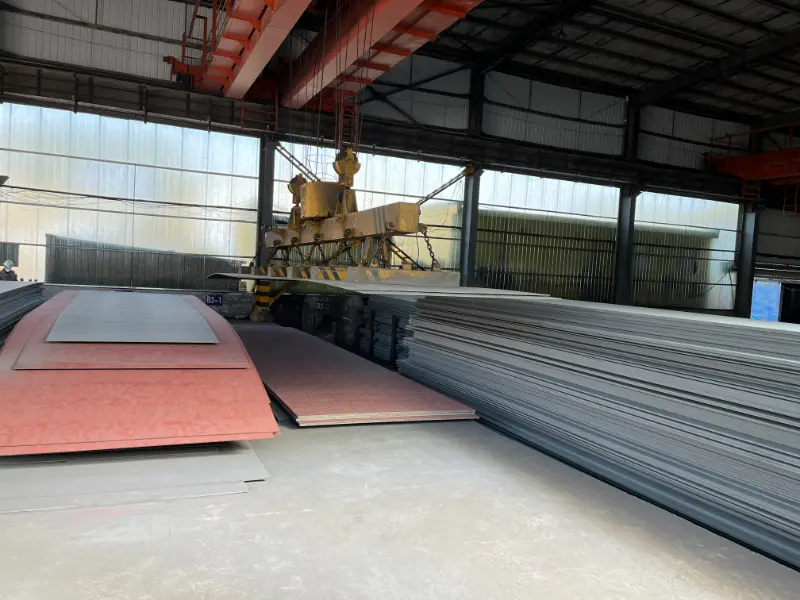
EN 10028-3 P460NH Steel Plate for Pressure Vessel and Boiler
EN 10028-3 P460NH Steel Plate for Pressure Vessel and Boiler: Properties and Equivalents
Detailed material data for P460NH steel grade according to EN 10028-3, covering chemical composition, mechanical and physical properties, international equivalents, and application guidance for high-temperature pressure equipment.
Hot rolling, normalizing, welding, cold forming, cutting, bending, machining
- Phone : +8618037372205
- Email : [email protected]
- WhatsApp: Contact via Whtsapp
- WeChat: +8618037372205
EN 10028-3 P460NH Steel Plate for Pressure Vessel and Boiler Introduction
P460NH is a normalized fine-grain structural steel defined in EN 10028-3, intended for pressurized components operating at elevated temperatures. It guarantees minimum yield strength of 460 MPa at room temperature and maintains specified proof strengths up to 400°C. The grade offers excellent weldability, good low-temperature toughness (impact energy ≥27 J at -20°C), and is suitable for wall thicknesses up to 100 mm in the normalized delivery condition.
- High strength with good ductility
- Guaranteed elevated temperature properties
- Normalized fine-grain structure for toughness
- Widely used in petrochemical, power generation, and boiler fabrication
EN 10028-3 P460NH Steel Plate for Pressure Vessel and Boiler Chemical Composition
Ladle analysis according to EN 10028-3. The steel is fully killed and fine-grain treated. Carbon equivalent (CEV) limits are mandatory to ensure weldability and avoidance of cold cracking.
| Chemical Element | Standard Value | Remarks |
|---|---|---|
| C | ≤0.20 | Maximum |
| Si | ≤0.60 | |
| Mn | 1.00 – 1.70 | |
| P | ≤0.025 | |
| S | ≤0.015 | |
| N | ≤0.020 | |
| Al total | ≥0.020 | If aluminium is used as grain refiner; metallic Al |
| Cr | ≤0.30 | |
| Cu | ≤0.70 | |
| Mo | ≤0.10 | |
| Nb | ≤0.05 | |
| Ni | ≤0.80 | |
| Ti | ≤0.03 | |
| V | ≤0.20 | |
| Carbon equivalent (CEV) | ≤0.53 (t ≤ 60 mm) / ≤0.55 (60 < t ≤ 100 mm) | CEV = C + Mn/6 + (Cr+Mo+V)/5 + (Ni+Cu)/15 |
EN 10028-3 P460NH Steel Plate for Pressure Vessel and Boiler Thermal and Electrical Physical Properties
Typical properties for normalized fine-grain structural steel P460NH. Values may vary slightly based on exact chemistry and heat treatment. Density, elastic moduli, and Poisson's ratio are nearly constant; thermal expansion, conductivity, specific heat, and resistivity are temperature-dependent.
| Property | Standard Requirement Value | Unit | Test Condition |
|---|---|---|---|
| Density (ρ) | 7850 | kg/m³ | at 20°C |
| Elastic modulus (E) | 210 | GPa | at 20°C |
| Shear modulus (G) | 80 | GPa | at 20°C |
| Poisson's ratio (ν) | 0.3 | — | at 20°C |
| Thermal expansion coefficient (α) | 11.5 | x10⁻⁶ /K | 20 – 100°C |
| Thermal expansion coefficient (α) | 12.0 | x10⁻⁶ /K | 20 – 200°C |
| Thermal expansion coefficient (α) | 12.8 | x10⁻⁶ /K | 20 – 300°C |
| Thermal expansion coefficient (α) | 13.5 | x10⁻⁶ /K | 20 – 400°C |
| Thermal conductivity (λ) | 36 | W/(m·K) | at 20°C |
| Thermal conductivity (λ) | 38 | W/(m·K) | at 100°C |
| Thermal conductivity (λ) | 37 | W/(m·K) | at 200°C |
| Thermal conductivity (λ) | 36 | W/(m·K) | at 300°C |
| Thermal conductivity (λ) | 34 | W/(m·K) | at 400°C |
| Specific heat capacity (cp) | 460 | J/(kg·K) | at 20°C |
| Specific heat capacity (cp) | 490 | J/(kg·K) | at 200°C |
| Specific heat capacity (cp) | 540 | J/(kg·K) | at 400°C |
| Electrical resistivity (ρ_e) | 0.25 | x10⁻⁶ Ω·m | at 20°C |
| Electrical resistivity (ρ_e) | 0.35 | x10⁻⁶ Ω·m | at 200°C |
| Electrical resistivity (ρ_e) | 0.45 | x10⁻⁶ Ω·m | at 400°C |
EN 10028-3 P460NH Steel Plate for Pressure Vessel and Boiler Mechanical Properties
Room temperature tensile and impact properties, plus minimum 0.2% proof strength at elevated temperatures. Test pieces transverse, according to EN 10028-3. Impact energy is average of 3 specimens, single min 19 J.
| Property | Standard Requirement Value | Unit | Test Condition |
|---|---|---|---|
| Yield strength (ReH) | ≥460 | MPa | thickness ≤ 16 mm, transverse |
| Yield strength (ReH) | ≥445 | MPa | 16 < t ≤ 40 mm, transverse |
| Yield strength (ReH) | ≥425 | MPa | 40 < t ≤ 60 mm, transverse |
| Yield strength (ReH) | ≥400 | MPa | 60 < t ≤ 100 mm, transverse |
| Tensile strength (Rm) | 570 – 720 | MPa | thickness ≤ 60 mm |
| Tensile strength (Rm) | 540 – 710 | MPa | 60 < t ≤ 100 mm |
| Elongation (A) | ≥17 | % | L0=5.65√S0, transverse, t ≤ 40 mm |
| Elongation (A) | ≥16 | % | 40 < t ≤ 60 mm |
| Elongation (A) | ≥15 | % | 60 < t ≤ 100 mm |
| Impact energy (KV) | ≥27 | J | at -20°C, transverse, t ≤ 100 mm |
| 0.2% proof strength (Rp0.2) at 100°C | ≥430 | MPa | elevated temperature |
| 0.2% proof strength (Rp0.2) at 150°C | ≥410 | MPa | elevated temperature |
| 0.2% proof strength (Rp0.2) at 200°C | ≥390 | MPa | elevated temperature |
| 0.2% proof strength (Rp0.2) at 250°C | ≥370 | MPa | elevated temperature |
| 0.2% proof strength (Rp0.2) at 300°C | ≥350 | MPa | elevated temperature |
| 0.2% proof strength (Rp0.2) at 350°C | ≥330 | MPa | elevated temperature |
| 0.2% proof strength (Rp0.2) at 400°C | ≥300 | MPa | elevated temperature |
EN 10028-3 P460NH Steel Plate for Pressure Vessel and Boiler Fully Equivalent Standards and Replaceable Grade Recommendations
| Country/Region | Standard | Grade | Remarks |
|---|---|---|---|
| European Union | EN 10028-3 | P460NH | Original specification |
| — | No exact equivalent | — | The grade is unique to EN 10028-3; the following are commonly suggested alternatives but are not fully equivalent in all aspects, especially elevated temperature proof strength. |
EN 10028-3 P460NH Steel Plate for Pressure Vessel and Boiler Application Introduction
P460NH is specifically designed for pressure equipment operating at elevated temperatures up to 400°C. Its combination of high strength, toughness, and weldability makes it ideal for reducing wall thickness and weight in large vessels. It is extensively used in the chemical and power industries. Processing requires attention to preheat and post-weld heat treatment to maintain toughness and avoid cracking.
- Good cold and hot forming characteristics
- Can be welded with conventional methods (SMAW, SAW, GMAW) using matching strength consumables
- Often supplied with EN 10204 type 3.1 or 3.2 certification
- Suitable for sour service and HIC-resistant variants upon agreement
Product Applications: Pressure vessel shells and heads, Boiler drums and superheater headers, Heat exchanger shells and channel covers, High-pressure piping components, Storage tanks for high-temperature fluids
Processed into products: Dished heads and hemispherical ends, Shell courses and cones, Flanges and nozzle forgings, Tube plates and floating heads, Support skirts and lugs, Manways, inspection ports, and reinforcement pads
Application industries: Power generation (boilers, steam drums, turbines), Oil & gas (pressure vessels, separators, knock-out drums), Chemical processing (reactors, columns, heat exchangers), Nuclear (containment structures, pressurizers), Shipbuilding (LPG/LNG tank components)
EN 10028-3 P460NH Steel Plate for Pressure Vessel and Boiler Similar/Alternative Material Recommendations
| Country/Region | Standard | Grade | Remarks |
|---|---|---|---|
| European Union | EN 10028-3 | P460N | Same base strength but without guaranteed elevated temperature proof strength |
| European Union | EN 10028-3 | P460NL1 | Low-temperature variant with impact tested at -40°C, otherwise similar |
| European Union | EN 10028-3 | P460NL2 | Low-temperature variant with impact tested at -60°C |
| European Union | EN 10028-3 | P355NH | Lower strength (355 MPa) but same elevated temperature capability; use where lower design stress acceptable |
| USA | ASTM A537 / ASME SA-537 | Class 2 | Normalized, similar strength for moderate thickness; elevated temperature proof strength not guaranteed |
| Japan | JIS G3115 | SPV490 | Comparable yield strength (490 MPa) for pressure vessels; verify thickness and temperature limits |
| China | GB/T 6654 | 18MnMoNbR | Approximate strength level, but different chemistry; can be considered for non-European codes with engineering assessment |
Notes:
When fabricating with P460NH, preheat temperatures of 100–150°C are typically required, and post-weld heat treatment (PWHT) at 580–620°C may be mandatory depending on thickness and applicable design code (e.g., ASME, EN 13445). The steel is fully killed and fine-grain treated with aluminum; micro-alloying elements (Nb, V, Ti) may be present. For sour service, a HIC-resistant version can be negotiated (often with lower S and controlled inclusion shape). The grade is not intended for use above 400°C for extended periods. Welding consumables should match the base metal strength and toughness; typical filler metals include AWS E9018-G or equivalent. Supplier certifications normally include chemical analysis, tensile, impact, and elevated temperature proof strength tests. Additional testing such as ultrasonic examination to EN 10160 class S2E3 is commonly specified.
- Share



