
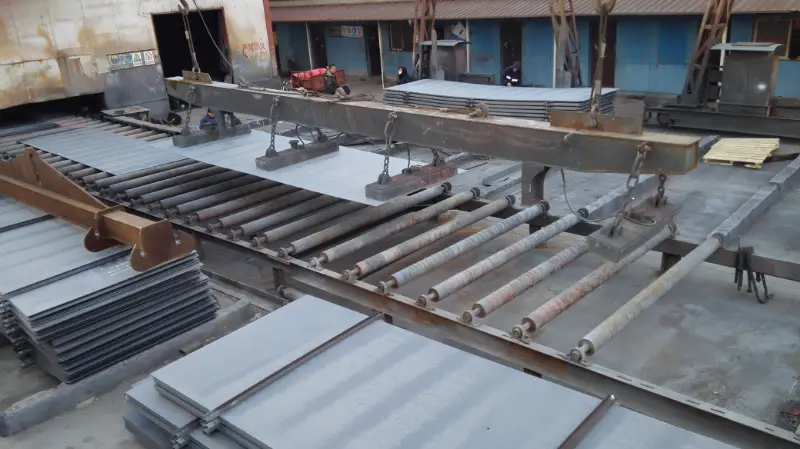
EN 10028-3 P355NL2
EN 10028-3 P355NL2: High-Strength Normalized Steel for Low-Temperature Pressure Vessels
P355NL2 is a European standard normalized fine grain steel for pressure vessels with guaranteed impact properties down to -50°C. Ideal for boilers, storage tanks, and chemical plants.
Welding, cold forming, hot forming, machining, cutting
- Phone : +8618037372205
- Email : [email protected]
- WhatsApp: Contact via Whtsapp
- WeChat: +8618037372205
EN 10028-3 P355NL2 Introduction
P355NL2 is a weldable fine grain structural steel grade according to EN 10028-3, intended for pressure vessels and boilers. It is delivered in the normalized condition to achieve a homogeneous fine-grained microstructure. The steel offers high yield strength (min. 355 MPa for thickness ≤16 mm), good tensile strength (490–630 MPa), and excellent low-temperature toughness with a minimum impact energy of 27 J at -50°C (transverse). Its controlled sulphur and phosphorus contents ensure superior cleanliness and resistance to brittle fracture.
- Designed for applications requiring high safety under pressure and cryogenic service.
- Can be fabricated by welding, forming, and machining.
- Complies with Pressure Equipment Directive (PED) and has international equivalents.
EN 10028-3 P355NL2 Chemical Composition
Limits according to EN 10028-3:2017. Elements not listed shall not be intentionally added without the purchaser's agreement. Fine grain practice requires Al content and controlled microalloying (Nb, V, Ti).
- CEV (carbon equivalent) shall not exceed 0.43% typically for thicknesses up to 250 mm.
- The sum of Nb+V+Ti is restricted to ≤0.12% for fine grain stabilization.
| Element | Standard Value (max %) | Remarks |
|---|---|---|
| Carbon (C) | 0.18 | Heat analysis |
| Silicon (Si) | 0.50 | Heat analysis |
| Manganese (Mn) | 1.10 - 1.70 | Heat analysis |
| Phosphorus (P) | 0.025 | Heat analysis |
| Sulfur (S) | 0.010 | Heat analysis |
| Aluminium total (Al) | ≥0.020 | Indicates fine grain treatment |
| Nitrogen (N) | 0.012 | Heat analysis |
| Niobium (Nb) | 0.05 | May be present as grain refiner |
| Vanadium (V) | 0.10 | May be present as grain refiner |
| Titanium (Ti) | 0.03 | May be present as grain refiner |
| Chromium (Cr) | 0.30 | Residual element |
| Copper (Cu) | 0.30 | Residual element |
| Molybdenum (Mo) | 0.08 | Residual element |
| Nickel (Ni) | 0.50 | Residual element |
| Nb+V+Ti | 0.12 | Sum for fine grain steels |
| CEV | Typically ≤0.43 | Carbon equivalent: C+Mn/6+(Cr+Mo+V)/5+(Ni+Cu)/15 |
EN 10028-3 P355NL2 Thermal and Electrical Physical Properties
These values are indicative for normalized P355NL2 at room temperature and may vary slightly depending on exact composition and processing. They are not specified in EN 10028-3 but are derived from general engineering data for similar low-alloy steels.
- Thermal properties change with temperature; values given for 20 °C / 100 °C where relevant.
- The steel is ferromagnetic.
| Property | Typical Value | Unit | Test Condition / Remarks |
|---|---|---|---|
| Density (ρ) | 7.85 | g/cm³ | At 20 °C |
| Modulus of Elasticity (E) | 210 | GPa | At 20 °C |
| Shear Modulus (G) | 81 | GPa | At 20 °C |
| Poisson's Ratio (ν) | 0.30 | – | At 20 °C |
| Thermal Expansion Coeff. (α) | 11.1 × 10⁻⁶ | /K | 20 – 100 °C |
| Thermal Expansion Coeff. (α) | 12.1 × 10⁻⁶ | /K | 20 – 200 °C |
| Thermal Conductivity (λ) | 50 | W/(m·K) | At 20 °C |
| Thermal Conductivity (λ) | 45 | W/(m·K) | At 200 °C |
| Specific Heat Capacity | 460 | J/(kg·K) | At 20 °C |
| Electrical Resistivity (ρₑ) | 0.22 – 0.30 | µΩ·m | At 20 °C |
EN 10028-3 P355NL2 Mechanical Properties
Requirements according to EN 10028-3. Testing performed at room temperature unless specified. Impact tests are conducted on Charpy-V notch specimens (transverse) at -50 °C.
- Yield strength and tensile strength are influenced by plate thickness.
- Bending test shall not reveal cracks (mandrel diameter dependent on thickness).
| Property | Required Value | Unit | Test Condition / Remarks |
|---|---|---|---|
| Yield Strength (ReH) | ≥355 | MPa | Thickness ≤16 mm |
| Yield Strength (ReH) | ≥345 | MPa | 16 < t ≤ 40 mm |
| Yield Strength (ReH) | ≥335 | MPa | 40 < t ≤ 60 mm |
| Yield Strength (ReH) | ≥315 | MPa | 60 < t ≤ 100 mm |
| Yield Strength (ReH) | ≥295 | MPa | 100 < t ≤ 150 mm |
| Yield Strength (ReH) | ≥275 | MPa | 150 < t ≤ 250 mm |
| Tensile Strength (Rm) | 490 – 630 | MPa | t ≤ 60 mm |
| Tensile Strength (Rm) | 470 – 610 | MPa | 60 < t ≤ 100 mm |
| Tensile Strength (Rm) | 460 – 600 | MPa | 100 < t ≤ 150 mm |
| Tensile Strength (Rm) | 450 – 590 | MPa | 150 < t ≤ 250 mm |
| Elongation (A) | ≥22 | % | t ≤ 60 mm, L0 = 5.65√So |
| Elongation (A) | ≥21 | % | 60 < t ≤ 250 mm, L0 = 5.65√So |
| Impact Energy (KV2) | ≥27 | J | Transverse, -50 °C, t ≤ 60 mm |
| Impact Energy (KV2) | ≥27 | J | Transverse, -50 °C, 60 < t ≤ 100 mm |
| Impact Energy (KV2) | ≥27 | J | Transverse, -50 °C, 100 < t ≤ 150 mm |
| Bend Test (Mandrel Ø = 2t) | No cracks | – | 180° bending, t ≤ 16 mm |
| Bend Test (Mandrel Ø = 3t) | No cracks | – | 180° bending, 16 < t ≤ 100 mm |
| Bend Test (Mandrel Ø = 4t) | No cracks | – | 180° bending, t > 100 mm |
EN 10028-3 P355NL2 Full Equivalent Material Standards and Substitute Grades
| Country/Region | Standard | Grade | Remarks |
|---|---|---|---|
| European Union | EN 10028-3:2017 | P355NL2 | Original specification, normalised |
| Germany | DIN EN 10028-3 | P355NL2 | Identical adoption |
| International | ISO 9328-3 | P355NL2 | Pressure vessel steel plates, normalised |
| France | NF EN 10028-3 | P355NL2 | French adoption of EN standard |
| UK | BS EN 10028-3 | P355NL2 | British adoption |
EN 10028-3 P355NL2 Application Introduction
P355NL2 is engineered for demanding pressure equipment operating at low ambient or process temperatures. Its combination of high strength, excellent notch toughness at -50 °C, and good weldability makes it suitable for a wide range of applications in the energy, chemical, and cryogenic industries.
- Typical manufacturing routes: cold forming, hot forming, cutting, welding (SMAW, SAW, GMAW), and subsequent normalizing if required.
- Post-weld heat treatment (PWHT): may be applied to relieve stresses, depending on code requirements and thickness.
Product Applications: Pressure vessels (horizontal/vertical tower, reactor), Boilers and steam drums, Heat exchangers (shell-and-tube, plate), Storage tanks for liquified gases (cryogenic service), Spheres and bullets for LPG, Piping systems and manifolds for low-temperature fluids, Wind turbine towers (in cold climates, where notch toughness is required)
Processed into products: Shell rings and heads, Nozzle and manway forgings (from cut plate), Flanges and blind flanges, Tube sheets and baffles, Stiffening rings and support skirts, Welding neck flanges (machined from plate), Cryogenic valve bodies, Compensator / expansion joints
Application industries: Oil and gas (onshore/offshore), Chemical and petrochemical processing, Cryogenic storage (LNG, LPG, ammonia), Power generation (conventional and nuclear), Industrial gas supply, Shipbuilding (liquefied gas carriers), Pharmaceutical and food processing (autoclaves)
EN 10028-3 P355NL2 Similar / Alternative Materials
| Country/Region | Standard | Grade | Remarks |
|---|---|---|---|
| European Union | EN 10028-3 | P355NL1 | Impact test at -40 °C; lower toughness requirement |
| European Union | EN 10028-3 | P355NH | Basic grade, impact at -20 °C; less stringent low-temperature performance |
| European Union | EN 10028-3 | P355M | Thermomechanically rolled, may have different delivery condition |
| USA | ASTM A537 / A537M | Class 2 (A537 CL2) | Normalized, comparable strength but different chemistry; verify impact temperature |
| USA | ASME SA-537 | Class 2 | ASME Boiler & Pressure Vessel Code Sect. II, similar but not identical to P355NL2 |
| China | GB 3531 | 16MnDR | Normalized low-temperature pressure vessel plate, min. impact temp -40 °C; often used as alternative but requires engineering review |
| Japan | JIS G 3126 | SPV355 | Carbon steel for pressure vessels, not specifically low-temperature; may be normalized, impact values differ |
Notes:
Additional Information:
- P355NL2 is suitable for moderate temperatures up to approx. 400 °C; for sustained elevated-temperature service, creep-resistant grades may be required.
- Thickness ranges for normalized condition typically 5 – 250 mm; consult manufacturer for larger dimensions.
- Ultrasonic testing (EN 10160 class S2/E2) and specific HIC/SSC testing can be specified for sour service.
- The 'L2' designation mandates minimum impact energy of 27 J at -50 °C in transverse direction for all thickness categories.
- When welding, suitable consumables (E7018-1, ER70S-6 etc.) must be used and preheating may be necessary depending on thickness and carbon equivalent.
- This steel is subject to the Pressure Equipment Directive (PED) 2014/68/EU and can be supplied with EN 10204 3.1 or 3.2 certification.
- Share



