
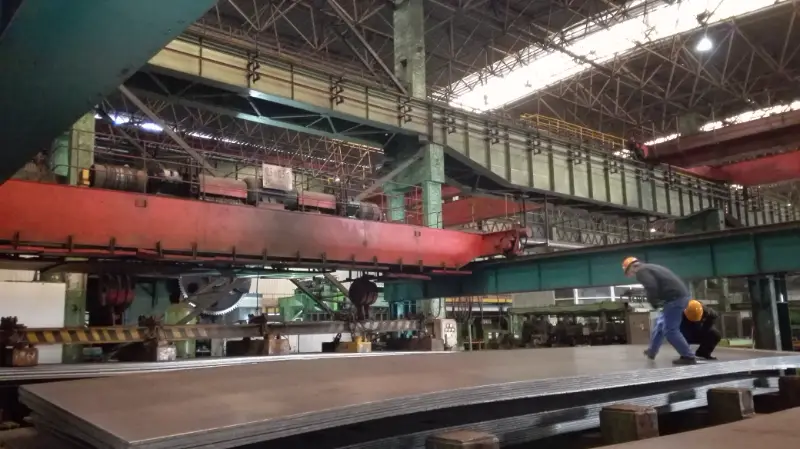
EN 10028-3 P355NL1 Pressure Vessel & Boiler Steel
EN 10028-3 P355NL1 Pressure Vessel & Boiler Steel - Normalized Fine Grain Low-Temperature Plate
Detailed data sheet for EN 10028-3 P355NL1 steel plate: chemical composition, mechanical and physical properties, international equivalents, and application guidance for low-temperature pressure vessels and boilers.
Normalizing (+N), welding (all common processes), hot forming, cold forming (with caution), cutting (flame, plasma, laser), machining
- Phone : +8618037372205
- Email : [email protected]
- WhatsApp: Contact via Whtsapp
- WeChat: +8618037372205
EN 10028-3 P355NL1 Pressure Vessel & Boiler Steel Introduction
EN 10028-3 P355NL1 is a normalized fine-grain structural steel specifically designed for pressure purposes and low-temperature service. It is covered by the European standard EN 10028-3, which specifies requirements for weldable fine grain steels for pressure vessels. P355NL1 provides a minimum yield strength of 355 MPa at room temperature and excellent notch toughness down to -50 °C. Its fine-grained microstructure, obtained through controlled rolling and normalizing, ensures superior weldability and resistance to brittle fracture. This makes the material ideal for fabricating storage tanks, boilers, heat exchangers, and process equipment operating in the chemical, petrochemical, and energy sectors. The steel is delivered in the normalized condition (+N), meeting strict safety and reliability criteria for pressure-bearing applications.
EN 10028-3 P355NL1 Pressure Vessel & Boiler Steel Chemical Composition
Typical heat analysis limits according to EN 10028-3:2017 for grade P355NL1 with product thickness ≤ 40 mm. Elements are given as maximum values unless a range is shown. The fine grain practice is ensured by a sufficient aluminum/nitrogen ratio and/or microalloying elements (Nb, Ti, V). Total content of Nb+Ti+V shall not exceed 0.12%.
| Element | Standard Requirement | Remarks |
|---|---|---|
| Carbon (C) | ≤ 0.18 | Low carbon ensures good weldability |
| Silicon (Si) | ≤ 0.50 | Deoxidizer; higher values may increase strength |
| Manganese (Mn) | 1.10 – 1.70 | Primary strengthening element |
| Phosphorus (P) | ≤ 0.020 | Controlled for toughness |
| Sulfur (S) | ≤ 0.010 | Low S for improved cleanliness and through-thickness properties |
| Aluminium total (Alt) | ≥ 0.020 | Grain refining element; ensures fine grain |
| Nitrogen (N) | ≤ 0.012 | Bound by Al and microalloys |
| Chromium (Cr) | ≤ 0.30 | Residual element |
| Copper (Cu) | ≤ 0.30 | Residual element |
| Molybdenum (Mo) | ≤ 0.08 | Residual element |
| Niobium (Nb) | ≤ 0.05 | Microalloy for grain refinement |
| Nickel (Ni) | ≤ 0.50 | Improves low-temperature toughness |
| Titanium (Ti) | ≤ 0.03 | Microalloy for grain refinement and N fixation |
| Vanadium (V) | ≤ 0.10 | Microalloy; limited to avoid reduced toughness |
| Nb + Ti + V | ≤ 0.12 | Sum of microalloying elements |
| Cr + Cu + Mo | ≤ 0.45 | Informative; not required by standard but often controlled |
EN 10028-3 P355NL1 Pressure Vessel & Boiler Steel Physical Properties
The following physical properties are representative of normalized P355NL1 steel and are not mandatory requirements of the standard. Values are suitable for design calculations (e.g., thermal stress, heat transfer). Density, elastic modulus, and thermal expansion coefficients are typical for low-carbon Mn-Si fine grain steels.
| Property | Typical Value | Unit | Test Condition / Remarks |
|---|---|---|---|
| Density (ρ) | 7.85 | g/cm³ | at 20 °C |
| Young's modulus (E) | 210 | GPa | at 20 °C, static |
| Shear modulus (G) | 80 | GPa | calculated from E and ν |
| Poisson's ratio (ν) | 0.3 | – | at 20 °C |
| Coefficient of thermal expansion (α) | 11.1 | 10⁻⁶/K | 20 – 100 °C |
| Coefficient of thermal expansion (α) | 11.9 | 10⁻⁶/K | 20 – 200 °C |
| Coefficient of thermal expansion (α) | 12.6 | 10⁻⁶/K | 20 – 300 °C |
| Coefficient of thermal expansion (α) | 13.3 | 10⁻⁶/K | 20 – 400 °C |
| Thermal conductivity (λ) | 52 | W/(m·K) | at 20 °C |
| Thermal conductivity (λ) | 49 | W/(m·K) | at 100 °C |
| Thermal conductivity (λ) | 47 | W/(m·K) | at 200 °C |
| Thermal conductivity (λ) | 43 | W/(m·K) | at 300 °C |
| Specific heat capacity (cp) | 460 | J/(kg·K) | at 20 °C |
| Electrical resistivity (ρe) | 0.22 | μΩ·m | at 20 °C |
EN 10028-3 P355NL1 Pressure Vessel & Boiler Steel Mechanical Properties
Mechanical properties as specified in EN 10028-3:2017 for normalized P355NL1 plates. Values depend on product thickness. The yield strength (ReH) and tensile strength (Rm) are minimum and range requirements. The elongation (A) is based on proportional test pieces (L0 = 5.65√S0). Charpy V-notch impact energy (KV2) is tested at -50 °C and must meet the minimum average value (min. individual value ≥ 70% of average). Bend test specimens are examined after 180° bending.
| Property | Standard Requirement | Unit | Test Condition / Thickness Range |
|---|---|---|---|
| Yield strength (ReH) | 355 | MPa | t ≤ 16 mm, transverse |
| Yield strength (ReH) | 345 | MPa | 16 < t ≤ 40 mm, transverse |
| Yield strength (ReH) | 335 | MPa | 40 < t ≤ 60 mm, transverse |
| Yield strength (ReH) | 315 | MPa | 60 < t ≤ 100 mm, transverse |
| Yield strength (ReH) | 295 | MPa | 100 < t ≤ 150 mm, transverse |
| Tensile strength (Rm) | 490 – 630 | MPa | t ≤ 60 mm, transverse |
| Tensile strength (Rm) | 480 – 630 | MPa | 60 < t ≤ 100 mm, transverse |
| Tensile strength (Rm) | 470 – 620 | MPa | 100 < t ≤ 150 mm, transverse |
| Elongation (A) | ≥ 22 | % | t ≤ 60 mm, transverse, L0=5.65√S0 |
| Elongation (A) | ≥ 21 | % | 60 < t ≤ 150 mm, transverse |
| Bend test (bending angle 180°) | No cracks | – | t ≤ 12.5 mm, mandrel diameter = 1×t |
| Bend test (bending angle 180°) | No cracks | – | 12.5 < t ≤ 25 mm, mandrel diameter = 2×t |
| Bend test (bending angle 180°) | No cracks | – | 25 < t ≤ 40 mm, mandrel diameter = 2×t |
| Bend test (bending angle 180°) | No cracks | – | 40 < t ≤ 60 mm, mandrel diameter = 3×t |
| Bend test (bending angle 180°) | No cracks | – | 60 < t ≤ 150 mm, mandrel diameter = 3×t |
| Impact energy (KV2) | ≥ 27 | J | at -50 °C, transverse, average of 3 tests |
| Impact energy (KV2) individual min. | ≥ 20 | J | at -50 °C, transverse |
EN 10028-3 P355NL1 Pressure Vessel & Boiler Steel Fully Equivalent Standards and Grades
| Country / Region | Standard | Grade | Remarks |
|---|---|---|---|
| Europe | EN 10028-3 | P355NL1 | Original European standard; normalized fine grain steel for pressure purposes |
| Germany | DIN EN 10028-3 | P355NL1 | Adopted as DIN standard, identical requirements |
| France | NF EN 10028-3 | P355NL1 | Adopted as NF standard |
| United Kingdom | BS EN 10028-3 | P355NL1 | Adopted as British standard |
| Italy | UNI EN 10028-3 | P355NL1 | Adopted as UNI standard |
| Spain | UNE EN 10028-3 | P355NL1 | Adopted as UNE standard |
| International | ISO 9328-2 | P355NL1 | ISO standard for pressure vessel steels, equivalent grade |
| China (equivalent) | GB/T 713 | Q345R (with special low-temp agreement) | Q345R often comparable but requires supplementary low-temperature impact test and fine grain practice; not identical |
EN 10028-3 P355NL1 Pressure Vessel & Boiler Steel Application Introduction
EN 10028-3 P355NL1 is engineered for welded pressure equipment operating at temperatures as low as -50 °C. Its combination of high strength, excellent notch toughness, and reliable weldability makes it a preferred material in critical applications across the energy and process industries. The steel is typically supplied in normalized condition and can be easily formed, machined, and welded using standard procedures. Post-weld heat treatment (PWHT) may be required depending on thickness and service code; the steel's composition is designed to resist grain growth during PWHT.
Product Applications: Low-temperature Pressure Vessels, Industrial Boilers and Steam Drums, Heat Exchangers and Condensers, Spherical Storage Tanks for LPG and Ethylene, Cryogenic Storage Tanks (down to -50 °C), Chemical Reactors and Columns, LNG Process Equipment
Processed into products: Shells and shells courses (rolled and welded cylinders), Dished heads (hemispherical, ellipsoidal, torispherical) – hot or cold formed, Tube sheets and flanges for heat exchangers, Nozzles, manways, and reinforcement pads, Support skirts, saddles, and lifting lugs, Vessel internal parts (trays, baffles, demisters) – cut and welded, Piping and valve bodies in some pressure equipment assemblies
Application industries: Oil & Gas (onshore and offshore), Petrochemical and Chemical Processing, Power Generation (conventional and nuclear), Industrial Gas (LNG, LPG, ammonia) Storage and Transportation, Shipbuilding (cargo tanks for low-temperature substances), Pharmaceutical and Food Processing (when applicable codes permit)
EN 10028-3 P355NL1 Pressure Vessel & Boiler Steel Similar / Approximate Substitute Materials
| Country / Region | Standard | Grade | Remarks |
|---|---|---|---|
| USA | ASTM A537/A537M | Class 1 | Normalized C-Mn-Si steel; yield 345 MPa min, tensile 485–620 MPa, impact at -45 °C typical. Lower design temperature than P355NL1 (-50 °C) but often used with additional impact requirements. |
| USA | ASTM A516/A516M | Grade 70 | General pressure vessel steel, not specifically fine grain. Yield 260 MPa min (thickness dependent), impact at -46 °C achievable. Lower strength and less defined low-temperature behavior; requires caution for -50 °C service. |
| Japan | JIS G3126 | SLA360 | Low-temperature service carbon steel plate for pressure vessels. Yield 355 MPa min (t ≤ 25 mm), tensile 520–640 MPa, impact at -60 °C. Very close in strength and toughness, but check exact thickness range. |
| China | GB/T 713 | Q345R (normalized + fine grain) | When ordered with fine grain requirement and impact at -50 °C, it can be a feasible substitute. Requires full chemical and mechanical verification against P355NL1. |
Notes:
Welding procedures must be qualified for low-temperature toughness (e.g., using basic electrodes or solid wire with low hydrogen). Preheat and interpass temperature control may be necessary depending on thickness. Post-weld heat treatment (PWHT) is typically performed at 580–620 °C, with time dependent on thickness. The steel is not intended for sour service (H₂S) unless specifically tested and qualified. When ordering, the normalized condition (+N) must be specified, and any supplementary impact or through-thickness (Z-quality) requirements should be clearly stated.
- Share



