
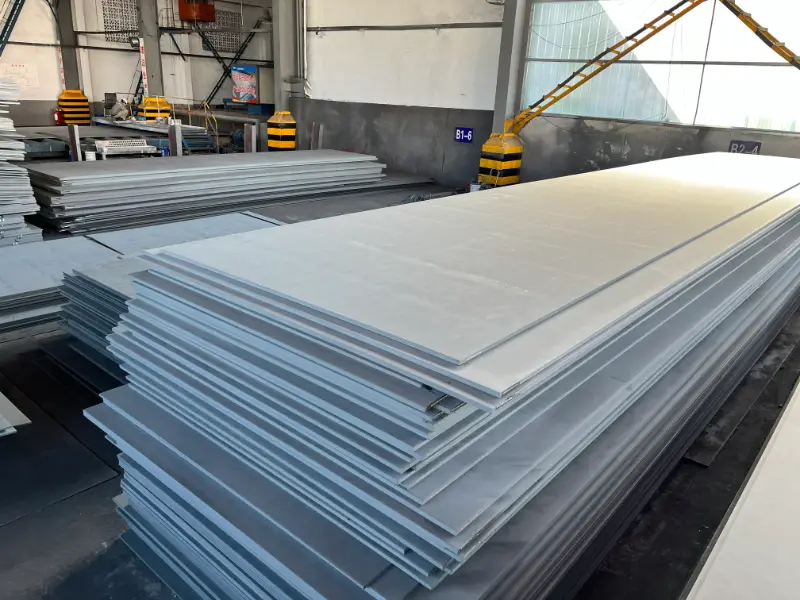
P355NH Pressure Vessel Steel
P355NH Pressure Vessel Steel | EN 10028-3 Grade P355NH Data & Equivalents
Detailed material properties of P355NH steel plate per EN 10028-3: chemical composition, mechanical properties, thermal and electrical characteristics, international equivalents, and application guidance.
Cutting, bending, welding, machining, forming
- Phone : +8618037372205
- Email : [email protected]
- WhatsApp: Contact via Whtsapp
- WeChat: +8618037372205
P355NH Pressure Vessel Steel Introduction
EN10028-3 P355NH is a weldable fine-grain normalized steel designed for elevated-temperature service in pressure vessels and boilers. The designation indicates a minimum yield strength of 355 MPa in thicknesses up to 16 mm, a normalized delivery condition, and guaranteed high-temperature properties. The steel offers excellent toughness, good formability, and reliable performance under cyclic thermal and mechanical loads. Its low carbon equivalent and controlled microalloying with niobium, vanadium, and titanium ensure consistent mechanical characteristics across a wide thickness range.
- Good weldability with standard processes
- High resistance to brittle fracture down to -20 °C
- Proven long-term creep strength for boiler and pressure equipment
P355NH Pressure Vessel Steel Chemical Composition
Ladle analysis according to EN 10028-3:2017. The steel is fully killed and contains fine-grain forming elements (Al, Nb, V, Ti). The carbon equivalent (CEV) limit ensures good weldability. Residual elements are controlled to maintain toughness and hot-workability.
| Element | Value (%) | Remarks |
|---|---|---|
| Carbon (C) | ≤0.18 | |
| Silicon (Si) | ≤0.50 | |
| Manganese (Mn) | 1.10 – 1.70 | |
| Phosphorus (P) | ≤0.025 | |
| Sulfur (S) | ≤0.015 | |
| Aluminium (Altot) | ≥0.020 | |
| Nitrogen (N) | ≤0.012 | |
| Niobium (Nb) | ≤0.05 | |
| Vanadium (V) | ≤0.10 | |
| Titanium (Ti) | ≤0.03 | |
| Chromium (Cr) | ≤0.30 | |
| Nickel (Ni) | ≤0.50 | |
| Molybdenum (Mo) | ≤0.08 | |
| Copper (Cu) | ≤0.30 | |
| Nb+V+Ti | ≤0.12 | |
| Carbon Equivalent (CEV) | ≤0.43 | CEV = C+Mn/6+(Cr+Mo+V)/5+(Ni+Cu)/15 |
P355NH Pressure Vessel Steel Thermal and Electrical Physical Properties
The values below are typical for medium-carbon fine-grain structural steels and are provided as engineering guidance. They are not mandatory requirements of EN 10028-3 but are widely accepted for design calculations and simulations.
| Property | Typical Value | Unit | Test Condition |
|---|---|---|---|
| Density (ρ) | ≈ 7.85 | g/cm³ | at 20 °C |
| Elastic modulus (E) | ≈ 205 | GPa | at 20 °C |
| Shear modulus (G) | ≈ 80 | GPa | at 20 °C |
| Poisson's ratio (ν) | ≈ 0.30 | – | at 20 °C |
| Thermal expansion (α) | 11.1 | 10⁻⁶ /K | 20 – 100 °C |
| Thermal expansion (α) | 12.1 | 10⁻⁶ /K | 20 – 200 °C |
| Thermal expansion (α) | 12.9 | 10⁻⁶ /K | 20 – 300 °C |
| Thermal expansion (α) | 13.5 | 10⁻⁶ /K | 20 – 400 °C |
| Thermal expansion (α) | 13.9 | 10⁻⁶ /K | 20 – 500 °C |
| Thermal conductivity (λ) | 42 | W/(m·K) | at 20 °C |
| Thermal conductivity (λ) | 43 | W/(m·K) | at 100 °C |
| Thermal conductivity (λ) | 42 | W/(m·K) | at 200 °C |
| Thermal conductivity (λ) | 40 | W/(m·K) | at 300 °C |
| Thermal conductivity (λ) | 38 | W/(m·K) | at 400 °C |
| Thermal conductivity (λ) | 35 | W/(m·K) | at 500 °C |
| Specific heat capacity | 460 | J/(kg·K) | at 20 °C |
| Specific heat capacity | 480 | J/(kg·K) | at 100 °C |
| Specific heat capacity | 500 | J/(kg·K) | at 200 °C |
| Specific heat capacity | 520 | J/(kg·K) | at 300 °C |
| Specific heat capacity | 540 | J/(kg·K) | at 400 °C |
| Specific heat capacity | 570 | J/(kg·K) | at 500 °C |
| Electrical resistivity (ρe) | ≈ 0.22 | µΩ·m | at 20 °C |
P355NH Pressure Vessel Steel Mechanical Properties
Mechanical properties at room temperature for normalized delivery condition. Requirements according to EN 10028-3:2017. Impact values are based on transverse Charpy V-notch specimens. The bending test ensures adequate ductility. Thickness-dependent values are given for the most commonly used product ranges.
| Property | Minimum / Range | Unit | Test Condition |
|---|---|---|---|
| Yield strength (ReH) | ≥355 | MPa | t ≤ 16 mm |
| Yield strength (ReH) | ≥345 | MPa | 16 < t ≤ 40 mm |
| Yield strength (ReH) | ≥335 | MPa | 40 < t ≤ 60 mm |
| Yield strength (ReH) | ≥315 | MPa | 60 < t ≤ 100 mm |
| Yield strength (ReH) | ≥295 | MPa | 100 < t ≤ 150 mm |
| Yield strength (ReH) | ≥280 | MPa | 150 < t ≤ 250 mm |
| Tensile strength (Rm) | 490 – 630 | MPa | t ≤ 40 mm |
| Tensile strength (Rm) | 490 – 630 | MPa | 40 < t ≤ 60 mm |
| Tensile strength (Rm) | 470 – 610 | MPa | 60 < t ≤ 100 mm |
| Tensile strength (Rm) | 460 – 600 | MPa | 100 < t ≤ 150 mm |
| Tensile strength (Rm) | 450 – 590 | MPa | 150 < t ≤ 250 mm |
| Elongation (A) | ≥22 | % | t ≤ 60 mm, longitudinal |
| Elongation (A) | ≥21 | % | 60 < t ≤ 250 mm, longitudinal |
| Charpy impact (KV) | ≥40 | J | -20 °C, transverse, min. average of 3 specimens |
| Bend test (mandrel diameter) | 2t | – | 180° bend, t ≤ 20 mm |
| Bend test (mandrel diameter) | 3t | – | 180° bend, 20 < t ≤ 50 mm |
P355NH Pressure Vessel Steel Identical Material Standards and Substitutable Grades
| Country/Region | Standard | Grade | Remarks |
|---|---|---|---|
| European Union | EN 10028-3 | P355NH | Original standard |
| Germany | DIN EN 10028-3 | P355NH | National adoption, identical requirements |
| United Kingdom | BS EN 10028-3 | P355NH | National adoption, identical requirements |
| France | NF EN 10028-3 | P355NH | National adoption, identical requirements |
| Italy | UNI EN 10028-3 | P355NH | National adoption, identical requirements |
| Spain | UNE EN 10028-3 | P355NH | National adoption, identical requirements |
| International | ISO 9328-2 | P355NH | Technically equivalent to EN 10028-3 |
P355NH Pressure Vessel Steel Application Introduction
P355NH is the material of choice for welded pressure vessels and boilers operating at moderate to high temperatures. Its balanced composition delivers excellent weldability, reliable toughness, and guaranteed minimum strength at elevated temperatures up to ~400 °C. Typical uses include:
Product Applications: Pressure vessels (ASME, EN codes), Heat exchangers, Storage tanks, Boiler drums, Reactor shells, Industrial autoclaves, Separation columns
Processed into products: Shell plates (cylindrical and spherical), Heads (elliptical, hemispherical, torispherical), Flanges, Tube sheets, Manholes and nozzles, Stiffening rings, Support structures for high-temperature service
Application industries: Oil & Gas, Chemical Processing, Power Generation, Petrochemical, Boiler and Pressure Vessel Manufacturing, Pharmaceutical Industry, Food Processing (large storage vessels)
P355NH Pressure Vessel Steel Similar / Substitute Material Recommendations
| Country/Region | Standard | Grade | Remarks |
|---|---|---|---|
| USA | ASTM A537 / ASME SA537 | Class 1 (normalized) | Similar strength and high-temperature properties; verify thickness and impact requirements |
| Japan | JIS G3115 | SPV355N | Comparable yield strength and weldability; check low-temperature toughness |
| China | GB/T 713 | Q345R (normalized) | Close match after normalizing; slight differences in Mn and microalloy content; review allowable stress |
| South Korea | KS D3521 | SPV355N | Essentially equivalent to JIS SPV355N; comparable to P355NH |
| Russia | GOST 5520 | 09G2S (with normalizing) | Approximate strength and composition; verify toughness at low temperature |
Notes:
Additional remarks:
- The carbon equivalent (CEV) ≤0.43 guarantees good field weldability with conventional methods (SMAW, SAW, GMAW, FCAW).
- For thicknesses above 40 mm, supplementary impact testing may be agreed upon.
- Post-weld heat treatment (PWHT) is normally not required for small thicknesses, but should follow design codes (e.g., EN 13445) for thicker sections.
- The steel conforms to EN 10028-5 for elevated-temperature properties; long-term creep data is available for design at temperatures up to 500 °C.
- Ultrasonic testing (UT) to EN 10160 is frequently specified for critical components.
- Share



