
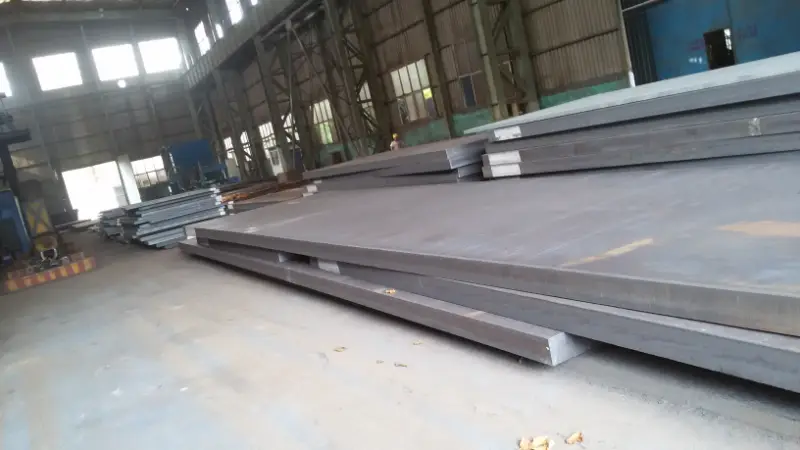
ASTM A662 Grade A (A662GR A) Pressure Vessel Steel Plate
ASTM A662 Grade A (A662GR A) Pressure Vessel Steel Plate - Low-Temperature Carbon-Manganese-Silicon Steel
ASTM A662 Grade A is a carbon-manganese-silicon steel plate intended for welded pressure vessels and boilers at moderate and lower temperatures. This normalized steel offers excellent notch toughness and weldability, suitable for storage tanks, process columns, and reactors.
Hot rolling, normalizing, welding, cold forming, cutting, machining
- Phone : +8618037372205
- Email : [email protected]
- WhatsApp: Contact via Whtsapp
- WeChat: +8618037372205
ASTM A662 Grade A Pressure Vessel Steel Plate Introduction
ASTM A662 Grade A is a normalized carbon-manganese-silicon steel plate designed for moderate and low-temperature pressure vessel applications. It exhibits good strength and excellent notch toughness down to temperatures depending on design requirements. The steel is typically supplied in the normalized condition, ensuring uniform fine-grain structure and enhanced mechanical properties. With controlled carbon content (max 0.14%) and a manganese range of 0.90-1.35%, it provides a balance of strength and ductility while maintaining weldability. Its ability to perform at low temperatures makes it a preferred choice for liquefied gas storage and chemical processing equipment.
- Low carbon content for improved weldability and toughness
- Normalized delivery condition ensures consistent properties
- Suitable for welded pressure vessels and boilers
ASTM A662 Grade A Pressure Vessel Steel Plate Chemical Composition
The chemical composition of ASTM A662 Grade A is carefully controlled to achieve low-temperature toughness and weldability. The limits are based on the ASTM A662/A662M standard for plates up to 50 mm (2 in.) thickness. Phosphorus and sulfur are kept low to enhance ductility and notch toughness. Silicon is added for deoxidation and strength, while manganese contributes to hardenability and fine grain formation.
| Element | Content (%) | Remarks |
|---|---|---|
| Carbon (C) | 0.14 max | Heat analysis; product analysis may vary as per standard |
| Manganese (Mn) | 0.90 - 1.35 | For plates ≤ 2 in. (50 mm); may be adjusted for thicker plates |
| Phosphorus (P) | 0.025 max | Ensures good ductility and weldability |
| Sulfur (S) | 0.025 max | Low sulfur improves toughness and resistance to lamellar tearing |
| Silicon (Si) | 0.15 - 0.40 | Added as deoxidizer and strengthener; for plates > 1.5 in. (40 mm), range may be 0.15-0.50 |
ASTM A662 Grade A Pressure Vessel Steel Plate Physical and Electrical Properties
The following properties are typical for normalized carbon-manganese-silicon steels similar to ASTM A662 Grade A. These values are based on room-temperature measurements unless otherwise noted and may vary slightly depending on exact chemistry and heat treatment. They are suitable for engineering design calculations (thermal expansion, heat transfer, stress analysis).
| Property | Value | Unit | Conditions |
|---|---|---|---|
| Density (ρ) | 7.85 | g/cm³ | 20 °C |
| Modulus of Elasticity (E) | 205 | GPa | Ambient temperature |
| Shear Modulus (G) | 80 | GPa | Calculated from E and ν |
| Poisson's Ratio (ν) | 0.29 | dimensionless | Typical for carbon steels |
| Thermal Expansion Coefficient (α) | 11.7 | 10⁻⁶/K | 20 - 100 °C |
| Thermal Conductivity (λ) | 52 | W/(m·K) | 20 °C |
| Specific Heat Capacity (c) | 460 | J/(kg·K) | 20 °C |
| Electrical Resistivity (ρₑ) | 0.15 | µΩ·m | 20 °C |
ASTM A662 Grade A Pressure Vessel Steel Plate Mechanical Properties
The tensile properties are determined in accordance with ASTM A370 and the requirements of ASTM A20/A20M. The minimum yield strength and tensile strength ranges are guaranteed for thicknesses up to 50 mm. Elongation is measured on a 2 in. (50 mm) gauge length. Charpy V-notch impact test requirements (if specified in the purchase order per Supplementary Requirement S5) are typically verified at the design low temperature (commonly -45 °C) with minimum absorbed energy values.
| Property | Value | Unit | Test condition / Remarks |
|---|---|---|---|
| Yield Strength (ReH) | 275 min | MPa | 0.2% offset, transverse specimen, normalized |
| Tensile Strength (Rm) | 400 - 540 | MPa | Transverse specimen, normalized |
| Elongation (A) | 23 min | % | 2 in. (50 mm) gauge length, thickness ≤ 2 in. (50 mm) |
ASTM A662 Grade A Pressure Vessel Steel Plate Exact Equivalent Material Standards and Substitutable Grades
| Country / Region | Standard | Grade / Designation | Remarks |
|---|---|---|---|
| USA | ASME SA662 / SA662M | SA662 Grade A | Identical to ASTM A662 Grade A; approved for ASME pressure vessel construction |
| European Union | EN 10028-3 | P275N (1.0486) | Similar normalized fine-grain steel, though tensile strength range is slightly lower (390–510 MPa); C ≤ 0.18, Mn 0.50–1.50; often interchangeable |
| China | GB/T 713 | Q345R | Higher strength, but comparable low-temperature applications when toughness requirements are met; verify chemical limits |
| International | ISO 9328-2 | P275NH | Normalized pressure vessel steel, yield 275 MPa, tensile 390–570 MPa; chemical composition differs; can substitute after design review |
ASTM A662 Grade A Pressure Vessel Steel Plate Application Introduction
ASTM A662 Grade A is primarily employed in the fabrication of welded pressure vessels and boilers where moderate strength and reliable low-temperature toughness are required. The normalized condition ensures consistent properties suitable for critical service. The steel is readily weldable by conventional methods and can be cold formed. Industries: oil & gas, petrochemical, chemical processing, power generation, and cryogenic storage. Typical products: cylindrical storage tanks, bullet tanks, gas cylinders, separation columns, reactor shells, and boiler drums. Components: shell plates, heads (hemispherical, elliptical), tube sheets, flanges, nozzles, and reinforcement pads.
Product Applications: Liquefied petroleum gas (LPG) storage tanks, Ammonia storage spheres and bullets, Low-temperature separation columns, Heat exchangers, Air separation unit columns, Boiler drums and steam accumulators
Processed into products: Shell plates and courses, Elliptical and hemispherical heads, Flanges and blind flanges, Nozzles and manway forgings (when forged from equivalent material), Tube sheets, Support saddles and rings, Reinforcement pads
Application industries: Oil and gas production and refining, Petrochemical plants, Chemical processing equipment, Power generation (boilers, steam drums), Cryogenic and refrigerated storage, Fertilizer and ammonia manufacturing
ASTM A662 Grade A Pressure Vessel Steel Plate Similar / Substitute Grades with Comparable Performance
| Country / Region | Standard | Grade / Designation | Remarks |
|---|---|---|---|
| USA | ASTM A516 / A516M | Grade 60 | Carbon-manganese-silicon steel for moderate and lower temperatures; yield min 220 MPa, tensile 415–550 MPa; lower strength but can be used with thickness adjustment; normalized condition |
| USA | ASTM A537 / A537M | Class 1 | Heat-treated carbon-manganese-silicon steel; higher strength (yield 310 MPa min), used for similar pressure vessels; may require toughness qualification |
| European Union | EN 10028-3 | P275NH | Normalized weldable fine-grain steel; yield 275 MPa, tensile 390–510 MPa; directly comparable for many pressure vessel applications |
| India | IS 2002 | Gr. 2 / A·2 | For boilers and pressure vessels; similar carbon-manganese steel, though exact equivalence must be verified |
Notes:
- When impact testing is required, it is normally conducted in accordance with ASTM A20 Supplementary Requirement S5 at the design minimum temperature. Typical absorbed energy requirements are 20 J (15 ft·lbf) average and 16 J (12 ft·lbf) minimum individual, but they must be specified by the purchaser.
- The steel is suitable for welding using standard processes (SMAW, SAW, GMAW, FCAW). Preheating and post-weld heat treatment (PWHT) may be required for thick sections to avoid cracking and to restore toughness.
- For service below -45°C, alternative grades with nickel (e.g., A353, A553) or 9% Ni steels are recommended.
- Ultrasonic testing and other non-destructive examinations are often specified by the purchaser to ensure internal soundness.
- Share



