
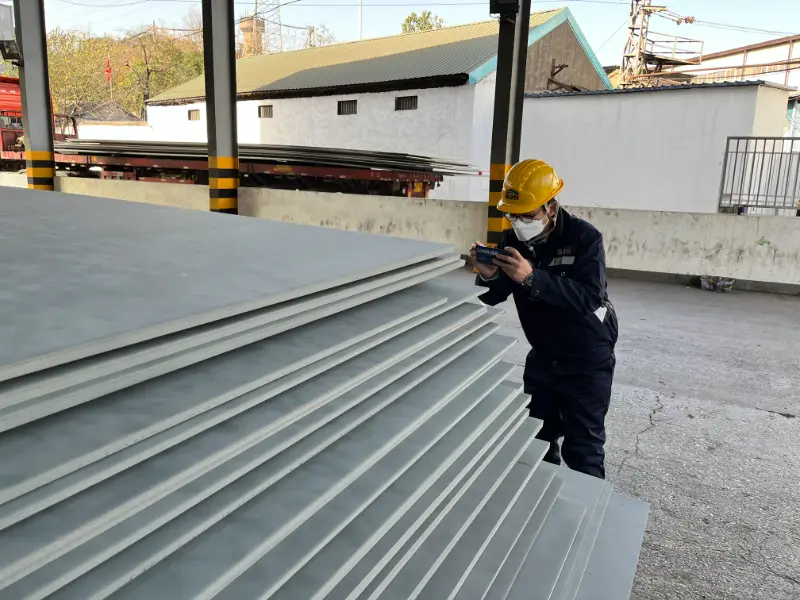
EN 10028-2 16Mo3 Pressure Vessel & Boiler Steel Plate
EN 10028-2 16Mo3 Pressure Vessel & Boiler Steel Plate - Composition, Properties & Equivalents
Comprehensive material data for EN 10028-2 16Mo3 steel plate: chemical composition, mechanical and physical properties, international equivalents, applications and processing guidelines.
Hot rolling, normalizing (+N), quenching and tempering (not typical), hot forming, cold forming (limited), welding (all common processes), machining, drilling, bending
- Phone : +8618037372205
- Email : [email protected]
- WhatsApp: Contact via Whtsapp
- WeChat: +8618037372205
EN 10028-2 16Mo3 Pressure Vessel & Boiler Steel Plate Introduction
16Mo3 is a chromium-molybdenum alloy steel defined in EN 10028-2 for flat products intended for pressure purposes at elevated temperatures. This normalized grade offers a balanced combination of strength, ductility, and weldability, with the molybdenum addition (0.25–0.35%) improving high-temperature strength and resistance to hydrogen attack. It is widely used in the fabrication of pressure vessels, boilers, and heat exchangers in the power generation, chemical, and oil & gas industries. The material is typically supplied in the normalized (+N) condition, ensuring uniform grain structure and consistent mechanical properties across thicknesses up to approximately 60 mm. With good formability and machinability, 16Mo3 is suitable for hot forming, welding, and bending, and it meets the strict requirements of the European Pressure Equipment Directive (PED). Internationally, it corresponds to grades like ASTM A204 Grade B and JIS G3103 SB450M, facilitating global procurement and engineering.
EN 10028-2 16Mo3 Pressure Vessel & Boiler Steel Plate Chemical Composition
The chemical composition of 16Mo3 is governed by EN 10028-2:2017. For thicknesses >25 mm, the carbon content may be increased up to 0.22% by agreement. The molybdenum content ensures elevated temperature strength and creep resistance. Residual elements are tightly controlled to maintain weldability and toughness.
| Element | Standard Value (wt%) | Remarks |
|---|---|---|
| Carbon (C) | 0.12 – 0.20 | For product thickness >25 mm, max. 0.22% by agreement |
| Silicon (Si) | ≤ 0.35 | |
| Manganese (Mn) | 0.40 – 0.90 | |
| Phosphorus (P) | ≤ 0.025 | |
| Sulfur (S) | ≤ 0.010 | |
| Chromium (Cr) | ≤ 0.30 | |
| Molybdenum (Mo) | 0.25 – 0.35 | Key element for high-temperature properties |
| Nickel (Ni) | ≤ 0.30 | |
| Copper (Cu) | ≤ 0.30 | |
| Niobium (Nb) | ≤ 0.01 | |
| Titanium (Ti) | ≤ 0.03 | |
| Vanadium (V) | ≤ 0.02 | |
| Nitrogen (N) | ≤ 0.012 |
EN 10028-2 16Mo3 Pressure Vessel & Boiler Steel Plate Thermal and Electrical Physical Properties
These physical properties are typical for 16Mo3 steel under normalized condition and are compiled from reliable published data. They are not mandatory requirements of EN 10028-2 but serve as practical engineering references. Minor variations may occur depending on exact composition and processing history.
| Property | Typical Value | Unit | Test Condition / Temperature |
|---|---|---|---|
| Density (ρ) | 7.85 | g/cm³ | at 20°C |
| Elastic Modulus (E) | 210 | GPa | at 20°C |
| Elastic Modulus (E) | 205 | GPa | at 100°C |
| Elastic Modulus (E) | 195 | GPa | at 200°C |
| Shear Modulus (G) | 81 | GPa | at 20°C (calculated) |
| Poisson's Ratio (ν) | 0.30 | – | at 20°C |
| Thermal Expansion Coefficient (α) | 12.5 | x10-6/K | 20–100°C |
| Thermal Expansion Coefficient (α) | 13.0 | x10-6/K | 20–200°C |
| Thermal Expansion Coefficient (α) | 13.5 | x10-6/K | 20–300°C |
| Thermal Conductivity (λ) | 44 | W/(m·K) | at 20°C |
| Thermal Conductivity (λ) | 42 | W/(m·K) | at 100°C |
| Thermal Conductivity (λ) | 39 | W/(m·K) | at 200°C |
| Specific Heat Capacity (cp) | 460 | J/(kg·K) | at 20°C |
| Specific Heat Capacity (cp) | 490 | J/(kg·K) | at 200°C |
| Electrical Resistivity (ρe) | 0.22 | x10-6 Ω·m | at 20°C |
EN 10028-2 16Mo3 Pressure Vessel & Boiler Steel Plate Mechanical Properties
Mechanical properties are valid for normalized plates at room temperature, in accordance with EN 10028-2. Yield strength (ReH), tensile strength (Rm), and elongation (A) are given for longitudinal (L) and transverse (T) specimens as applicable. Impact energy (KV) values are based on Charpy V-notch specimens. For thicknesses above the tabulated range, properties shall be agreed upon.
| Property | Value | Unit | Test Condition / Orientation |
|---|---|---|---|
| Yield Strength, ReH (min) | 275 | MPa | t ≤ 16 mm, longitudinal (L) |
| Yield Strength, ReH (min) | 270 | MPa | 16 < t ≤ 40 mm, L |
| Yield Strength, ReH (min) | 260 | MPa | 40 < t ≤ 60 mm, L |
| Tensile Strength, Rm | 440 – 590 | MPa | t ≤ 40 mm |
| Tensile Strength, Rm | 430 – 580 | MPa | 40 < t ≤ 60 mm |
| Elongation A, min | 24 | % | t ≤ 40 mm, L |
| Elongation A, min | 22 | % | t ≤ 40 mm, transverse (T) |
| Elongation A, min | 23 | % | 40 < t ≤ 60 mm, L |
| Elongation A, min | 21 | % | 40 < t ≤ 60 mm, T |
| Impact Energy KV, min (Charpy V) | 31 | J | at +20°C, L |
| Impact Energy KV, min | 27 | J | at +20°C, T |
| Impact Energy KV, min | 27 | J | at 0°C, L |
| Impact Energy KV, min | 24 | J | at 0°C, T |
| Impact Energy KV, min | 24 | J | at -10°C, L |
| Impact Energy KV, min | 21 | J | at -10°C, T |
| Impact Energy KV, min | 20 | J | at -20°C, L |
| Impact Energy KV, min | 17 | J | at -20°C, T |
EN 10028-2 16Mo3 Pressure Vessel & Boiler Steel Plate Completely Equivalent Material Standards and Replaceable Grades
| Country/Region | Standard | Grade | Remarks |
|---|---|---|---|
| Europe | EN 10028-2 | 16Mo3 (1.5415) | Base specification; material number 1.5415 |
| International | ISO 9328-2 | 16Mo3 | Technically identical to EN grade |
| USA | ASTM A204/A204M | Grade B | Closest equivalent; Mo range 0.45–0.60% (slightly different); verify property requirements |
| Japan | JIS G3103 | SB450M | Mo range 0.45–0.65% in some versions; SB480M also comparable |
| China | GB/T 713 | 15Mo3 (obsolete modern replacement: 14Mo3?) | Similar composition and application; check latest GB standards for exact match |
| Germany (former) | DIN 17155 | 15Mo3 | Obsolete, replaced by EN 10028-2 16Mo3 |
| United Kingdom (former) | BS 1501 | 240 | Obsolete; corresponding to 16Mo3 type steel |
EN 10028-2 16Mo3 Pressure Vessel & Boiler Steel Plate Application Introduction
16Mo3 is a workhorse grade for welded pressure-containing equipment operating at temperatures typically up to 500°C. Its balanced chemical composition ensures easy weldability, good formability, and reliable long-term service under mechanical and thermal loads. The normalized condition provides a fine-grained microstructure, which enhances toughness and makes the steel suitable for low-temperature down to -20°C (and lower with special requirements).
Welding: Preheating (150–250°C) is recommended for thicker sections to avoid cold cracking; post-weld heat treatment (PWHT) may be required depending on code and service conditions.
Forming: Hot forming at 900–1000°C followed by normalizing restores properties; cold forming should be limited to small deformation due to strain aging.
Product Applications: High-pressure steam boilers and superheaters, Waterwall panels and boiler drums, Heat exchangers (shell-and-tube, plate type), Pressure vessel shells and heads, Reactors and autoclaves, Process columns (distillation, extraction), Oil/water separators and knock-out drums, Piping components (flanges, fittings, spools)
Processed into products: Boiler tubesheets (tube plates), Nozzles and manway fittings, Flanges (weld neck, slip-on, blind), Stiffening rings and support brackets, Partition plates and baffles, Forged vessel connections, Expansion joints (limited), Custom fabricated headers and manifolds
Application industries: Power generation (fossil fuel, nuclear, biomass steam boilers), Chemical and petrochemical processing, Oil and gas (upstream and downstream equipment), Hydrogen production and storage, Industrial compressors and turbines, Renewable energy (thermal storage systems), Heavy machinery and steelmaking
EN 10028-2 16Mo3 Pressure Vessel & Boiler Steel Plate Similar/Comparable Substitute Materials
| Country/Region | Standard | Grade | Remarks |
|---|---|---|---|
| Europe | EN 10028-2 | 13CrMo4-5 (1.7335) | 0.70–1.15% Cr, 0.40–0.60% Mo – higher creep strength for higher temperatures; often interchangeable with 16Mo3 for moderate services |
| Europe | EN 10028-2 | 10CrMo9-10 (1.7380) | 2.00–2.50% Cr, 0.90–1.10% Mo – superior high-temperature performance, used in severe applications |
| USA | ASTM A387 | Grade 2 Class 1/2 | 0.50–0.80% Cr, 0.45–0.65% Mo; similar elevated-temperature service, but higher strength |
| Germany | VdTÜV Materialblatt | 15NiCuMoNb5-6-4 (WB36) | Ni-Cu-Mo-Nb alloy; used for boiler drums and piping, higher strength at elevated temperatures |
| Japan | JIS G4108 | SCM415 (similar but different product form) | Used for bolts and forgings; comparatively similar Mo content but aimed at mechanical parts |
Notes:
- For thicknesses above 60 mm, the mechanical properties and heat treatment must be agreed between manufacturer and purchaser. Normalizing after rolling may be mandatory.
- Where the material is intended for sour service (H2S-containing environments), additional requirements per NACE MR0175/ISO 15156 may apply; 16Mo3 is generally acceptable but hardness limits must be observed.
- In power plants, 16Mo3 is often used for components that do not exceed 500°C. For long-term creep strength, allowable design stresses are provided in EN 13445 and other pressure vessel codes.
- Care should be taken to avoid excessive cold working, as strain aging can reduce toughness after subsequent heating; post-forming normalizing may be necessary.
- The steel is fully killed and fine-grain treated, though Al addition is not mandatory unless specified as Option 4 of the standard.
- Share



