
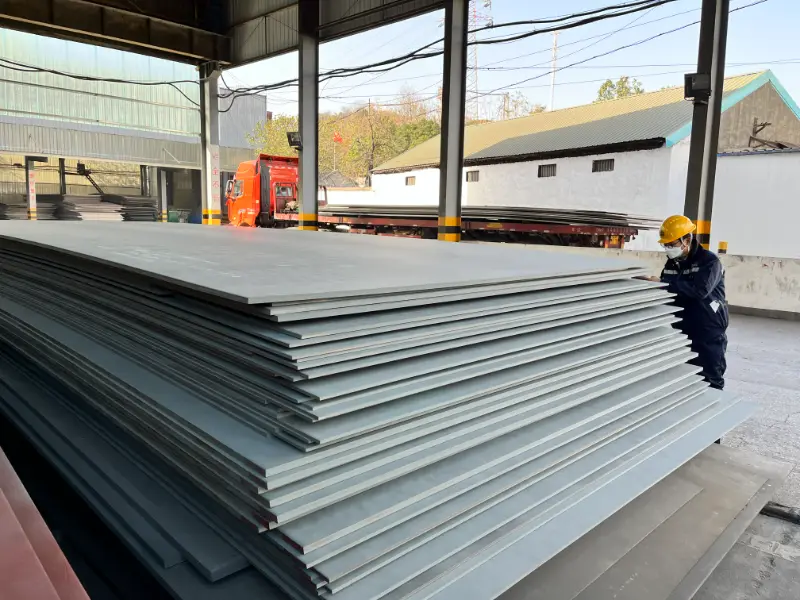
EN10028-2 P355GH Pressure Vessel And Boiler Steel Plate
EN10028-2 P355GH Pressure Vessel And Boiler Steel Plate
Comprehensive material properties of P355GH steel plate according to EN 10028-2: chemical composition, mechanical properties, physical data, equivalent grades, and application guidance.
Hot rolling, normalizing, cutting, forming, welding, machining, drilling
- Phone : +8618037372205
- Email : [email protected]
- WhatsApp: Contact via Whtsapp
- WeChat: +8618037372205
EN10028-2 P355GH Pressure Vessel And Boiler Steel Plate Introduction
EN10028-2 P355GH is a European standard hot-rolled weldable fine-grain structural steel intended for pressure vessels and boilers operating at elevated temperatures. It belongs to the group of steels with specified high-temperature properties, offering a minimum yield strength of 355 MPa at room temperature (for thickness ≤ 16 mm). The steel is supplied in normalized condition (symbol N) and is characterized by excellent weldability, good toughness, and reliable creep resistance up to approximately 400°C. Typical applications include steam drums, heat exchangers, chemical reactors, and high-pressure storage tanks. Its low sulfur and phosphorus contents combined with aluminum grain refinement ensure homogeneous mechanical properties and improved corrosion resistance in many environments.
EN10028-2 P355GH Pressure Vessel And Boiler Steel Plate Chemical Composition
Typical chemical composition of P355GH according to EN 10028-2:2017 Table 1.
Notes: Aluminium is added as a grain refiner; the total Al content is specified. The sum of incidental elements (Cr+Cu+Mo+Ni) ≤ 0.70% is generally observed. Nb, Ti, and V are limited individually and in combination to ensure fine grain stability.
| Element | Value (mass%) | Remarks |
|---|---|---|
| C | ≤ 0.22 | Ladle analysis |
| Si | ≤ 0.60 | Ladle analysis |
| Mn | 1.00 – 1.70 | Ladle analysis |
| P | ≤ 0.025 | Ladle analysis |
| S | ≤ 0.015 | Ladle analysis |
| Al (total) | ≥ 0.020 | Minimum for grain refinement |
| N | ≤ 0.012 | Ladle analysis |
| Cr | ≤ 0.30 | Residual element |
| Cu | ≤ 0.30 | Residual element |
| Mo | ≤ 0.08 | Residual element |
| Nb | ≤ 0.02 | Microalloying |
| Ni | ≤ 0.30 | Residual element |
| Ti | ≤ 0.03 | Microalloying |
| V | ≤ 0.02 | Microalloying |
| Cr+Cu+Mo+Ni | ≤ 0.70 | Sum of incidental elements |
| Nb+Ti+V | ≤ 0.12 | Sum of microalloying elements |
EN10028-2 P355GH Pressure Vessel And Boiler Steel Plate Physical Properties
The data below represent typical physical properties of P355GH type steel at room temperature and at elevated temperatures. These values are not mandatory in EN 10028-2 but are essential for design calculations. Density, Elastic modulus, and thermal properties are similar to standard C-Mn steels. Note: Thermal conductivity and specific heat vary with temperature; values are given for key temperature steps.
| Property | Typical Value | Unit | Test Conditions |
|---|---|---|---|
| Density ρ | 7.85 | g/cm³ | At 20°C |
| Elastic modulus E | 212 | GPa | At 20°C |
| Elastic modulus E | 200 | GPa | At 200°C |
| Elastic modulus E | 190 | GPa | At 400°C |
| Shear modulus G | 81 | GPa | At 20°C |
| Poisson's ratio ν | 0.3 | – | At 20°C (typical for steel) |
| Thermal expansion coefficient α | 11.1 | 10⁻⁶/K | 20 – 100°C |
| Thermal expansion coefficient α | 12.1 | 10⁻⁶/K | 20 – 200°C |
| Thermal expansion coefficient α | 12.9 | 10⁻⁶/K | 20 – 300°C |
| Thermal expansion coefficient α | 13.5 | 10⁻⁶/K | 20 – 400°C |
| Thermal expansion coefficient α | 13.9 | 10⁻⁶/K | 20 – 500°C |
| Thermal conductivity λ | 51.9 | W/(m·K) | At 20°C |
| Thermal conductivity λ | 48.6 | W/(m·K) | At 200°C |
| Thermal conductivity λ | 44.4 | W/(m·K) | At 300°C |
| Thermal conductivity λ | 40.2 | W/(m·K) | At 400°C |
| Thermal conductivity λ | 35.6 | W/(m·K) | At 500°C |
| Specific heat capacity cp | 461 | J/(kg·K) | At 20°C |
| Specific heat capacity cp | 496 | J/(kg·K) | At 100°C |
| Specific heat capacity cp | 533 | J/(kg·K) | At 200°C |
| Specific heat capacity cp | 563 | J/(kg·K) | At 300°C |
| Specific heat capacity cp | 592 | J/(kg·K) | At 400°C |
| Specific heat capacity cp | 622 | J/(kg·K) | At 500°C |
| Electrical resistivity ρe | 0.22 | µΩ·m | At 20°C (typical carbon steel) |
EN10028-2 P355GH Pressure Vessel And Boiler Steel Plate Mechanical Properties at Ambient Temperature
Minimum specified values for plates in normalized condition according to EN 10028-2:2017 Table 3 and Table 4.
Charpy V-notch test applies to thicknesses > 12 mm; minimum average energy (3 specimens) at -20°C is 27 J, with individual minimum 19 J. Values for thinner gauges may be agreed upon. The bending test is not mandatory for P355GH and is only performed when specified in the order; typical mandrel diameter is 3.5a for ultimate tensile strength exceeding 460 MPa.
| Property | Specified Value | Unit | Test Conditions / Remarks |
|---|---|---|---|
| Yield strength ReH | ≥ 355 | MPa | Plate thickness ≤ 16 mm |
| Yield strength ReH | ≥ 345 | MPa | 16 mm < t ≤ 40 mm |
| Yield strength ReH | ≥ 335 | MPa | 40 mm < t ≤ 60 mm |
| Yield strength ReH | ≥ 315 | MPa | 60 mm < t ≤ 100 mm |
| Yield strength ReH | ≥ 295 | MPa | 100 mm < t ≤ 150 mm |
| Yield strength ReH | ≥ 280 | MPa | 150 mm < t ≤ 250 mm |
| Tensile strength Rm | 490 – 630 | MPa | t ≤ 60 mm |
| Tensile strength Rm | 480 – 630 | MPa | 60 mm < t ≤ 100 mm |
| Tensile strength Rm | 470 – 630 | MPa | 100 mm < t ≤ 150 mm |
| Tensile strength Rm | 460 – 630 | MPa | 150 mm < t ≤ 250 mm |
| Elongation A (5.65√So) | ≥ 22 | % | t ≤ 60 mm |
| Elongation A (5.65√So) | ≥ 21 | % | 60 mm < t ≤ 100 mm |
| Elongation A (5.65√So) | ≥ 21 | % | 100 mm < t ≤ 150 mm |
| Elongation A (5.65√So) | ≥ 20 | % | 150 mm < t ≤ 250 mm |
| Charpy V-notch KV2 at -20°C | ≥ 27 (average) / ≥ 19 (individual) | J | Transverse, thickness > 12 mm |
EN10028-2 P355GH Pressure Vessel And Boiler Steel Plate Identical Standards and Equivalent Grade Substitutions
| Country/Region | Standard | Grade | Remarks |
|---|---|---|---|
| International | ISO 9328-2:2018 | P355GH | Identical technical delivery conditions |
| European Union | EN 10028-2:2017 | P355GH | Original CEN standard |
| Germany | DIN EN 10028-2 | P355GH | Directly adopts EN |
| United Kingdom | BS EN 10028-2 | P355GH | Directly adopts EN |
| France | NF EN 10028-2 | P355GH | Directly adopts EN |
| Italy | UNI EN 10028-2 | P355GH | Directly adopts EN |
| Spain | UNE EN 10028-2 | P355GH | Directly adopts EN |
| Sweden | SS-EN 10028-2 | P355GH | Directly adopts EN |
EN10028-2 P355GH Pressure Vessel And Boiler Steel Plate Application Introduction
P355GH plates are widely used in the fabrication of welded pressure equipment subjected to moderate temperatures and pressures. The steel combines good formability with excellent weldability, allowing fabrication of large cylindrical and spherical structures. Typical processing includes flame cutting, cold/hot forming, submerged arc welding (SAW), and post-weld heat treatment (PWHT) when required by design codes.
Product Applications: Pressure vessels, Steam boilers & drums, Heat exchangers, Chemical reactors, Condensers, High-pressure storage tanks, Autoclaves, Heater shells
Processed into products: Shell plates (rolled and welded cylinders), Heads (hemispherical, ellipsoidal, torispherical), Tube sheets, Flanges and ring flanges, Nozzles, Manways and inspection doors, Baffles and supports, Piping components (welded elbows, tees as per vessel codes)
Application industries: Oil & Gas (refinery columns, separators), Power Generation (boiler drums, superheater headers), Chemical & Petrochemical (reactors, storage spheres), Water Treatment (pressure filters, softening vessels), Industrial Gas (air receivers, CO₂ tanks), Shipbuilding (auxiliary boiler shells)
EN10028-2 P355GH Pressure Vessel And Boiler Steel Plate Similar Materials for Alternative Selection
| Country/Region | Standard | Grade | Remarks |
|---|---|---|---|
| USA | ASTM A516 / A516M | Grade 70 | Comparable pressure vessel steel with similar strength; charpy temperature usually -46°C; higher allowable sulfur and carbon content possible. Suitable substitute with minor design adjustments. |
| Japan | JIS G3118 | SGV480 | Carbon steel for boilers and pressure vessels, min. tensile 480–590 MPa; toughness requirement may differ. Consult code for equivalence. |
| China | GB/T 713 | Q345R | Chinese boiler and pressure vessel grade; yield 345 MPa for thickness ≤16 mm; not exactly equivalent for elevated temperature application but often used in similar service. |
| Russia | GOST 5520 | 17G1S (17Г1С) | Common pressure vessel steel; chemical composition close but manganese range varies (1.2–1.6%); may be used with verification of high-temperature properties. |
Notes:
Welding: P355GH is suitable for all common welding processes. Preheating (100–200°C) is recommended for thicker sections to avoid cold cracking. Matching welding consumables (e.g., AWS A5.17 F7A6-EM12K under SAW) are typically used. Post-Weld Heat Treatment: Stress relieving at 600–640°C may be required by design codes such as ASME VIII or EN 13445, depending on thickness and service. Inspection: Ultrasonic testing (UT) according to EN 10160 Class S1E1 is common. Certification: Plates are delivered with EN 10204 Type 3.1 or 3.2 inspection certificates.
- Share



