
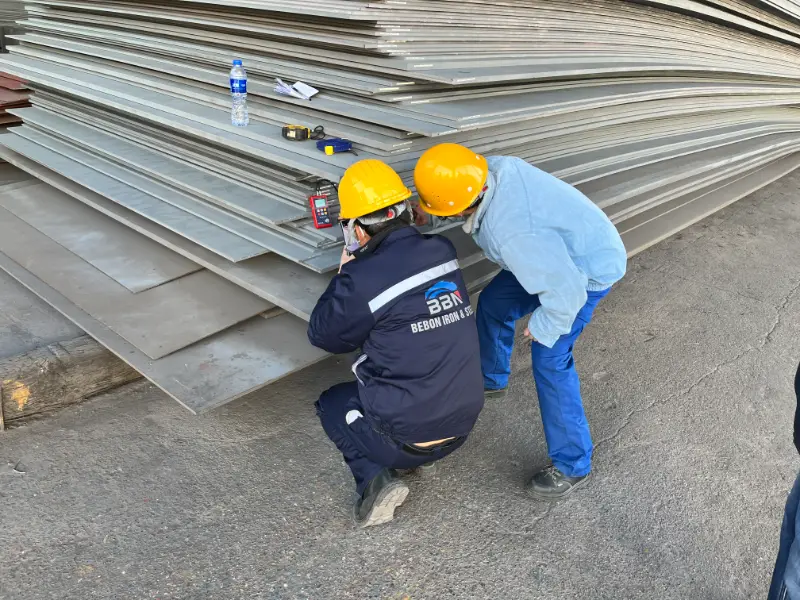
ASTM A516 Grade 70 (A516GR70) Pressure Vessel & Boiler Steel Plate
ASTM A516 Grade 70 Pressure Vessel Steel Plate Properties and Equivalents
Comprehensive material data for ASTM A516 Grade 70 (A516GR70) carbon steel plate for pressure vessels and boilers, including chemical composition, mechanical properties, thermal and electrical physical properties, international equivalents, and application guidance.
Hot rolling, normalizing, stress relieving, welding, hot forming, cold forming (with consideration of thickness and equipment)
- Phone : +8618037372205
- Email : [email protected]
- WhatsApp: Contact via Whtsapp
- WeChat: +8618037372205
ASTM A516 Grade 70 Pressure Vessel & Boiler Steel Plate Introduction
ASTM A516 Grade 70 (A516GR70) is a carbon steel plate intended primarily for welded pressure vessels where improved notch toughness is important. It is produced in accordance with ASTM A516/A516M standard and is widely used in moderate- and lower-temperature service. The grade features a specified minimum tensile strength of 70 ksi (485 MPa) and a minimum yield strength of 38 ksi (260 MPa).
The steel exhibits excellent weldability and formability thanks to controlled carbon and manganese content, with maximum carbon typically limited to 0.28% for thicknesses up to 50 mm, and manganese between 0.85% and 1.20% (heat analysis). It is often supplied in the normalized condition to refine grain structure and enhance toughness. S5 supplementary requirements for impact testing are commonly invoked to guarantee Charpy V-notch energy absorption at specified temperatures.
Typical applications include pressure vessels, boilers, storage tanks, and heat exchangers in the oil & gas, chemical, and power generation industries.
ASTM A516 Grade 70 Pressure Vessel & Boiler Steel Plate Chemical Composition
Chemical composition limits as per ASTM A516/A516M-17 for Grade 70 (heat analysis). The requirements apply to plates in all thicknesses up to limits defined in the standard.
Key features: Controlled carbon ensures good weldability, while manganese provides strength and toughness. Residual elements such as chromium, nickel, copper, and molybdenum are restricted to maintain weldability and avoid hardenability issues. Fine grain practice (e.g., aluminum-grain refinement) is commonly applied to enhance notch toughness.
| Element | Heat Analysis (max or range, %) | Remarks |
|---|---|---|
| Carbon (C) | 0.27 max (≤12.5 mm); 0.28 max (>12.5 to 50 mm); consult standard for thicker plates | For thickness >50 mm, carbon max may be 0.30, subject to agreement |
| Manganese (Mn) | 0.85 – 1.20 (heat analysis) | Product analysis tolerance: ±0.05 |
| Phosphorus (P) | 0.035 max | Low phosphorus to ensure ductility |
| Sulfur (S) | 0.035 max | Low sulfur for improved formability and cleanliness |
| Silicon (Si) | 0.15 – 0.40 | Silicon is added for deoxidation and strength |
| Copper (Cu)* | 0.40 max | Maximum content when copper is specified (residual) |
| Nickel (Ni)* | 0.40 max | Residual element |
| Chromium (Cr)* | 0.30 max | Residual element |
| Molybdenum (Mo)* | 0.12 max | Residual element |
| Niobium (Nb)* | 0.02 max | Residual element; may be added for grain refinement within limits |
| Vanadium (V)* | 0.03 max | Residual element |
| Titanium (Ti)* | 0.03 max | Residual element; may be used for deoxidation/grain refinement |
ASTM A516 Grade 70 Pressure Vessel & Boiler Steel Plate Thermal and Electrical Physical Properties
Typical physical properties for ASTM A516 Grade 70 carbon steel at room temperature and elevated temperatures, based on published data for similar carbon-manganese-silicon steels. These values are not mandatory acceptance criteria but are useful for design. Properties such as density, elastic modulus, and thermal conductivity are relatively insensitive to heat treatment variations.
References: Data compiled from ASME BPVC Section II Part D (typical for carbon steel) and standard engineering handbooks.
| Property | Typical Value | Unit | Test Condition / Temperature |
|---|---|---|---|
| Density (ρ) | 7.85 | g/cm³ | Room temperature |
| Elastic Modulus (E) | 200 – 210 | GPa | Room temperature; decreases slightly with increasing temperature |
| Shear Modulus (G) | 77 – 80 | GPa | Room temperature |
| Poisson's Ratio (ν) | 0.27 – 0.30 | — | Elastic range |
| Thermal Expansion Coefficient (α) | 12.0 | µm/m·°C | 20 – 100°C (68 – 212°F) |
| Thermal Expansion Coefficient (α) | 13.0 | µm/m·°C | 20 – 200°C (68 – 392°F) |
| Thermal Expansion Coefficient (α) | 14.0 | µm/m·°C | 20 – 400°C (68 – 752°F) |
| Thermal Conductivity (λ) | 51.9 | W/m·K | at 100°C (212°F) |
| Thermal Conductivity (λ) | 47.5 | W/m·K | at 200°C (392°F) |
| Thermal Conductivity (λ) | 38.5 | W/m·K | at 400°C (752°F) |
| Specific Heat Capacity (cp) | 486 | J/kg·K | Room temperature |
| Electrical Resistivity (ρe) | 0.13 – 0.18 | µΩ·m | at 20°C; varies with alloying additions |
ASTM A516 Grade 70 Pressure Vessel & Boiler Steel Plate Mechanical Properties
Mechanical property requirements for ASTM A516 Grade 70 plates at room temperature, as specified by ASTM A516/A516M. Tension test specimens are oriented transverse to the rolling direction. Bend tests are required to ensure adequate ductility. Impact tests (Charpy V-notch) are not mandatory unless supplementary requirement S5 is invoked; typical values at -50°F (-46°C) are indicated where available from commercial data.
Note: Properties may vary with thickness and heat treatment condition. The values below represent minimum or typical values for normalized plates in thicknesses up to 40 mm. For precise requirements, refer to the material test certificate.
| Property | Standard Requirement / Typical Value | Unit | Test Condition |
|---|---|---|---|
| Tensile Strength (Rm) | 485 – 620 (70 – 90 ksi) | MPa (ksi) | Room temperature, transverse specimen |
| Yield Strength (ReH) | ≥260 (≥38 ksi) | MPa (ksi) | 0.2% offset or 0.5% extension under load, room temperature |
| Elongation (A) – 50 mm (2") | ≥21 | % | Gage length 50 mm (2 in.), standard round specimen |
| Elongation (A) – 200 mm (8") | ≥17 | % | Gage length 200 mm (8 in.), flat specimen |
| Bend Test (Bend Angle / Diameter Ratio) | 180° bend without cracking; bend diameter = 2t for thickness ≤25 mm (1 in.) | — | Specimen thickness t; bend diameter varies with tensile strength range; for tensile >70 ksi, 2.5t |
| Charpy V-notch Impact Energy (KV) – longitudinal (Typical, with S5) | ≥27 J @ -46°C (≥20 ft·lbf @ -50°F) | J (ft·lbf) | 10 mm × 10 mm specimen; transverse values typically lower; actual value determined by supplementary requirement S5 |
ASTM A516 Grade 70 Pressure Vessel & Boiler Steel Plate Fully Equivalent Material Standards and Replaceable Grades
| Region / Country | Standard | Grade / Designation | Remarks |
|---|---|---|---|
| United States / International | ASME SA-516/ASTM A516M | Grade 70 (SA-516 Gr.70) | Identical chemical and mechanical requirements; ASME section II material accepted for pressure vessel construction. |
| European Union | EN 10028-3 | P295GH (1.0481) | For elevated temperature service; tensile strength 460–580 MPa, yield ≥295 MPa. Not fully identical: A516 Gr.70 has lower yield (≥260 MPa) but similar applications. Charpy impact values can be ordered at low temperature (P295GH-L1/L2). |
| European Union | EN 10028-3 | P355GH (1.0473) | Higher strength class (tensile 510–650 MPa, yield ≥355 MPa). May be substituted where higher design stress is allowed, but weldability and toughness must be verified. |
| Japan | JIS G3115 | SPV355 | Tensile strength 490–610 MPa, yield ≥355 MPa. Closely matches A516 Gr.70 in terms of strength, but SPV355 has higher yield. Used for pressure vessels at moderate temperature. |
| International (ISO) | ISO 9328-2 | P295GH, P355GH | Identical to EN 10028-3 grades listed above. Applicable for pressure purposes. |
ASTM A516 Grade 70 Pressure Vessel & Boiler Steel Plate Application Introduction
ASTM A516 Grade 70 is primarily used for welded pressure vessels and boilers operating at moderate and lower temperatures, where good notch toughness is essential. It is chosen for applications requiring reliable mechanical properties, weldability, and the ability to be formed into shells, heads, and other pressure-containing components. Typical service environments include petroleum refining, chemical processing, and power generation. The steel is suitable for both shop fabrication and field erection, and it can be normalized to achieve consistent properties in thick sections.
Key processing notes: Preheating may be required for thicknesses above 32 mm before welding; post-weld heat treatment (PWHT) is often performed to relieve residual stresses. Cold forming should be followed by stress relieving if deformation exceeds 5% to restore toughness.
Product Applications: Pressure Vessels (horizontal and vertical cylindrical shells), Boilers (shells, tube sheets, drum plates), Storage Tanks (LPG, ammonia, cryogenic liquids down to -46°C where toughness certified), Heat Exchangers (shell, heads, channel covers), Reactor Vessels, Distillation Columns, Deaerators, Autoclaves
Processed into products: Vessel shells and courses, Formed heads (elliptical, hemispherical, torispherical), Flanges and forged components (when subsequent welding is required; ring forgings can be cut from plate), Nozzle reinforcement pads, Tube sheets and baffles (for heat exchangers), Manway covers and blind flanges (when plate is used instead of forging), Skirt and support structures, Stiffening rings, Bolting (rarely; typically studs are alloy steel, but plate can be used for large tie rods)
Application industries: Oil & Gas (refineries, LNG plants, pipelines), Chemical and Petrochemical (reactors, columns, storage), Power Generation (boiler drums, heat exchangers, steam drums), Shipbuilding (cargo tanks, pressure tanks on ships), Water Treatment (high-pressure tanks, filters), Pharmaceutical & Food Processing (sterilization vessels, storage)
ASTM A516 Grade 70 Pressure Vessel & Boiler Steel Plate Similar / Close Alternative Material Recommendations
| Region / Country | Standard | Grade / Designation | Remarks |
|---|---|---|---|
| United States | ASTM A285/A285M | Grade C | Firebox quality carbon steel plate for pressure vessels. Tensile strength 55–75 ksi (380–515 MPa), yield ≥30 ksi (205 MPa). Lower strength but acceptable for lower pressure applications; less controlled notch toughness. |
| United States | ASTM A537/A537M | Class 1 | Heat-treated carbon-manganese-silicon steel plate. Tensile 70–90 ksi, yield ≥50 ksi (345 MPa). Offers higher yield strength with good toughness; requires PWHT in some cases. |
| European Union | EN 10028-3 | P275NH / P275NL1 | Tensile 390–510 MPa, yield ≥275 MPa. Slightly lower strength but excellent low-temperature toughness (NL1 tested at -40°C). Suitable substitute where lower strength can be accepted. |
| China | GB/T 713 | Q345R (16MnR) | Tensile 490–620 MPa, yield ≥345 MPa. Widely used pressure vessel steel; higher yield but comparable tensile strength. C and Mn ranges differ; compatibility must be checked. |
| Korea | KS D 3521 | SPV315, SPV355 | Similar to JIS G3115 grades; SPV315 tensile 440–590 MPa, SPV355 tensile 490–610 MPa. Viable alternatives for pressure vessel applications. |
Notes:
- Impact Testing: Unlike many structural steels, ASTM A516 Grade 70 is frequently ordered with supplementary requirement S5 (Charpy V-notch impact testing). Common test temperatures are -20°F, -40°F, -50°F, or -60°F (-29°C, -40°C, -46°C, -51°C). Minimum average absorbed energy is typically 20 ft·lbf (27 J) for longitudinal specimens and may be 15 ft·lbf (20 J) transverse, but exact values should be specified in the purchase order.
- Weldability: Carbon equivalent (CE) using IIW formula is usually below 0.43% for thicknesses up to 40 mm. Preheat and interpass temperature control may be required to avoid cold cracking; for thicker plates, a post-weld heat treatment at 600–650°C is commonly applied.
- Forming: Hot forming should be performed between 1600°F and 2000°F (870–1095°C) and may require subsequent normalizing. Cold forming limits are per ASME code; for strains >5%, a stress relief heat treatment is recommended.
- Standard Updates: Always consult the latest edition of ASTM A516/A516M and the applicable ASME Boiler and Pressure Vessel Code Section II for current requirements. The data presented here is based on ASTM A516/A516M-17. Actual certified values may vary and should be verified with the material test report.
- Share



