
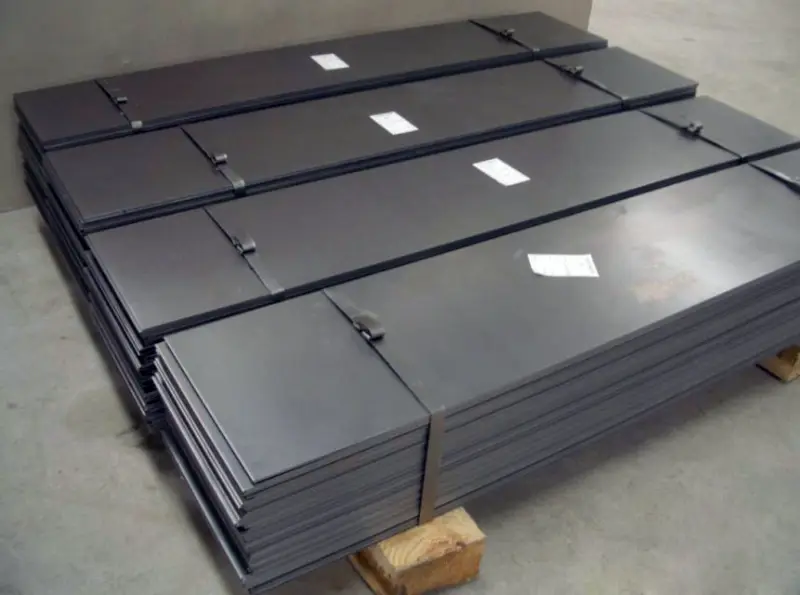
ASTM A515 Grade 65 (A515GR65) Boiler & Pressure Vessel Steel Plate
ASTM A515 Grade 65 (A515GR65) Carbon-Silicon Steel for Pressure Vessel and Boiler Plates | Comprehensive Material Data
Detailed material data for ASTM A515 Grade 65 (A515GR65) pressure vessel and boiler steel plate, including chemical composition, mechanical properties, thermal and electrical physical properties, international equivalents, and application guidance.
Hot rolling, normalizing (optional), stress relieving, welding, bending, forming, machining
- Phone : +8618037372205
- Email : [email protected]
- WhatsApp: Contact via Whtsapp
- WeChat: +8618037372205
ASTM A515 Grade 65 Boiler & Pressure Vessel Steel Plate Introduction
ASTM A515 Grade 65 (A515GR65) is a carbon-silicon steel plate intended for intermediate- and higher-temperature service in pressure vessels and boilers. It is produced to a killed steel practice, with silicon as the primary deoxidizer, ensuring fine grain structure and improved homogeneity. This grade offers a minimum tensile strength of 65 ksi (450 MPa) and a minimum yield strength of 35 ksi (240 MPa), providing reliable strength and moderate toughness at elevated temperatures up to approximately 450°C. Typical applications include boiler drums, heat exchangers, and pressure vessel shells. The material is supplied in the as-rolled or normalized condition, and can be welded using conventional methods, though post-weld heat treatment may be required depending on thickness and service conditions.
ASTM A515 Grade 65 Boiler & Pressure Vessel Steel Plate Chemical Composition
Chemical composition limits for ASTM A515 Grade 65 steel according to ASTM A515/A515M. The steel is fully killed with silicon. The carbon content is controlled to provide strength while ensuring weldability. Phosphorus and sulfur are minimized for cleanliness and ductility.
| Element | Standard Value (max, unless range given) | Remarks |
|---|---|---|
| Carbon (C) | 0.24% (for thickness ≤ 50 mm) / 0.27% (for thickness > 50 mm) | Contributes to strength and hardenability |
| Manganese (Mn) | 0.90% (heat analysis) | Improves hardenability and counteracts sulfur |
| Phosphorus (P) | 0.035% | Maximum limit for ductility |
| Sulfur (S) | 0.035% | Maximum limit to avoid hot shortness |
| Silicon (Si) | 0.15 – 0.40% | Deoxidizer, improves strength and oxidation resistance |
| Iron (Fe) | Balance | Base element |
ASTM A515 Grade 65 Boiler & Pressure Vessel Steel Plate Thermal and Electrical Physical Properties
Typical physical properties for carbon-silicon steel similar to ASTM A515 Grade 65. These values are not mandatory in the standard but are representative for engineering design. Actual values may vary slightly depending on exact composition and heat treatment condition.
| Property | Typical Value | Unit | Test Condition / Temperature |
|---|---|---|---|
| Density (ρ) | 7.85 | g/cm³ | At room temperature, typical for carbon steel |
| Elastic Modulus (E) | 200 | GPa | At room temperature |
| Shear Modulus (G) | 80 | GPa | Calculated from E and Poisson's ratio |
| Poisson's Ratio (ν) | 0.30 | – | At room temperature, within elastic range |
| Thermal Expansion Coefficient (α) | 11.7 | 10⁻⁶/K | 20–100 °C |
| Thermal Expansion Coefficient (α) | 12.5 | 10⁻⁶/K | 20–200 °C |
| Thermal Expansion Coefficient (α) | 13.2 | 10⁻⁶/K | 20–300 °C |
| Thermal Conductivity (λ) | 51 | W/(m·K) | At 100 °C |
| Thermal Conductivity (λ) | 48 | W/(m·K) | At 200 °C |
| Thermal Conductivity (λ) | 44 | W/(m·K) | At 300 °C |
| Specific Heat Capacity (cp) | 460 | J/(kg·K) | At 20–100 °C (typical) |
| Electrical Resistivity (ρe) | 0.17 | μΩ·m | At 20 °C |
ASTM A515 Grade 65 Boiler & Pressure Vessel Steel Plate Mechanical Properties
Tensile properties and bend test requirements as per ASTM A515/A515M for Grade 65. Values apply to the as-rolled or normalized condition. Impact toughness (KV) is not a mandatory requirement unless specified as a supplementary requirement (e.g., Charpy V-notch testing per supplementary requirement S5).
| Property | Standard Required Value | Unit | Test Condition / Remarks |
|---|---|---|---|
| Tensile Strength (Rm) | 450 – 585 (65 – 85) | MPa (ksi) | Transverse specimen, all thicknesses |
| Yield Strength (ReH) | ≥ 240 (≥ 35) | MPa (ksi) | Minimum, 0.2% offset or 0.5% extension |
| Elongation in 200 mm (A200) | ≥ 19 | % | For thickness ≤ 50 mm, sheet-type specimen |
| Elongation in 50 mm (A50) | ≥ 23 | % | For thickness ≤ 50 mm, round bar or proportional specimen |
| Bend Test (180°) – thickness ≤ 25 mm | d = 1.5t | – | Bend diameter (d) = 1.5 times specimen thickness (t), no cracks |
| Bend Test (180°) – thickness 25–50 mm | d = 2t | – | Bend diameter = 2 times specimen thickness |
| Bend Test (180°) – thickness 50–100 mm | d = 2.5t | – | Bend diameter = 2.5 times specimen thickness |
| Bend Test (180°) – thickness > 100 mm | d = 3t | – | Bend diameter = 3 times specimen thickness, by agreement |
ASTM A515 Grade 65 Boiler & Pressure Vessel Steel Plate Directly Equivalent Material Standards and Substitutable Grades
There is no perfectly identical international equivalent for ASTM A515 Grade 65, but EN P265GH and ISO P26 have comparable strength and intended service. Note that toughness requirements may differ; A515 Gr.65 does not mandate impact testing, while EN P265GH usually does.
| Country / Region | Standard | Grade / Designation | Remarks |
|---|---|---|---|
| Europe | EN 10028-2 | P265GH | Comparable tensile range (410-530 MPa), but impact requirements (-20°C/KV ≥27J) differ. Fully killed silicon-killed fine-grain steel. |
| International (ISO) | ISO 2604-4 | P26 | Similar carbon-manganese steel for pressure purposes, strength close but not identical. |
| Japan | JIS G3103 | SB450 | Carbon steel for boilers and pressure vessels, tensile strength 450-580 MPa, similar but Mn range may be broader. |
| China | GB/T 713 | Q245R | Tensile strength 400-520 MPa, yield ≥245 MPa. Not an exact match, but may serve as an alternative for moderate temperature service. |
ASTM A515 Grade 65 Boiler & Pressure Vessel Steel Plate Application Introduction
ASTM A515 Grade 65 is designed for fusion-welded pressure vessels and boilers operating at intermediate to elevated temperatures (typically up to 450 °C). It exhibits good formability and weldability when proper preheating and post-weld heat treatment are applied. Common processing includes hot forming, cold bending, and submerged arc welding. The steel is often supplied in the normalized condition to enhance microstructure uniformity and mechanical properties. It is widely accepted under ASME Boiler and Pressure Vessel Code Section II and Section VIII.
Product Applications: Boiler drums and shells, Pressure vessel bodies and heads, Heat exchanger shells and channels, Autoclaves and digesters, Steam accumulators, Process columns and reactors, Storage tanks for hot liquids
Processed into products: Cylindrical shells (rolled and welded), Dished and ellipsoidal heads, Nozzle and flange forgings (from plate blanks), Tube sheets for moderate temperature, Baffle plates, Support skirts and saddles, Manhole and handhole covers
Application industries: Oil & gas processing, Chemical and petrochemical plants, Power generation (fossil fuel and nuclear auxiliary), Industrial boiler manufacturing, Heat exchanger and pressure vessel fabrication, Food and pharmaceutical processing (moderate temperature), Water treatment and desalination
ASTM A515 Grade 65 Boiler & Pressure Vessel Steel Plate Similar / Alternative Material Recommendations
These materials offer comparable strength and are used in similar pressure vessel applications. When substituting, verify welding procedures, post-weld heat treatment requirements, and code certification.
| Country / Region | Standard | Grade | Remarks |
|---|---|---|---|
| USA | ASTM A516/A516M | Grade 65 | Carbon steel for moderate/lower temperature service. Similar strength but improved notch toughness (Charpy V-notch mandatory). Not a direct substitute for A515 Gr.65 because of different toughness guarantees. |
| Europe | EN 10028-2 | P295GH | Higher strength (460-580 MPa tensile), suitable for elevated temperature. Substitute if higher strength is acceptable. |
| Japan | JIS G3118 | SGV450 | Carbon steel for intermediate temperature pressure vessels, tensile strength 450-580 MPa. Similar but may have different deoxidation practice. |
| China | GB/T 713 | Q345R (16MnR) | High-strength C-Mn steel, minimum yield 345 MPa, tensile 510-640 MPa. Over-matching, requires careful design review when replacing A515 Gr.65. |
Notes:
Welding: Preheat (minimum 100°C) may be required depending on thickness and carbon equivalent. Post-weld heat treatment (PWHT) at 600–650°C is typically mandated for thicknesses above 32 mm or as per construction code. Toughness: ASTM A515 does not have mandatory Charpy V-notch requirements; for low-temperature applications, consider A516 Grade 65 or specify supplementary requirement S5. Ultrasonic Testing: May be ordered as a supplementary requirement (S8) per ASTM A435/A435M. Marking: Each plate shall be marked with manufacturer, heat number, standard, grade, and dimension unless otherwise agreed.
- Share



