
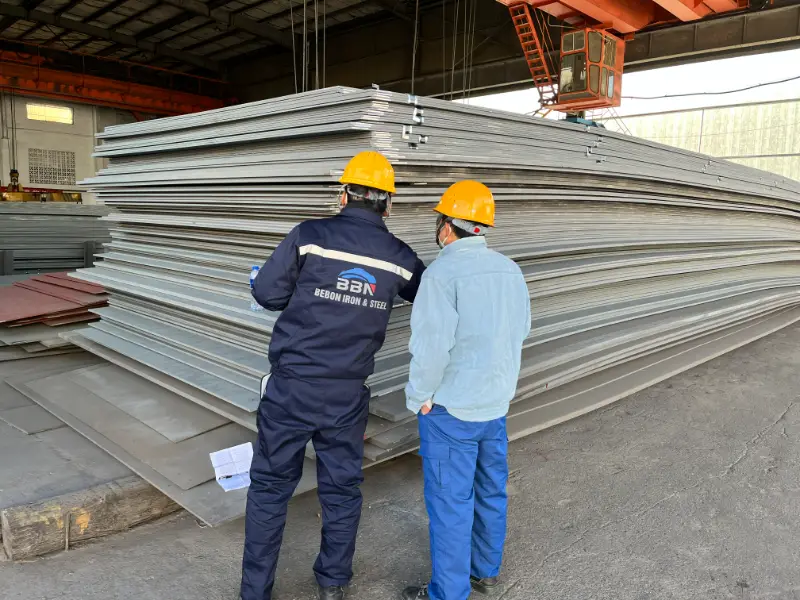
JIS G3114 SMA490CP Weather Resistant Steel Plate
SMA490CP Weathering Steel: High-Strength JIS G3114 Structural Plate for Welded Bridges & Buildings
Explore JIS G3114 SMA490CP weather-resistant steel plate: chemical composition, mechanical & thermal properties, international equivalents, and applications in bridges, buildings, and industrial equipment.
Cutting, welding (all common methods), bending, cold forming, punching, drilling, coating/painting
- Phone : +8618037372205
- Email : [email protected]
- WhatsApp: Contact via Whtsapp
- WeChat: +8618037372205
JIS G3114 SMA490CP Weather Resistant Steel Plate Introduction
SMA490CP is a hot-rolled atmospheric corrosion-resisting steel for welded structures specified in JIS G3114. It belongs to the 490 MPa tensile strength class and the 'C' toughness category (impact test at 0°C) with a 'P' suffix indicating suitability for painted applications. The steel develops a protective patina under cyclic wet/dry conditions, reducing maintenance costs. Key features include:
- Minimum yield strength of 365 MPa (t ≤ 16 mm)
- Good weldability and formability for structural fabrication
- Enhanced resistance to atmospheric corrosion through alloying with Cu, Cr, and Ni
- Available in thicknesses up to 100 mm in the as-rolled or normalized condition
JIS G3114 SMA490CP Weather Resistant Steel Plate Chemical Composition
The chemical composition of SMA490CP is balanced to provide a protective rust layer while maintaining weldability. Copper, chromium, and nickel are key alloying elements that improve atmospheric corrosion resistance. Carbon content is limited for good toughness and weldability. Phosphorus and sulfur are restricted to ensure cleanliness.
| Element | Value (max, unless range) | Remarks |
|---|---|---|
| Carbon (C) | 0.18% | Ladle analysis |
| Silicon (Si) | 0.55% | Ladle analysis |
| Manganese (Mn) | 0.90 - 1.40% | Ladle analysis |
| Phosphorus (P) | 0.035% | Ladle analysis |
| Sulfur (S) | 0.035% | Ladle analysis |
| Chromium (Cr) | 0.30 - 0.80% | Ladle analysis |
| Nickel (Ni) | 0.65% | Ladle analysis |
| Copper (Cu) | 0.20 - 0.60% | Ladle analysis |
| Residual elements | Reported | Trace amounts allowed as per standard |
JIS G3114 SMA490CP Weather Resistant Steel Plate Thermal and Electrical Physical Properties
Physical properties are typical for low-alloy weathering steels. They assist in design calculations involving thermal loads, heat transfer, and electrical applications. Values may vary slightly with temperature and specific heat. Density and thermal expansion are comparable to carbon steels.
| Property | Typical Value | Unit | Test Condition / Temperature |
|---|---|---|---|
| Density (ρ) | 7.85 | g/cm³ | At 20°C |
| Elastic Modulus (E) | 210 | GPa | At 20°C |
| Shear Modulus (G) | 80 | GPa | At 20°C |
| Poisson's Ratio (ν) | 0.3 | - | At 20°C |
| Thermal Expansion Coefficient (α) | 12.0 × 10⁻⁶ | K⁻¹ | 20°C to 100°C |
| Thermal Expansion Coefficient (α) | 12.5 × 10⁻⁶ | K⁻¹ | 20°C to 200°C |
| Thermal Expansion Coefficient (α) | 13.0 × 10⁻⁶ | K⁻¹ | 20°C to 300°C |
| Thermal Conductivity (λ) | 42 | W/(m·K) | At 20°C |
| Thermal Conductivity (λ) | 40 | W/(m·K) | At 100°C |
| Specific Heat Capacity | 460 | J/(kg·K) | At 20°C |
| Electrical Resistivity (ρ_e) | 0.25 × 10⁻⁶ | Ω·m | At 20°C, typical |
JIS G3114 SMA490CP Weather Resistant Steel Plate Mechanical Properties
Mechanical properties are guaranteed by the manufacturer according to JIS G3114. Values depend on product thickness. Impact toughness is verified at 0°C with a minimum absorbed energy of 27 J. The steel exhibits a good combination of strength and ductility for structural design.
| Property | Required Value | Unit | Test Condition / Thickness Range |
|---|---|---|---|
| Yield Strength (ReH) | ≥365 | MPa | t ≤ 16 mm |
| Yield Strength (ReH) | ≥355 | MPa | 16 mm < t ≤ 40 mm |
| Yield Strength (ReH) | ≥335 | MPa | 40 mm < t ≤ 75 mm |
| Yield Strength (ReH) | ≥325 | MPa | 75 mm < t ≤ 100 mm |
| Tensile Strength (Rm) | 490 - 610 | MPa | t ≤ 100 mm |
| Elongation (A) | ≥15 | % | t ≤ 5 mm, gauge 50 mm |
| Elongation (A) | ≥17 | % | 5 mm < t ≤ 16 mm, gauge 50 mm |
| Elongation (A) | ≥19 | % | 16 mm < t ≤ 50 mm, gauge 200 mm |
| Elongation (A) | ≥21 | % | 50 mm < t ≤ 100 mm, gauge 200 mm |
| Bend Test (180°) | No cracks | - | Bend diameter: 1.5t (t ≤ 16 mm); 2.0t (t > 16 mm) |
| Impact Energy (KV2) | ≥27 | J | 0°C, longitudinal, V-notch, full-size specimen |
JIS G3114 SMA490CP Weather Resistant Steel Plate Completely Equivalent Material Standards & Replaceable Grades
| Country/Region | Standard | Grade | Remarks |
|---|---|---|---|
| Japan | JIS G3114 | SMA490CP | Base standard; 0°C impact, painted application |
| Japan | JIS G3114 | SMA490CW | Same base grade but for unpainted (weathering) use when impact class C is required |
| China | GB/T 4171 | Q355NHD (or Q355NH) | Grade with comparable strength and corrosion resistance; check impact requirements |
| Europe | EN 10025-5 | S355J2W (1.8965) | Impact at -20°C surpasses 0°C; check delivery condition |
| Europe | EN 10025-5 | S355J2WP (1.8946) | Contains higher phosphorus for enhanced corrosion resistance; verify weldability |
| USA | ASTM A588 / A588M | Grade B | Similar strength and atmospheric corrosion resistance; impact test optional |
| USA | ASTM A242 / A242M | Type 1 | Lower minimum tensile strength (≥480 MPa); verify grade equivalence |
JIS G3114 SMA490CP Weather Resistant Steel Plate Application Introduction
SMA490CP is designed for welded structures exposed to the atmosphere, where reduced maintenance through painting is intended. Its balanced chemical composition provides a stable protective oxide layer when paint is compromised, but the 'P' designation makes it fully suitable for painting systems. Typical uses involve heavy structural components that must withstand variable weather conditions over long service lives.
Product Applications: Welded plate girders and box girders for bridges, Painted bridge decks and trusses, Column and beam sections for multi-story buildings, Railcar bodies and bogie frames, Shipping containers and intermodal equipment, Offshore platform substructures (with coating), Wind turbine towers (plate sections)
Processed into products: Flanges and webs of welded I‑beams, Stiffeners and diaphragm plates, Bolted and welded splice plates, Heavy‑duty cantilever supports, Crane runway beams and gantry girders, Mining dump truck chassis components, Earth‑moving equipment arms and booms
Application industries: Bridge construction (highway, railway, pedestrian), Building and civil engineering (exposed frameworks, architectural skins), Railway vehicles (wagons, underframes), Container manufacturing, Offshore and marine structures (topsides, decks when painted), Power transmission towers and poles, Industrial machinery and plant construction
JIS G3114 SMA490CP Weather Resistant Steel Plate Similar / Closely Matching Alternative Materials
| Country/Region | Standard | Grade | Remarks |
|---|---|---|---|
| Japan | JIS G3114 | SMA490BW | Tensile/yield identical; impact at 0°C instead of 0°C? (B class typically 0°C); verify actual test temperature. 'W' means unpainted. |
| Europe | EN 10025-5 | S355K2W (1.8967) | Higher toughness (-20°C) and same strength; suitable for more demanding fracture-critical applications |
| USA | ASTM A709 / A709M | 50W (Grade 345W) | Bridge steel with equivalent strength and weathering ability; impact class may differ |
| International | ISO 4952 | S355W (with C impact class) | Closely aligned strength, needs adjustment for impact temperature (ISO impact class C = 0°C) |
| India | IS 11587 | E350W (Fe 490) | Weathering structural steel with similar carbon and mechanical properties; verify impact test requirements |
Notes:
- All data follows JIS G3114:2004 (revised in 2008). Always refer to the latest standard edition and the mill's test certificate.
- For welded fabrication, low‑hydrogen practices and appropriate preheat/interpass temperatures are recommended to avoid hydrogen cracking, especially in thicker sections.
- When used in unpainted 'weathering' mode, design details must avoid water traps and ensure proper drainage; the grade is fully weldable with matching weathering electrodes/filler wires (e.g., AWS E8018‑W).
- Impact test requirement (0°C, 27 J) is for longitudinal samples; transverse or specific orientations may be agreed upon.
- The chemical composition allows slight variations; Cu, Cr, and Ni combined should be within limits that ensure a protective patina develops.
- Share



