
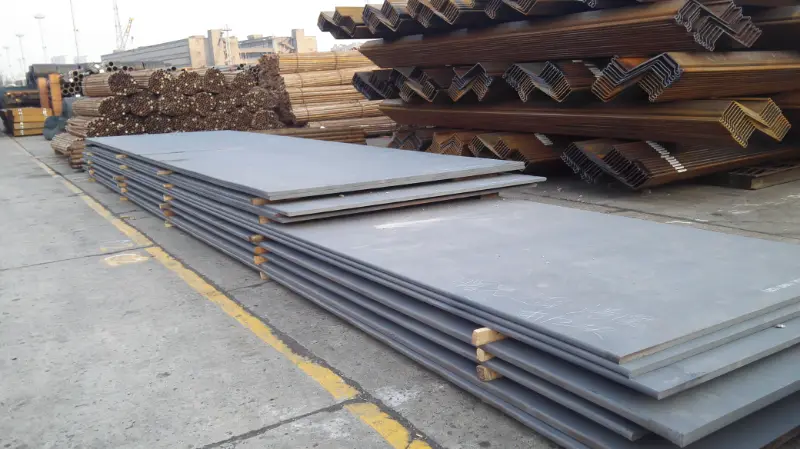
SMA570W Weather Resistant Steel Plate
SMA570W Weather Resistant Steel Plate - JIS G3114 High Strength Structural Steel
In-depth analysis of SMA570W steel plate under JIS G3114 standard, including chemical composition, mechanical properties, physical properties, international equivalents, applications, and processing capabilities.
Welding, cutting, forming, machining, hot-rolling, controlled rolling, normalizing
- Phone : +8618037372205
- Email : [email protected]
- WhatsApp: Contact via Whtsapp
- WeChat: +8618037372205
SMA570W Weather Resistant Steel Plate Introduction
SMA570W is a high-strength, weldable, atmospheric corrosion-resistant structural steel defined by Japanese Industrial Standard JIS G3114. Key attributes:
- High strength: Minimum tensile strength of 570 MPa and yield strength up to 430 MPa (depending on thickness), suitable for heavy-loaded structures.
- Weather resistance: Alloyed with Cu, Cr, and Ni, forming a protective patina that reduces corrosion in atmospheric environments, eliminating the need for painting in many cases.
- Excellent weldability: Designed for welded structures with strict impact toughness requirements (Charpy ≥47 J at -5°C), ensuring performance in low-temperature conditions.
- Thickness capability: Available in plates up to 160 mm thickness with specified mechanical properties.
SMA570W Weather Resistant Steel Plate Chemical Composition
The chemical composition of SMA570W is precisely controlled to achieve high strength and atmospheric corrosion resistance. Copper, chromium, and nickel are key alloying elements that promote the formation of a dense, adherent oxide layer (patina). Microalloying elements like Nb, V, and Ti may be added to refine grain size and enhance strength.
| Element | Specification (wt%) | Remarks |
|---|---|---|
| C | ≤0.18 | |
| Si | ≤0.55 | |
| Mn | ≤1.40 | |
| P | ≤0.035 | |
| S | ≤0.035 | |
| Cu | 0.30–0.50 | Key for corrosion resistance |
| Cr | 0.45–0.75 | Key for corrosion resistance |
| Ni | 0.05–0.30 | Enhances toughness and corrosion resistance |
| Nb | ≤0.10 (optional) | Grain refiner; may be added singly or in combination |
| V | ≤0.10 (optional) | Grain refiner |
| Ti | ≤0.10 (optional) | Grain refiner |
SMA570W Weather Resistant Steel Plate Physical Properties
Physical properties are typical for low-alloy weathering steel and are not specified in JIS G3114. These values serve as reference for design calculations such as thermal expansion, heat transfer, and elastic behavior. Values may vary slightly depending on exact composition and condition.
| Property | Typical Value | Unit | Conditions / Remarks |
|---|---|---|---|
| Density (ρ) | 7850 | kg/m³ | At 20°C |
| Elastic modulus (E) | 206 | GPa | At 20°C |
| Shear modulus (G) | 80 | GPa | Calculated from E and ν, approx. |
| Poisson's ratio (ν) | 0.3 | – | |
| Thermal expansion coefficient (α) | 12 × 10⁻⁶ | /K | 20–100°C range (average) |
| Thermal conductivity (λ) | 45 | W/(m·K) | At 100°C, typical for weathering steel |
| Specific heat capacity (cp) | 460 | J/(kg·K) | At 20°C |
| Electrical resistivity (ρe) | 0.22 × 10⁻⁶ | Ω·m | At 20°C |
SMA570W Weather Resistant Steel Plate Mechanical Properties
The mechanical properties of SMA570W are dependent on plate thickness. Tensile strength is uniform across all thicknesses, while yield strength and elongation decrease slightly with increasing thickness. Charpy V-notch impact tests at -5°C guarantee sufficient toughness for welded structures.
| Property | Requirement | Unit | Test Condition / Remarks |
|---|---|---|---|
| Yield strength (ReH) | ≥430 | MPa | Thickness ≤16 mm |
| Yield strength (ReH) | ≥420 | MPa | Thickness >16 mm to ≤40 mm |
| Yield strength (ReH) | ≥410 | MPa | Thickness >40 mm to ≤75 mm |
| Yield strength (ReH) | ≥400 | MPa | Thickness >75 mm to ≤100 mm |
| Yield strength (ReH) | ≥390 | MPa | Thickness >100 mm to ≤160 mm |
| Tensile strength (Rm) | 570–720 | MPa | All thicknesses |
| Elongation (A) | ≥17 | % | Thickness ≤5 mm, JIS No.5 test piece, longitudinal |
| Elongation (A) | ≥19 | % | Thickness >5 mm to ≤16 mm, JIS No.1A test piece, longitudinal |
| Elongation (A) | ≥26 | % | Thickness >16 mm to ≤50 mm, JIS No.1A test piece, longitudinal |
| Elongation (A) | ≥20 | % | Thickness >50 mm to ≤100 mm, JIS No.10 test piece, longitudinal |
| Charpy impact (KV2) | ≥47 (average of 3 tests, single min ≥ 33 J for full-size specimen; reduced section specimens adjusted proportionally) | J | -5°C, V-notch, longitudinal, for thickness >12 mm |
SMA570W Weather Resistant Steel Plate Fully Equivalent Material Standards and Substitute Grades
| Country/Region | Standard | Grade | Remarks |
|---|---|---|---|
| Japan | JIS G3114 | SMA570W | Original standard and grade |
| Korea | KS D 3529 | SMA570W | Identical adoption of JIS standard |
| China | GB/T 4171 | Q550NH | Close in yield/tensile, but tensile range 690–880 MPa, slightly higher; requires verification for specific thickness and impact test |
| USA | ASTM A871/A871M | Grade 70 (Type unspecified) | Comparable strength: min yield 485 MPa, tensile 585–760 MPa; weathering type; Charpy requirements differ |
| Europe | EN 10025-5 | S460J2W (1.8963) | Lower minimum yield (460 MPa), tensile 530–720 MPa; similar atmospheric corrosion resistance; impact at -20°C |
SMA570W Weather Resistant Steel Plate Application Introduction
SMA570W is employed in heavy structural applications where high strength and atmospheric corrosion resistance are essential. Its weldability and low‑temperature toughness make it suitable for critical welded assemblies. Preheating and post-weld heat treatment may be required depending on thickness to avoid cold cracking. Key applications include:
Product Applications: Steel bridge girders and arches, Offshore platform modules and jackets, High-strength building frames and columns, Railway passenger and freight wagons, Large storage containers and silos, Welded structural assemblies for corrosive environments
Processed into products: Welded box sections and built‑up beams, Crane booms and jibs, Excavator arms and attachments, Heavy‑duty chassis frames, Flanges and web plates for plate girders, Wind tower flanges (when corrosion protection is needed)
Application industries: Bridge construction (pedestrian, highway, railway bridges), Shipbuilding and offshore engineering (deck plates, hull reinforcements), Railway vehicle manufacturing (bogies, underframes, wagon bodies), Construction machinery (excavator booms, crane frames, bulldozer blades), Mining and heavy equipment (dump truck bodies, conveyor structures), Container manufacturing (cargo containers exposed to marine atmosphere)
SMA570W Weather Resistant Steel Plate Similar or Comparable Material Standards and Grades
| Country/Region | Standard | Grade | Remarks |
|---|---|---|---|
| Japan | JIS G3114 | SMA570P | Same strength but impact test not mandatory; used where Charpy requirement is less critical |
| USA | ASTM A709/A709M | HPS 70W (Grade 70W) | High-performance steel for bridges; min yield 485 MPa, tensile 585–760 MPa; improved weldability and toughness |
| Europe | EN 10025-5 | S460J0W (1.8960) | Weathering steel with impact test at 0°C; tensile 530–720 MPa; often used as substitute if -5°C toughness is not required |
| China | GB/T 4171 | Q550NHL | Welded weathering steel with similar strength; additional requirements on corrosion resistance index |
| International | ISO 5952 | Fe 460 WF (?) | ISO standard for weather-resistant structural steel; closest grade is approximately Fe 460 or Fe 510, but no direct match for 570 MPa tensile |
Notes:
SMA570W is suitable for use in unpainted condition in many atmospheric environments, relying on the protective patina. However, in aggressive environments (marine splash zone, industrial acid conditions), supplementary coating or higher alloy content (e.g., higher Ni) may be required. Welding consumables should match the strength and weathering characteristics; preheating is recommended for thicknesses above 25 mm to reduce hydrogen cracking risk. The impact test temperature of -5°C is specific to the 'W' grade; for lower temperature applications, consider SMA570W with additional low‑temperature toughness agreement. For thicknesses above 100 mm, normalized delivery condition is often specified to ensure through‑thickness properties. Users should refer to the latest JIS G3114 standard for exact requirements and tolerances.
- Share



