
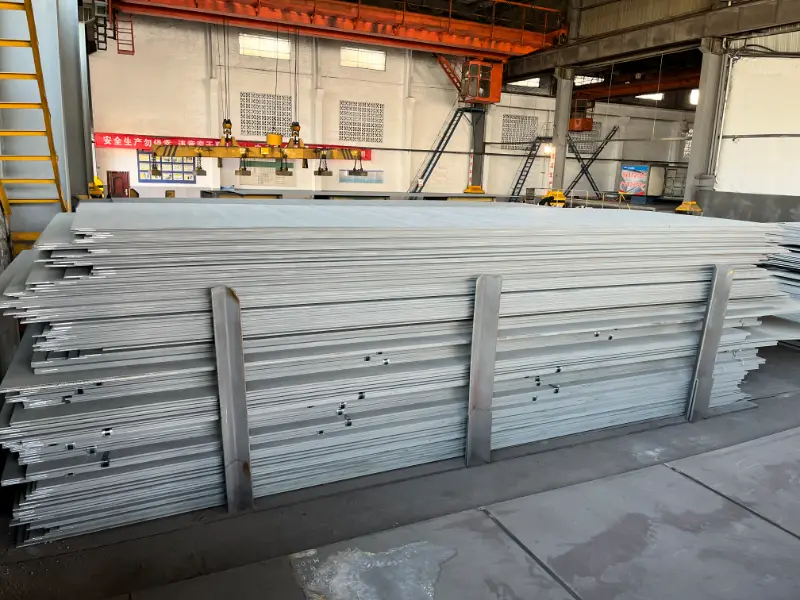
EN10028-3 P460N Pressure Vessel & Boiler Steel Plate
EN10028-3 P460N Pressure Vessel & Boiler Steel Plate - Properties, Equivalents & Applications
Explore detailed material data for P460N steel to EN10028-3: chemical composition, mechanical and physical properties, international equivalent grades, and industrial applications.
Hot rolling, normalizing, cutting, forming (bending, rolling), welding
- Phone : +8618037372205
- Email : [email protected]
- WhatsApp: Contact via Whtsapp
- WeChat: +8618037372205
EN10028-3 P460N Pressure Vessel & Boiler Steel Plate Introduction
P460N is a weldable fine-grain structural steel specified in EN 10028-3, designed for pressure purposes such as pressure vessels and boilers. Supplied in the normalized condition, it offers a minimum yield strength of 460 MPa at room temperature combined with excellent toughness and good weldability. The steel is produced with controlled chemical composition, including micro-alloying elements (Nb, V, Ti), to achieve fine grain microstructure that ensures uniform mechanical properties and resistance to brittle fracture. Typical thicknesses range up to 60 mm for yield strength guarantees. Its balanced composition also provides good resistance to hydrogen-induced cracking and creep performance at moderate temperatures.
- Key features: high strength, superior notch toughness down to -20°C, good formability and weldability.
- Main usage: fabrication of boilers, pressure vessels, storage tanks, and heat exchangers in power generation, chemical, and oil & gas industries.
EN10028-3 P460N Pressure Vessel & Boiler Steel Plate Chemical Composition
Typical chemical composition according to EN 10028-3:2017. Limits apply unless otherwise agreed. Micro-alloying elements niobium, vanadium and titanium are added to ensure fine grain size. For product analysis, slight deviations may be permitted according to the standard.
| Element | Content (max or range) | Notes |
|---|---|---|
| Carbon (C) | ≤ 0.20 | For thickness ≤ 60 mm |
| Silicon (Si) | ≤ 0.60 | |
| Manganese (Mn) | 1.00 – 1.70 | |
| Phosphorus (P) | ≤ 0.025 | |
| Sulfur (S) | ≤ 0.015 | |
| Aluminium total (Altot) | ≥ 0.020 | Minimum required for fine grain practice |
| Nitrogen (N) | ≤ 0.020 | |
| Chromium (Cr) | ≤ 0.30 | |
| Nickel (Ni) | ≤ 0.80 | |
| Molybdenum (Mo) | ≤ 0.10 | |
| Copper (Cu) | ≤ 0.70 | |
| Niobium (Nb) | ≤ 0.05 | Sum of Nb+V+Ti ≤ 0.22% |
| Vanadium (V) | ≤ 0.20 | Sum of Nb+V+Ti ≤ 0.22% |
| Titanium (Ti) | ≤ 0.05 | Sum of Nb+V+Ti ≤ 0.22% |
| Boron (B) | Not specified | May be added by agreement |
| Iron (Fe) | Balance |
EN10028-3 P460N Pressure Vessel & Boiler Steel Plate Thermal and Electrical Properties
Physical properties at room temperature or as indicated. These are typical data for normalized fine-grain carbon-manganese steels and can be used for design calculations. Values may vary slightly depending on exact composition and heat treatment.
| Property | Value | Unit | Test Condition / Temperature |
|---|---|---|---|
| Density (ρ) | 7.85 | kg/dm³ | 20°C |
| Modulus of elasticity (E) | 205 – 210 | GPa | 20°C |
| Shear modulus (G) | 80 – 81 | GPa | 20°C (calculated) |
| Poisson's ratio (ν) | 0.30 | – | 20°C (typical) |
| Thermal expansion coefficient (α) | 11.5 × 10⁻⁶ | K⁻¹ | 20 – 100°C |
| Thermal expansion coefficient (α) | 12.5 × 10⁻⁶ | K⁻¹ | 20 – 200°C |
| Thermal expansion coefficient (α) | 13.5 × 10⁻⁶ | K⁻¹ | 20 – 400°C |
| Thermal conductivity (λ) | 51 – 49 | W/(m·K) | 20 – 100°C |
| Thermal conductivity (λ) | 47 | W/(m·K) | 200°C |
| Specific heat capacity (cp) | 460 – 480 | J/(kg·K) | 20 – 200°C |
| Electrical resistivity (ρe) | 0.22 – 0.25 | µΩ·m | 20°C |
EN10028-3 P460N Pressure Vessel & Boiler Steel Plate Mechanical Properties
Minimum required values according to EN 10028-3 for P460N in normalized condition. The properties depend on product thickness. Tensile test (transverse specimens) according to EN 10002-1, impact test (KV, longitudinal specimen) according to EN 10045-1.
- Yield strength (ReH) is given for different thickness ranges.
- Elongation (A) based on gauge length 5.65√So.
- Impact energy at -20°C, minimum single value 27 J (longitudinal).
| Property | Value | Unit | Condition/Thickness |
|---|---|---|---|
| Yield strength (ReH) | ≥ 460 | MPa | t ≤ 16 mm |
| Yield strength (ReH) | ≥ 445 | MPa | 16 < t ≤ 40 mm |
| Yield strength (ReH) | ≥ 425 | MPa | 40 < t ≤ 60 mm |
| Tensile strength (Rm) | 570 – 720 | MPa | t ≤ 16 mm |
| Tensile strength (Rm) | 550 – 720 | MPa | 16 < t ≤ 40 mm |
| Tensile strength (Rm) | 530 – 700 | MPa | 40 < t ≤ 60 mm |
| Elongation (A) | ≥ 17 | % | t ≤ 60 mm (transverse, 5.65√So) |
| Impact energy (KV, -20°C) | ≥ 27 | J | Longitudinal specimen, average / single min. |
| Bend test (180°) | D = 3t | – | t ≤ 16 mm (mandrel diameter) |
| Bend test (180°) | D = 3t | – | 16 < t ≤ 30 mm |
| Bend test (180°) | D = 4t | – | t > 30 mm |
EN10028-3 P460N Pressure Vessel & Boiler Steel Plate Fully Equivalent Standards & Replaceable Grades
| Country / Region | Standard | Grade / Designation | Remarks |
|---|---|---|---|
| Europe (EU) | EN 10028-3 | P460N | Base standard – normalized fine grain steel for pressure purposes |
| International | ISO 9328-2:2018 | PH460 | Normalized condition; identical technical requirements |
| China | GB/T 713-2014 | Q460R | Normalized pressure vessel steel, comparable chemistry and mechanical properties |
EN10028-3 P460N Pressure Vessel & Boiler Steel Plate Application Introduction
P460N steel is predominantly used in pressure-retaining components where high strength, good weldability and guaranteed toughness at low temperatures are required. Its normalized delivery condition ensures homogeneous microstructure and mechanical properties throughout the thickness.
- Typical industries: oil & gas processing, power generation (boiler drums, steam separators), chemical process equipment, shipbuilding for pressure parts.
- Suitable for static and low-cycle fatigue loading; operating temperatures up to approx. 400°C depending on design code.
- Fabrication methods include flame cutting, cold bending, hot forming (followed by re-normalizing if necessary) and welding with low-hydrogen processes.
Product Applications: Pressure vessels (reactors, separators, knock-out drums), Steam boilers and boiler drums, Storage tanks (high pressure), Heat exchangers, Autoclaves and digesters, Piping system components (manifolds, headers)
Processed into products: Shell plates and courses, Hemispherical and ellipsoidal heads, Tube plates and baffles, Nozzle reinforcement pads, Flanges (when forged from plate), Structural supports and skirts for tall vessels
Application industries: Oil & gas (upstream and downstream), Power generation (thermal power plants, nuclear secondary systems), Chemical and petrochemical industry, Boiler and pressure vessel manufacturing, Hydrocarbon processing (refineries, gas plants)
EN10028-3 P460N Pressure Vessel & Boiler Steel Plate Similar / Alternative Materials
| Country / Region | Standard | Grade | Remarks |
|---|---|---|---|
| Europe (EU) | EN 10028-3 | P420N | Lower minimum yield strength (420 MPa), same field of application |
| Europe (EU) | EN 10028-3 | P500N | Higher strength (500 MPa), requires careful welding procedure |
| USA | ASTM A516 / A516M | Grade 70 | Lower yield strength (260 MPa), normalized; often used for similar pressure vessels |
| USA | ASTM A738 / A738M | Grade A | Normalized carbon-manganese-silicon steel for moderate/low temp., yield ~415 MPa |
| Japan | JIS G3115 | SPV450 | Yield ≥450 MPa, for pressure vessels; close in strength not identical |
Notes:
Welding precautions: Preheating (typically 100–150°C for greater thicknesses) and post-weld heat treatment (PWHT) may be required depending on welding procedure qualification. Low hydrogen welding consumables are recommended. The steel is not intended for applications in sour service environments without further testing (HIC/SSC). The CEV (carbon equivalent) is usually in the range of 0.45–0.48%, facilitating good weldability without excessive cooling rates. For thicknesses greater than 60 mm, slightly reduced strength values apply; consult the full standard.
- Share



