
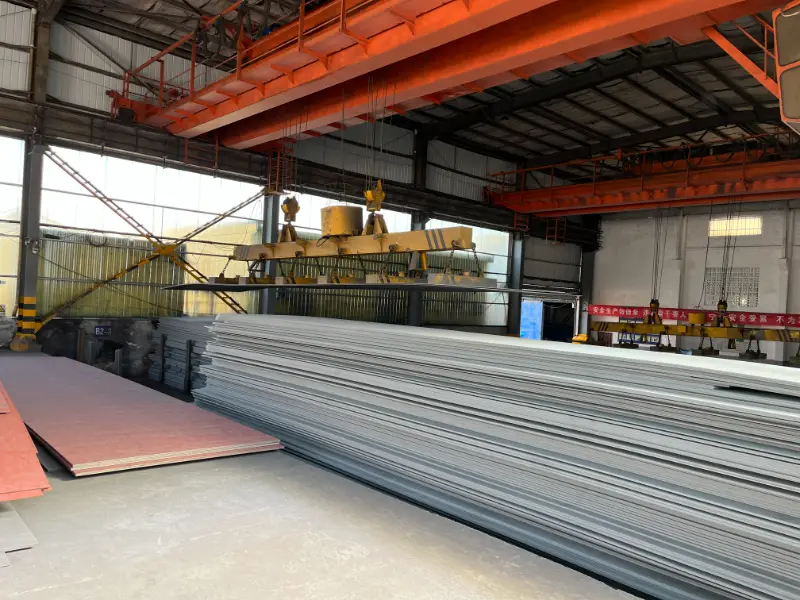
EN10028-2 P235GH Pressure Vessel Steel Plate
EN 10028-2 P235GH: Premium Non-Alloy Steel Plate for Pressure Vessels and Boilers
Detailed data sheet for EN 10028-2 P235GH, a normalized non-alloy steel for pressure purposes at elevated temperatures. Includes chemical composition, mechanical and physical properties, international equivalents, and application guidance.
Hot rolling, normalizing, welding, cold forming, hot forming, machining
- Phone : +8618037372205
- Email : [email protected]
- WhatsApp: Contact via Whtsapp
- WeChat: +8618037372205
EN10028-2 P235GH Pressure Vessel Steel Plate Introduction
P235GH is a non-alloy steel grade defined in the European standard EN 10028-2, specifically designed for pressure vessel and boiler applications requiring elevated temperature service. It is characterized by its good weldability, sufficient toughness at low temperatures, and reliable mechanical properties up to 400°C. The steel is typically supplied in the normalized condition (+N), ensuring a fine ferritic-pearlitic microstructure that provides consistent strength and ductility.
This grade is extensively utilized in the fabrication of unfired pressure vessels, steam boilers, heat exchangers, and piping components. Its balanced composition offers excellent formability and weldability without the need for preheating in moderate thicknesses, while still maintaining the required elevated temperature proof strength. The controlled levels of sulfur and phosphorus, together with microalloying elements like aluminum (for grain refinement) and trace niobium/titanium, contribute to its durability and resistance to aging. P235GH is a cornerstone material in the energy, chemical, and petrochemical industries, complying with the strict safety requirements of the European Pressure Equipment Directive (PED).
EN10028-2 P235GH Pressure Vessel Steel Plate Chemical Composition , as per EN 10028-2:2017
The chemical composition of P235GH is strictly controlled to ensure good weldability, adequate notch toughness, and sufficient elevated temperature strength. The steel is fully killed (Al ≥ 0.020%) and possesses low sulfur and phosphorus contents to enhance cleaness and toughness. The limits on Cr, Cu, Mo, Nb, Ni, Ti, and V are defined to maintain the non-alloy character and avoid undesirable hardenability or property variations.
| Chemical Element | Standard Value (wt%) | Remarks |
|---|---|---|
| Carbon (C) | ≤ 0.16 | Ladle analysis |
| Silicon (Si) | ≤ 0.35 | Ladle analysis |
| Manganese (Mn) | 0.60 – 1.20 | Ladle analysis |
| Phosphorus (P) | ≤ 0.025 | Ladle analysis |
| Sulfur (S) | ≤ 0.015 | Ladle analysis |
| Aluminium (Altotal) | ≥ 0.020 | Grain-refining, fully killed |
| Nitrogen (N) | ≤ 0.012 | Ladle analysis |
| Chromium (Cr) | ≤ 0.30 | Ladle analysis; part of sum (Cr+Cu+Mo+Ni) ≤ 0.70 |
| Copper (Cu) | ≤ 0.30 | Ladle analysis; part of sum (Cr+Cu+Mo+Ni) ≤ 0.70 |
| Molybdenum (Mo) | ≤ 0.08 | Ladle analysis; part of sum (Cr+Cu+Mo+Ni) ≤ 0.70 |
| Niobium (Nb) | ≤ 0.020 | Ladle analysis |
| Nickel (Ni) | ≤ 0.30 | Ladle analysis; part of sum (Cr+Cu+Mo+Ni) ≤ 0.70 |
| Titanium (Ti) | ≤ 0.03 | Ladle analysis |
| Vanadium (V) | ≤ 0.02 | Ladle analysis |
| Cr+Cu+Mo+Ni | ≤ 0.70 | Ladle analysis |
EN10028-2 P235GH Pressure Vessel Steel Plate Thermal and Electrical Physical Properties
The following physical properties are typical for P235GH (non-alloy carbon steel) and are provided for engineering calculations. They are not part of the standard but are derived from recognized material databases. The density, modulus of elasticity, and thermal conductivity are similar to other C-Mn steels and are suitable for design in the 20–400°C range.
| Property | Typical Value | Unit | Test Condition / Temperature |
|---|---|---|---|
| Density (ρ) | 7.85 | g/cm³ | 20°C |
| Elastic Modulus (E) | 210 | GPa | 20°C |
| Elastic Modulus (E) | 190 | GPa | 300°C |
| Elastic Modulus (E) | 180 | GPa | 400°C |
| Shear Modulus (G) | 81 | GPa | 20°C |
| Poisson's Ratio (ν) | 0.30 | - | 20°C |
| Thermal Expansion Coefficient (α) | 11.5 | 10⁻⁶/K | 20 – 100°C |
| Thermal Expansion Coefficient (α) | 12.0 | 10⁻⁶/K | 20 – 200°C |
| Thermal Expansion Coefficient (α) | 12.5 | 10⁻⁶/K | 20 – 300°C |
| Thermal Expansion Coefficient (α) | 12.9 | 10⁻⁶/K | 20 – 400°C |
| Thermal Conductivity (λ) | 52 | W/(m·K) | 20°C |
| Thermal Conductivity (λ) | 51 | W/(m·K) | 100°C |
| Thermal Conductivity (λ) | 49 | W/(m·K) | 200°C |
| Thermal Conductivity (λ) | 47 | W/(m·K) | 300°C |
| Thermal Conductivity (λ) | 44 | W/(m·K) | 400°C |
| Specific Heat Capacity (c) | 460 | J/(kg·K) | 20°C |
| Specific Heat Capacity (c) | 480 | J/(kg·K) | 100°C |
| Specific Heat Capacity (c) | 500 | J/(kg·K) | 200°C |
| Specific Heat Capacity (c) | 520 | J/(kg·K) | 300°C |
| Specific Heat Capacity (c) | 540 | J/(kg·K) | 400°C |
| Electrical Resistivity (ρe) | 0.18 | µΩ·m | 20°C |
EN10028-2 P235GH Pressure Vessel Steel Plate Mechanical Properties , as per EN 10028-2
Mechanical properties of P235GH are guaranteed at room temperature and elevated temperatures. The values depend on the product thickness. The steel exhibits a well-balanced combination of yield strength, tensile strength, and ductility. Impact properties are verified in the transverse direction for thicknesses ≤ 60 mm; for heavier sections, longitudinal specimens are permitted. The elevated temperature proof strength Rp0.2 ensures load-carrying capability up to 400°C.
| Property | Standard Requirement | Unit | Test Condition / Thickness |
|---|---|---|---|
| Yield Strength (ReH) | ≥ 235 | MPa | t ≤ 16 mm |
| Yield Strength (ReH) | ≥ 225 | MPa | 16 < t ≤ 40 mm |
| Yield Strength (ReH) | ≥ 215 | MPa | 40 < t ≤ 60 mm |
| Yield Strength (ReH) | ≥ 200 | MPa | 60 < t ≤ 100 mm |
| Yield Strength (ReH) | ≥ 185 | MPa | 100 < t ≤ 150 mm |
| Yield Strength (ReH) | ≥ 170 | MPa | 150 < t ≤ 250 mm |
| Tensile Strength (Rm) | 360 – 480 | MPa | t ≤ 250 mm |
| Elongation (A) on L0 = 5.65√S0 | ≥ 24 | % | t ≤ 40 mm; transverse |
| Elongation (A) | ≥ 23 | % | 40 < t ≤ 60 mm; transverse |
| Elongation (A) | ≥ 22 | % | 60 < t ≤ 100 mm; transverse |
| Elongation (A) | ≥ 22 | % | 100 < t ≤ 150 mm; transverse |
| Elongation (A) | ≥ 21 | % | 150 < t ≤ 250 mm; transverse |
| Charpy V-notch Impact Energy (KV2) | ≥ 27 at 0°C | J | Transverse; t ≤ 60 mm |
| Charpy V-notch Impact Energy (KV2) | ≥ 27 at -20°C (optional) | J | Transverse; t ≤ 60 mm |
| Charpy V-notch Impact Energy (KVL) | ≥ 40 at 0°C | J | Longitudinal; t > 60 mm |
| Bend Test (180°) | No cracks; mandrel diameter = 1.0 t | - | t ≤ 25 mm |
| Bend Test (180°) | No cracks; mandrel diameter = 2.0 t | - | t > 25 mm |
| Elevated Temperature Rp0.2 | ≥ 205 | MPa | 50°C |
| Elevated Temperature Rp0.2 | ≥ 188 | MPa | 100°C |
| Elevated Temperature Rp0.2 | ≥ 170 | MPa | 150°C |
| Elevated Temperature Rp0.2 | ≥ 157 | MPa | 200°C |
| Elevated Temperature Rp0.2 | ≥ 145 | MPa | 250°C |
| Elevated Temperature Rp0.2 | ≥ 136 | MPa | 300°C |
| Elevated Temperature Rp0.2 | ≥ 126 | MPa | 350°C |
| Elevated Temperature Rp0.2 | ≥ 118 | MPa | 400°C |
EN10028-2 P235GH Pressure Vessel Steel Plate Fully Equivalent Standards and Substitutable Grades
| Country/Region | Standard | Grade | Remarks |
|---|---|---|---|
| European Union | EN 10028-2 | P235GH | Original standard; normalized pressure vessel steel. |
| International (ISO) | ISO 9328-2 | P235GH | Technically identical to EN grade; same chemical and mechanical requirements. |
| Germany | DIN EN 10028-2 | P235GH | Adopted EN; also formerly designated as HI according to older DIN. |
| United Kingdom | BS EN 10028-2 | P235GH | British adoption of the EN standard; equivalent to former BS 1501-161 or 164. |
| France | NF EN 10028-2 | P235GH | French national version, identical requirements. |
| Italy | UNI EN 10028-2 | P235GH | Italian adoption; fully interchangeable. |
EN10028-2 P235GH Pressure Vessel Steel Plate Application Introduction
P235GH is widely employed in industries that require reliable pressure‑containing equipment operating at moderate elevated temperatures. Its excellent weldability, combined with controlled toughness, makes it a first choice for boiler components, pressure vessels, and heat exchangers. Typical deliverables include normalized plates that can be formed, welded, and machined into critical parts. Below are common application areas and components:
Product Applications: Steam boilers (drum shells, headers, tubesheets), Unfired pressure vessels (separators, reactors, distillation columns), Heat exchangers (shells, channel heads, tubesheets), Hot water boilers and accumulators, Deaerators and feedwater tanks, Compressed air receivers, Piping components (large‑diameter flanges, reducers, elbows)
Processed into products: Boiler drums and shells, Dished heads (ellipsoidal, torispherical), Tube sheets and baffles for heat exchangers, Pressure vessel shells and manway rings, Welded nozzles and reinforcement pads, Flanges (plate flanges, blind flanges), Large‑size girth flanges for columns, Expansion bellows (in moderate temperature service), Structural attachments welded to pressure parts, Skirt support parts (subject to pressure vessel code)
Application industries: Power generation (conventional and cogeneration plants), Petrochemical and chemical processing, Oil and gas (refinery vessels, separators), Pharmaceutical and food processing (sterilizers, autoclaves), Industrial boiler manufacturing, Heat exchanger and condenser fabrication, Storage tank construction (pressurized tanks)
EN10028-2 P235GH Pressure Vessel Steel Plate Similar / Comparable Material Recommendations
| Country/Region | Standard | Grade | Remarks |
|---|---|---|---|
| China | GB/T 713 | Q245R | Similar low‑carbon boiler steel; minimum yield 245 MPa, tensile 400–520 MPa; direct substitute in many designs. |
| Japan | JIS G3103 | SB410 | Carbon‑steel boiler and pressure vessel plate; tensile 410–550 MPa; somewhat higher strength, suitable for comparable service. |
| USA | ASTM A285 / ASME SA285 | Grade C | Pressure vessel plates for lower‑temperature applications; yield 205 MPa min, tensile 380–515 MPa; often used where P235GH is specified but with minor design adjustments. |
| India | IS 2002 | Gr. 1 | Quality A/B carbon steel for boilers; analogous to P235GH; check supplementary impact requirements. |
| European (higher strength) | EN 10028-2 | P265GH | Similar alloy concept with higher yield (265 MPa min) and tensile strength; used when a thinner wall thickness is desired. |
| European (higher strength) | EN 10028-2 | P295GH | Higher strength grade (295 MPa min yield); can replace P235GH if design allows and welding considerations are addressed. |
Notes:
Additional Information:
- P235GH is suitable for hydrogen service up to certain thresholds; consult NACE MR0175/ISO 15156 if sour service is anticipated.
- Post‑weld heat treatment (PWHT) is normally required according to the design code (e.g., EN 13445) based on thickness and welding energy.
- For thicknesses above 150 mm, special qualifying tests (e.g., simulated PWHT properties) may be agreed upon.
- The grade can be supplied with restricted chemical composition for improved toughness or elevated temperature properties (e.g., with controlled nitrogen and aluminum ratio).
- When vacuum degassing is applied, the steel possesses very low hydrogen content, reducing the risk of hydrogen‑induced cracking.
- Share



