
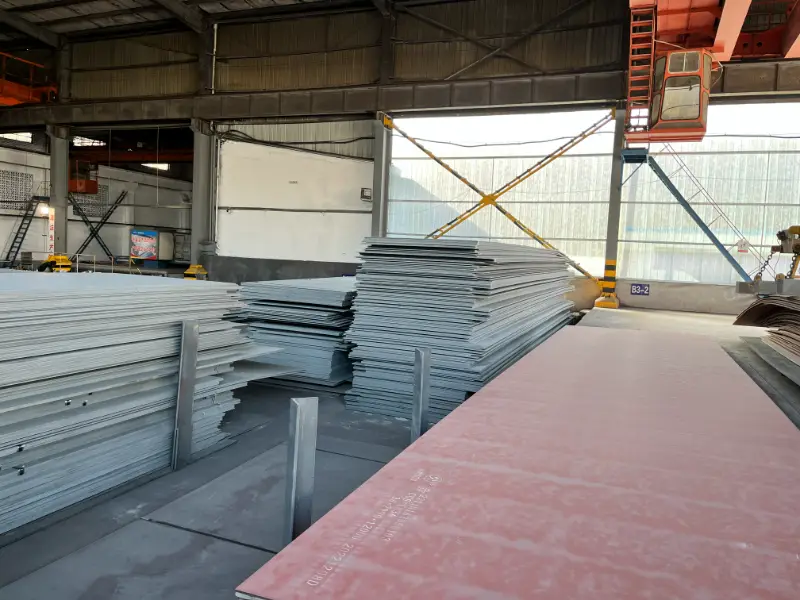
EN 10028-2 P265GH Pressure Vessel and Boiler Steel Plate
EN 10028-2 P265GH Pressure Vessel and Boiler Steel Plate - Properties, Equivalents and Applications
Comprehensive technical data for P265GH steel according to EN 10028-2, including chemical composition, mechanical properties, thermal/physical characteristics, global equivalents and application guidelines.
Hot rolling, normalizing, cutting, bending, welding, forming
- Phone : +8618037372205
- Email : [email protected]
- WhatsApp: Contact via Whtsapp
- WeChat: +8618037372205
EN 10028-2 P265GH Pressure Vessel and Boiler Steel Plate Introduction
P265GH is a non-alloy steel grade specified in EN 10028-2 for pressure vessels and boilers operating at elevated temperatures. It is supplied in the normalized condition and offers a good combination of weldability, high-temperature strength and ductility. The minimum yield strength is 265 MPa for thicknesses up to 16 mm, with tensile strength in the range 410–530 MPa. The steel is suitable for moderate temperature applications up to approximately 400 °C and is widely used in the fabrication of pressure equipment such as boiler drums, storage tanks and heat exchangers. Key features include:
- Excellent weldability and formability
- Good notch toughness at low temperatures when impact tested
- Consistent mechanical properties through thickness up to 250 mm
- Worldwide recognition with equivalent grades in ASME, ISO and other national standards
EN 10028-2 P265GH Pressure Vessel and Boiler Steel Plate Chemical Composition
Ladle analysis according to EN 10028-2 for grade P265GH. Carbon content depends on product thickness; values below are for thickness ≤16 mm. For thicker plates, the maximum carbon increases (e.g. ≤0.22% for 16< t ≤40 mm). Total aluminium ensures fine grain practice. Cr+Cu+Mo+Ni ≤ 0.70% is a hard maximum on residual elements.
| Element | Standard Value | Remarks |
|---|---|---|
| Carbon (C) | ≤ 0.20 | Applies to thickness ≤ 16 mm; higher limits for thicker sections |
| Silicon (Si) | ≤ 0.40 | |
| Manganese (Mn) | 0.50 – 1.40 | |
| Phosphorus (P) | ≤ 0.025 | |
| Sulfur (S) | ≤ 0.015 | |
| Aluminium (Al total) | ≥ 0.020 | Typically 0.020–0.060; ensures fine grain practice |
| Nitrogen (N) | ≤ 0.012 | |
| Chromium (Cr) | ≤ 0.30 | |
| Copper (Cu) | ≤ 0.30 | |
| Molybdenum (Mo) | ≤ 0.08 | |
| Niobium (Nb) | ≤ 0.01 | |
| Nickel (Ni) | ≤ 0.30 | |
| Titanium (Ti) | ≤ 0.03 | |
| Vanadium (V) | ≤ 0.02 | |
| Cr+Cu+Mo+Ni | ≤ 0.70 | Sum of residual elements |
EN 10028-2 P265GH Pressure Vessel and Boiler Steel Plate Thermal and Electrical Physical Properties
Representative physical properties for P265GH as a carbon steel. These values are not directly specified in the material standard but are typical for this grade across the operating temperature range. The properties are essential for design calculations involving heat transfer, thermal expansion and stress analysis.
| Property | Typical Value | Unit | Condition / Remarks |
|---|---|---|---|
| Density (ρ) | 7.85 | g/cm³ | At 20 °C |
| Elastic Modulus (E) | 210 | GPa | At 20 °C |
| Shear Modulus (G) | ≈ 81 | GPa | Calculated, at 20 °C |
| Poisson's Ratio (ν) | 0.30 | — | At 20 °C |
| Thermal Expansion Coefficient (α) | 11.5 | ×10⁻⁶ /K | 20 – 100 °C |
| Thermal Expansion Coefficient (α) | 12.2 | ×10⁻⁶ /K | 20 – 200 °C |
| Thermal Expansion Coefficient (α) | 12.8 | ×10⁻⁶ /K | 20 – 300 °C |
| Thermal Conductivity (λ) | 51 | W/(m·K) | At 20 °C |
| Thermal Conductivity (λ) | 50 | W/(m·K) | At 100 °C |
| Thermal Conductivity (λ) | 48 | W/(m·K) | At 200 °C |
| Thermal Conductivity (λ) | 45 | W/(m·K) | At 300 °C |
| Specific Heat Capacity (cp) | 460 | J/(kg·K) | At 20 °C |
| Electrical Resistivity (ρ_e) | 0.13 – 0.20 | Ω·mm²/m | At 20 °C, typical for carbon steel |
EN 10028-2 P265GH Pressure Vessel and Boiler Steel Plate Mechanical Properties
Mechanical properties at room temperature for P265GH in normalized (+N) condition according to EN 10028-2. Yield strength and elongation depend on plate thickness. Tensile strength is nearly constant across the thickness range. Impact energy values are for transverse test pieces with option 4 (0 °C) or option 5 (-20 °C) when agreed at the time of enquiry and order. Bend test applies to sheared or flame-cut edges.
| Property | Standard Requirement | Unit | Test Condition / Remarks |
|---|---|---|---|
| Yield Strength (ReH) | 265 | MPa | Thickness ≤ 16 mm |
| Yield Strength (ReH) | 255 | MPa | Thickness > 16 mm ≤ 40 mm |
| Yield Strength (ReH) | 245 | MPa | Thickness > 40 mm ≤ 60 mm |
| Yield Strength (ReH) | 215 | MPa | Thickness > 60 mm ≤ 100 mm |
| Yield Strength (ReH) | 200 | MPa | Thickness > 100 mm ≤ 150 mm |
| Yield Strength (ReH) | 185 | MPa | Thickness > 150 mm ≤ 250 mm |
| Tensile Strength (Rm) | 410 – 530 | MPa | Thickness ≤ 100 mm |
| Tensile Strength (Rm) | 400 – 530 | MPa | Thickness > 100 mm ≤ 250 mm |
| Elongation (A, L0=5.65√S0) | 24 | % | Longitudinal, thickness ≤ 40 mm |
| Elongation (A, L0=5.65√S0) | 23 | % | Longitudinal, thickness > 40 mm ≤ 60 mm |
| Elongation (A, L0=5.65√S0) | 22 | % | Longitudinal, thickness > 60 mm ≤ 100 mm |
| Elongation (A, L0=5.65√S0) | 22 | % | Transverse, thickness ≤ 40 mm |
| Elongation (A, L0=5.65√S0) | 21 | % | Transverse, thickness > 40 mm ≤ 60 mm |
| Elongation (A, L0=5.65√S0) | 20 | % | Transverse, thickness > 60 mm ≤ 100 mm |
| Impact Energy (KV, 0 °C) | ≥ 34 | J | Transverse, thickness ≤ 60 mm (Option 4) |
| Impact Energy (KV, 0 °C) | ≥ 27 | J | Transverse, thickness > 60 mm ≤ 100 mm (Option 4) |
| Impact Energy (KV, -20 °C) | ≥ 27 | J | Transverse, thickness ≤ 60 mm (Option 5) |
| Bend Test (180°) | Mandrel diameter = 2 × thickness | — | Thickness < 12.5 mm |
| Bend Test (180°) | Mandrel diameter = 3 × thickness | — | Thickness ≥ 12.5 mm |
EN 10028-2 P265GH Pressure Vessel and Boiler Steel Plate Exactly Equivalent Material Standards and Replaceable Grades
Grades that are technically identical to EN 10028-2 P265GH, either through direct adoption of the EN standard or via ISO harmonisation. These materials share the same chemical composition, mechanical properties and delivery condition and may be used interchangeably without additional qualification.
| Country/Region | Standard | Grade | Remarks |
|---|---|---|---|
| Europe / International | EN 10028-2 | P265GH | Original standard; normalized delivery condition |
| International | ISO 9328-2 | P265GH | Identical technical content |
| France | NF A36-205 | P265GH | National adoption of EN |
| Germany | DIN EN 10028-2 | P265GH | German edition |
| United Kingdom | BS EN 10028-2 | P265GH | British Standard adoption |
| Italy | UNI EN 10028-2 | P265GH | Italian edition |
| Spain | UNE EN 10028-2 | P265GH | Spanish edition |
EN 10028-2 P265GH Pressure Vessel and Boiler Steel Plate Application Introduction
P265GH is a versatile pressure vessel steel designed for the fabrication of welded pressure equipment operating at elevated temperatures. Its good weldability, formability and consistent through-thickness properties make it suitable for a wide range of industrial applications, from simple storage tanks to complex boiler components. The steel is typically normalized to refine the grain structure, ensuring reliable mechanical properties.
Product Applications: Pressure vessels and storage tanks (LPG, ammonia, process chemicals), Industrial boilers and steam drums, Heat exchangers and condensers, Boiler tubes and headers (when produced from plate), Autoclaves and reactors, Piping components (reducers, flanges, pipe bends), Columns and distillation towers
Processed into products: Cylindrical shells and dished ends of pressure vessels, Tube plates and baffles for heat exchangers, Flanges and bolted connection parts (when flame-cut from plate), Steam drum barrel plates and water wall headers, Reinforcement pads and nozzles, Structural parts for high-temperature service, Bend segments and pipe fittings (e.g. elbows, tees)
Application industries: Oil & Gas (upstream and downstream processing equipment), Chemical and Petrochemical Plants, Power Generation (conventional and nuclear thermal power plants), Shipbuilding (LPG carriers, boiler pressure parts), Industrial Boiler and Heat Exchanger Construction, Nuclear Engineering (secondary circuit components), Food and Beverage (storage and process vessels)
EN 10028-2 P265GH Pressure Vessel and Boiler Steel Plate Similar / Close Alternative Material Recommendations
Steel grades with comparable chemical and mechanical properties, commonly used as substitutes for P265GH in pressure vessel applications. While not fully identical, these materials can often be used with appropriate design adjustments and code approvals. Pay attention to yield strength differences and impact requirements.
| Country/Region | Standard | Grade | Remarks |
|---|---|---|---|
| USA | ASTM A516/A516M | Grade 60 | Tensile 415–550 MPa, yield 220 MPa min. Lower yield but similar tensile range; suitable for moderate temperatures |
| USA | ASTM A516/A516M | Grade 65 | Tensile 450–585 MPa, yield 240 MPa min. Higher tensile strength; commonly used as a replacement |
| USA | ASTM A516/A516M | Grade 70 | Tensile 485–620 MPa, yield 260 MPa min. Higher strength; may require re-certification for welding |
| Japan | JIS G3103 | SB450 | Tensile 450–590 MPa, yield 245 MPa min. Similar pressure vessel steel for elevated temperature |
| China | GB 713 | Q245R | Tensile 400–520 MPa, yield 245 MPa min. Chinese boiler and pressure vessel steel; closely matches P265GH |
| Korea | KS D 3521 | SPV235 | Tensile 400–510 MPa, yield 235 MPa min. Slightly lower strength but compatible in many designs |
Notes:
When ordering P265GH according to EN 10028-2, the following options should be agreed at the time of enquiry: impact testing temperature (0 °C or -20 °C), supplementary non-destructive testing (e.g. ultrasonic examination), and limitations on residual elements. For thicknesses above 100 mm, through-thickness properties (Z-quality) may be required according to EN 10164. The material is not intended for long-term service above 400 °C; for higher temperatures, creep-resistant grades such as 16Mo3 or 13CrMo4-5 should be considered. P265GH is fully weldable using all common arc welding processes with preheating and post-weld heat treatment according to EN 13445 or ASME VIII.
- Share



