
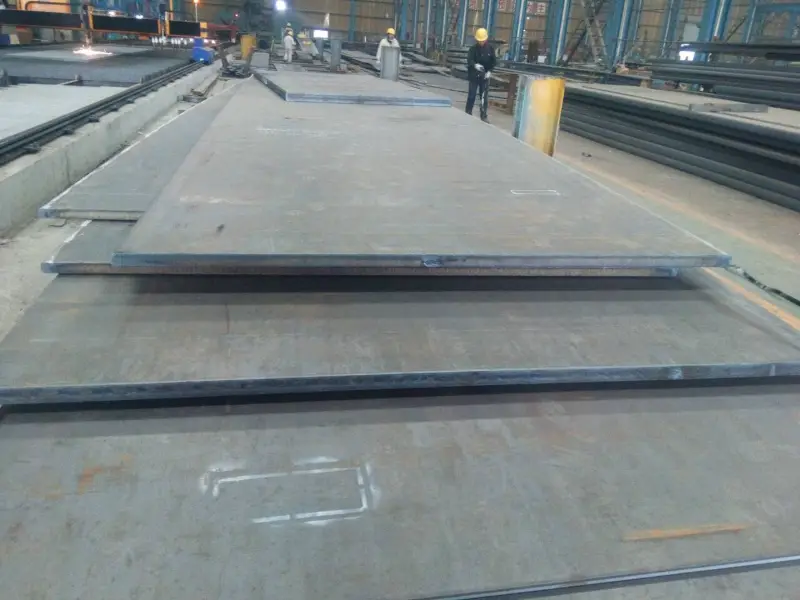
P275NL1 Pressure Vessel Steel Plate
P275NL1 Pressure Vessel Steel Plate | EN 10028-3 Standard, Low-Temperature Properties
Explore EN 10028-3 P275NL1 normalized fine-grain steel for pressure vessels and boilers. Chemical composition, mechanical properties, and thermal data provided.
Hot rolling and normalizing; suitable for welding, bending, flanging, and machining
- Phone : +8618037372205
- Email : [email protected]
- WhatsApp: Contact via Whtsapp
- WeChat: +8618037372205
P275NL1 Pressure Vessel Steel Plate Introduction
P275NL1 is a normalized, weldable fine-grain steel plate specified in EN 10028-3 for pressure vessels and boilers operating at low temperatures. The designator NL1 indicates enhanced notch toughness at a minimum design temperature of -40°C. It offers a good combination of yield strength (≥275 MPa for thinner gauges), excellent weldability, and resistance to brittle fracture. The steel is supplied in normalized condition and is suitable for the fabrication of cylindrical shells, heads, and support structures in the petrochemical, chemical, and power generation industries. Its fine-grain practice ensures uniform properties across thicknesses up to 250 mm.
P275NL1 Pressure Vessel Steel Plate Chemical Composition
Chemical limits according to EN 10028-3:2017 for P275NL1. Values are maximum unless a range is given. Fine-grain elements such as Al, Nb, Ti, and V are controlled to ensure the notch toughness at low temperatures.
| Element | Standard Value (%) | Remarks |
|---|---|---|
| Carbon (C) | ≤ 0.16 | |
| Silicon (Si) | ≤ 0.40 | |
| Manganese (Mn) | 0.80 – 1.50 | |
| Phosphorus (P) | ≤ 0.020 | |
| Sulfur (S) | ≤ 0.010 | |
| Aluminum (Al, total) | ≥ 0.020 | Fine-grain element |
| Nitrogen (N) | ≤ 0.012 | |
| Chromium (Cr) | ≤ 0.30 | |
| Copper (Cu) | ≤ 0.30 | |
| Molybdenum (Mo) | ≤ 0.08 | |
| Niobium (Nb) | ≤ 0.05 | |
| Nickel (Ni) | ≤ 0.50 | |
| Titanium (Ti) | ≤ 0.03 | |
| Vanadium (V) | ≤ 0.05 | |
| Cr + Cu + Mo | ≤ 0.45 | Combined maximum |
| Nb + Ti + V | ≤ 0.12 | Combined maximum |
P275NL1 Pressure Vessel Steel Plate Thermal and Electrical Physical Properties
Physical data are typical for normalized fine-grain carbon-manganese steels and are not specified in the standard. They may vary slightly with heat treatment and composition. Density, modulus, and thermal expansion are essential for design calculations.
| Property | Typical Value | Unit | Test Condition / Remarks |
|---|---|---|---|
| Density (ρ) | 7.85 | g/cm³ | 20°C |
| Young Modulus (E) | 210 | GPa | 20°C |
| Shear Modulus (G) | 81 | GPa | 20°C, calculated from E and ν |
| Poisson Ratio (ν) | 0.3 | - | Typical for steel |
| Thermal expansion coefficient (α) | 12.0 × 10⁻⁶ | K⁻¹ | 20 – 100°C |
| Thermal expansion coefficient (α) | 12.5 × 10⁻⁶ | K⁻¹ | 20 – 200°C |
| Thermal expansion coefficient (α) | 13.0 × 10⁻⁶ | K⁻¹ | 20 – 300°C |
| Thermal conductivity (λ) | 50 | W/(m·K) | at 20°C |
| Thermal conductivity (λ) | 47 | W/(m·K) | at 200°C |
| Thermal conductivity (λ) | 43 | W/(m·K) | at 300°C |
| Specific heat capacity | 460 | J/(kg·K) | 20 – 100°C |
| Specific heat capacity | 500 | J/(kg·K) | 20 – 200°C |
| Specific heat capacity | 530 | J/(kg·K) | 20 – 300°C |
| Electrical resistivity (ρ_e) | 0.22 – 0.25 | µΩ·m | at 20°C |
P275NL1 Pressure Vessel Steel Plate Mechanical Properties
Minimum specified values per EN 10028-3. Actual properties depend on thickness (t, in mm). Impact testing is performed at -40°C for NL1 grade. For thickness >250 mm, properties shall be agreed at the time of enquiry and order.
| Property | Standard Requirement | Unit | Test Condition / Remarks |
|---|---|---|---|
| Yield Strength (ReH) | ≥ 275 | MPa | t ≤ 16 mm |
| Yield Strength (ReH) | ≥ 265 | MPa | 16 < t ≤ 40 mm |
| Yield Strength (ReH) | ≥ 255 | MPa | 40 < t ≤ 60 mm |
| Yield Strength (ReH) | ≥ 245 | MPa | 60 < t ≤ 100 mm |
| Yield Strength (ReH) | ≥ 235 | MPa | 100 < t ≤ 150 mm |
| Yield Strength (ReH) | ≥ 225 | MPa | 150 < t ≤ 250 mm |
| Tensile Strength (Rm) | 390 – 530 | MPa | t ≤ 40 mm |
| Tensile Strength (Rm) | 380 – 520 | MPa | 40 < t ≤ 60 mm |
| Tensile Strength (Rm) | 370 – 510 | MPa | 60 < t ≤ 100 mm |
| Tensile Strength (Rm) | 360 – 510 | MPa | 100 < t ≤ 150 mm |
| Tensile Strength (Rm) | 350 – 510 | MPa | 150 < t ≤ 250 mm |
| Elongation after fracture (A) | ≥ 24 | % | t ≤ 40 mm, gauge length 5.65√So |
| Elongation after fracture (A) | ≥ 23 | % | 40 < t ≤ 60 mm |
| Elongation after fracture (A) | ≥ 22 | % | 60 < t ≤ 100 mm |
| Elongation after fracture (A) | Agreed | - | t > 100 mm |
| Impact energy (KV) at -40°C | ≥ 27 | J | Longitudinal, 10×10 mm specimen; transverse 20 J |
| Bend test (mandrel diameter) | No cracks | - | 180° bend, d=2a (t≤16mm), d=3a (t>16mm) |
P275NL1 Pressure Vessel Steel Plate Fully Equivalent Material Standards and Substitutable Grades
| Country/Region | Standard | Grade | Remarks |
|---|---|---|---|
| EU | EN 10028-3 | P275NL1 | Identical parent grade |
| Germany | DIN EN 10028-3 (adopted) | P275NL1 | German adoption of EN standard |
| UK | BS EN 10028-3 | P275NL1 | British adoption; formerly 224-490B |
| France | NF EN 10028-3 | P275NL1 | French standard, identical to EN |
| Italy | UNI EN 10028-3 | P275NL1 | Italian adoption |
| Spain | UNE EN 10028-3 | P275NL1 | Spanish adoption |
| Japan | JIS G 3115 | SPV315 (with low-temperature test) | Comparable but not identical; requires supplementary impact testing at -40°C |
| USA | ASTM A537 / A537M | Class 1 | Similar normalized pressure vessel steel; impact test at -40°F (-40°C) may be specified |
P275NL1 Pressure Vessel Steel Plate Application Introduction
P275NL1 is designed for the fabrication of welded pressure-containing components operating at low ambient temperatures and moderate pressure. It can be cut, cold formed, hot formed (with subsequent normalizing if necessary), and welded using all common arc welding processes with low-hydrogen practices.
Product Applications: Pressure vessels and reactors, Boiler drums and shells, Heat exchangers and condensers, Low-temperature storage tanks (LPG, ammonia), Columns and distillation towers, Autoclaves
Processed into products: Cylindrical shells and courses (rolled and welded), Ellipsoidal, hemispherical, and torispherical heads (pressed or spun), Nozzle and manway reinforcements, Support skirts and saddles, Flanges and blind covers, Stiffening rings and lifting lugs
Application industries: Oil & Gas (refineries, LNG plants, pipelines), Petrochemical and chemical processing, Power generation (boiler drums, heat recovery steam generators), Renewable energy (biomass boilers, geothermal components), Shipbuilding (cargo tanks, pressure vessels on FPSOs), Industrial gas storage and transport
P275NL1 Pressure Vessel Steel Plate Similar / Alternative Steel Recommendations
| Country/Region | Standard | Grade | Remarks |
|---|---|---|---|
| EU | EN 10028-3 | P275NL2 | Higher low-temperature toughness (tested at -50°C), slightly higher Ni content |
| EU | EN 10028-3 | P275N | Similar base strength without low-temperature requirement |
| USA | ASTM A516 / A516M | Grade 65 or 70 | Carbon steel for pressure vessels; requires supplementary impact testing for low-temperature service; deoxidized practice differs |
| USA | ASTM A516 / A516M | Grade 70 (with HIC test) | For sour service; not inherently fine-grain treated |
| China | GB/T 713 | 14Cr1MoR, 12Cr2Mo1R | Cr-Mo steels for pressure vessels; different mechanical and thermal properties, used for elevated temperatures |
| International | ISO 16833 | PH 275 | Comparable normalized steel for pressure purposes; similar composition and properties |
Notes:
Note: All values are based on the latest edition of EN 10028-3. For thickness above 250 mm, requirements are subject to agreement. This steel is produced via a fine-grain practice (Al and/or Nb, V, Ti microalloyed) and must exhibit a minimum of 27 J at -40°C on longitudinal Charpy-V specimens. Supplemental requirements such as ultrasonic testing, elevated temperature properties, and simulated post-weld heat treatment can be specified at the time of order. This material is CE marked under the EU Construction Products Regulation when used in structural pressure applications.
- Share



