
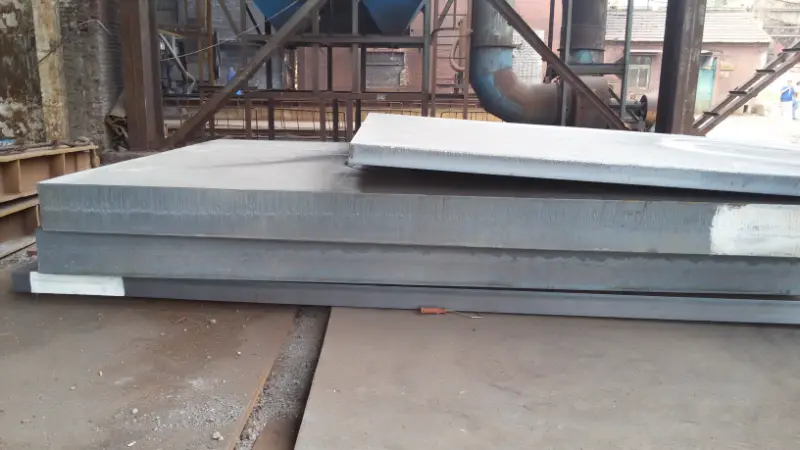
EN 10028-5 P420ML1
EN 10028-5 P420ML1: Thermomechanically Rolled Fine Grain Steel for Pressure Vessels and Boilers
Detailed technical data for EN 10028-5 P420ML1 steel plate: chemical composition, mechanical properties, physical properties, international equivalents, and application guidelines.
Thermomechanical rolled (TMCP); suitable for cold forming, hot forming within limits, welding by all conventional methods; no normalizing required.
- Phone : +8618037372205
- Email : [email protected]
- WhatsApp: Contact via Whtsapp
- WeChat: +8618037372205
EN 10028-5 P420ML1 Introduction
EN 10028-5 P420ML1 is a high-strength, thermomechanically rolled weldable fine grain steel designed for pressure vessel and boiler applications. The 'M' denotes thermomechanical rolling (TMCP), which refines grain structure and provides an excellent balance of strength, ductility, and weldability. The 'L1' indicates guaranteed impact toughness down to -40 °C. With a minimum yield strength of 420 MPa in thinner gauges, it allows lighter vessel designs while maintaining safety margins. Carbon and microalloying elements are closely controlled to ensure low carbon equivalent (CEV) and good weldability, often eliminating or reducing the need for preheating. Widely adopted in European pressure vessel fabrication, P420ML1 complies with EN 13445 and other international design codes.
EN 10028-5 P420ML1 Chemical Composition
The composition of P420ML1 is carefully balanced to achieve fine grain size, high strength, and excellent weldability. Maximum carbon is limited to 0.16% to maintain low carbon equivalent. Microalloying elements (Nb, V, Ti) provide grain refinement and precipitation strengthening while their combined content is restricted. Low phosphorus and sulfur levels ensure good ductility and cleanliness. A minimum aluminium content guarantees full deoxidation. The carbon equivalent (CEV) is typically below 0.45%, ensuring good weldability without excessive preheat.
| Element | Heat Analysis (max, unless range) | Remarks |
|---|---|---|
| C (Carbon) | 0.16 | |
| Si (Silicon) | 0.50 | |
| Mn (Manganese) | 1.70 | |
| P (Phosphorus) | 0.020 | |
| S (Sulfur) | 0.010 | |
| Al total (Aluminium) | ≥ 0.020 | Minimum total aluminium content |
| Nb (Niobium) | 0.05 | |
| V (Vanadium) | 0.10 | |
| Ti (Titanium) | 0.05 | |
| Cr (Chromium) | 0.30 | |
| Ni (Nickel) | 1.00 | |
| Mo (Molybdenum) | 0.20 | |
| Cu (Copper) | 0.30 | |
| N (Nitrogen) | 0.020 | If sufficient nitrogen-fixing elements are present, higher N may be allowed |
| Cr+Cu+Mo | 0.45 | Maximum combined content |
| Nb+V+Ti | 0.12 | Maximum combined content |
| CEV | ≈0.45 (typical) | CEV = C + Mn/6 + (Cr+Mo+V)/5 + (Ni+Cu)/15 |
EN 10028-5 P420ML1 Physical Properties
These typical physical property values are provided for engineering calculations. They are not specified in EN 10028-5 but represent standard data for carbon-manganese steels of this type. Density is approximately 7.85 g/cm³. The elastic constants, thermal expansion, thermal conductivity, specific heat, and electrical resistivity are given for common temperature ranges encountered in pressure vessel design. Actual values may vary slightly depending on exact chemical composition and thermomechanical processing history.
| Property | Typical Value | Unit | Condition / Temperature |
|---|---|---|---|
| Density (ρ) | 7.85 | g/cm³ | 20 °C |
| Modulus of elasticity (E) | 210 | GPa | 20 °C |
| Shear modulus (G) | 81 | GPa | Calculated from E and ν |
| Poisson's ratio (ν) | 0.3 | – | 20 °C |
| Thermal expansion coefficient (α) | 11.5 | 10⁻⁶/K | 20 – 200 °C |
| Thermal expansion coefficient (α) | 12.4 | 10⁻⁶/K | 20 – 300 °C |
| Thermal conductivity (λ) | 43 | W/(m·K) | 20 °C |
| Thermal conductivity (λ) | 40 | W/(m·K) | 200 °C |
| Specific heat capacity (c) | 460 | J/(kg·K) | 20 °C |
| Specific heat capacity (c) | 490 | J/(kg·K) | 200 °C |
| Electrical resistivity (ρ_e) | 0.25 | µΩ·m | 20 °C |
EN 10028-5 P420ML1 Mechanical Properties
Tensile tests are performed at room temperature per EN ISO 6892-1. Impact tests are carried out on Charpy V-notch specimens at -40 °C, with minimum average energy of 27 J for transverse samples. Yield strength decreases with increasing plate thickness; the table lists the standard thickness categories. Elongation is measured on a gauge length of 5.65√S0 (A5) for longitudinal specimens; for transverse specimens, the minimum values may be 2 percentage points lower. Values for thicknesses beyond 100 mm are subject to agreement.
| Property | Required Value | Unit | Test Condition |
|---|---|---|---|
| Yield strength (ReH) | ≥ 420 | MPa | Thickness t ≤ 16 mm |
| Yield strength (ReH) | ≥ 400 | MPa | 16 mm < t ≤ 40 mm |
| Yield strength (ReH) | ≥ 380 | MPa | 40 mm < t ≤ 63 mm |
| Yield strength (ReH) | ≥ 360 | MPa | 63 mm < t ≤ 100 mm |
| Tensile strength (Rm) | 530 – 680 | MPa | t ≤ 40 mm |
| Tensile strength (Rm) | 510 – 660 | MPa | 40 mm < t ≤ 63 mm |
| Tensile strength (Rm) | 500 – 650 | MPa | 63 mm < t ≤ 100 mm |
| Elongation (A) | ≥ 19 | % | Longitudinal, t ≤ 40 mm |
| Elongation (A) | ≥ 19 | % | Longitudinal, 40 mm < t ≤ 63 mm |
| Elongation (A) | ≥ 19 | % | Longitudinal, 63 mm < t ≤ 100 mm |
| Impact energy (KV2) | ≥ 27 | J | -40 °C, transverse, average of 3; one individual ≥ 70% of average |
EN 10028-5 P420ML1 Exact Equivalent Material Standards and Alternative Designations
| Region/Standard | Standard | Grade | Remarks |
|---|---|---|---|
| International (ISO) | ISO 9328-4:2018 | P420ML1 | Direct equivalent for pressure vessel plates, same chemical and mechanical requirements. |
| Europe | EN 10028-5 | P420ML2 | Upgrade substitute with better low-temperature toughness (-50 °C); otherwise identical. |
| Germany | DIN EN 10028-5 | P420ML1 | National adoption of EN standard, completely identical. |
| USA | ASTM A841/A841M | Grade B | TMCP pressure vessel plate with similar minimum yield strength (420 MPa for t ≤ 25 mm). Not identical but technically comparable. |
EN 10028-5 P420ML1 Application Introduction
P420ML1 is optimized for welded pressure equipment operating at low to moderate temperatures. Its fine grain structure and clean composition provide excellent resistance to brittle fracture. It is extensively used in the as-delivered thermomechanically rolled condition without subsequent heat treatment. Cold forming should follow recommended strain limits to avoid strain ageing; for severe forming, hot forming or a subsequent stress relief may be advisable. Post-weld heat treatment (PWHT) can be applied according to pressure vessel code requirements, and the steel retains good properties after such treatment. Welding procedures should consider the carbon equivalent and recommended heat inputs to maintain toughness in the heat-affected zone.
Product Applications: Welded pressure vessels for high-pressure processes, Industrial and utility boilers, Spherical and cylindrical storage tanks for cold liquids and gases, Process columns, reactors, and distillation towers, Shell-and-tube heat exchangers and condensers, High-pressure piping and manifolds, Penstocks and hydroelectric conduits, Cryogenic storage vessels (LPG, ethylene, etc.)
Processed into products: Shell courses and cylindrical shell plates, Formed and pressed heads (dished ends), Tube sheets and flanges, Nozzle necks, reinforcements, and forgings, Stiffening rings, support skirts, and saddles, Baffles, trays, and internal structures, Transition joints between different strength levels, Gusset plates, lifting lugs, and attachment pads
Application industries: Oil and gas processing and storage, Chemical and petrochemical plants, Power generation (conventional and nuclear), Shipbuilding (LNG and LPG tanks), Offshore platforms and topside modules, Cryogenic and low-temperature equipment (down to -40 °C), Heat exchanger and boiler manufacturing, Water treatment and desalination facilities
EN 10028-5 P420ML1 Similar or Alternative Materials for Comparison
| Material Name | Standard | Key Differences | Remarks |
|---|---|---|---|
| P355ML1 | EN 10028-5 | Lower minimum yield strength (355 MPa). | Suitable for less demanding pressure applications; can replace P420ML1 if design stress allows. |
| P460ML1 | EN 10028-5 | Higher minimum yield strength (460 MPa). | Offers weight savings for high-pressure vessels; requires more stringent welding controls. |
| P420QH | EN 10028-6 | Quenched and tempered instead of TMCP. | Same strength class but different processing; may exhibit different toughness and weldability. |
| A537 Class 1 | ASTM A537/A537M | Quenched and tempered, min. YS 310 MPa, not strength equivalent. | Not a direct substitute; only suitable where lower strength is permissible. |
| S420ML | EN 10025-4 | Structural steel (TMCP) with same yield strength, but not intended for pressure vessels. | Lacks pressure vessel certification; use only in non-pressure structural components. |
Notes:
For demanding applications, additional requirements may be specified: improved through-thickness properties (Z-quality) per EN 10164, ultrasonic testing (UT) per EN 10160 equivalent to S2E3 or S1E1, and lower carbon equivalent (e.g., CEV ≤ 0.43) for enhanced weldability. Design stresses should be derived from the relevant pressure vessel code (EN 13445, ASME Section VIII, or PD 5500) using the specified minimum yield and tensile strengths. For service below -40 °C, consider the ML2 variant (EN 10028-5 P420ML2) which guarantees toughness down to -50 °C. Always refer to the latest edition of the standard and project-specific specifications.
- Share



