
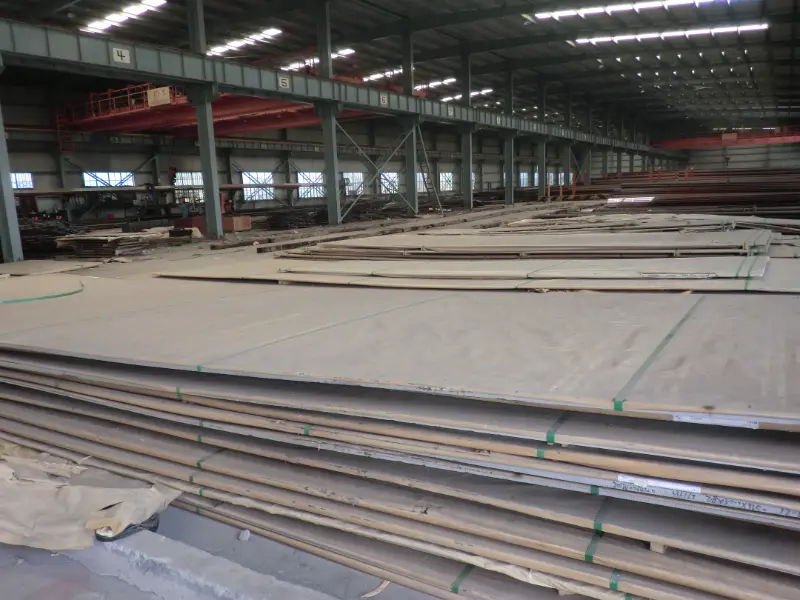
EN10028-6 P460Q Steel Plate
EN10028-6 P460Q Steel Plate: High-Strength Quenched & Tempered Steel for Pressure Vessels
Detailed data for EN10028-6 P460Q, a quenched and tempered fine-grain steel for pressure vessels. Includes chemical composition, mechanical properties, physical properties, and equivalent grades.
Hot rolling, quenching and tempering, welding, hot forming (with subsequent heat treatment)
- Phone : +8618037372205
- Email : [email protected]
- WhatsApp: Contact via Whtsapp
- WeChat: +8618037372205
EN10028-6 P460Q Steel Plate Introduction
P460Q is a weldable fine-grain structural steel for pressure purposes, supplied in the quenched and tempered (+QT) condition under standard EN 10028-6. It offers a minimum yield strength of 460 MPa (for thicknesses up to 50 mm) combined with good toughness down to low temperatures. The chemical composition is balanced to ensure excellent weldability, high strength, and reliable performance in demanding pressure vessel and boiler applications. Typical thicknesses range from 3 mm to 150 mm. This steel is characterized by its fine-grain microstructure obtained through controlled rolling, quenching, and tempering, which provides uniform mechanical properties over the entire plate. It is suitable for static and dynamic loads, and when proper welding procedures are followed, it retains its toughness in the heat-affected zone. Common industrial sectors include petrochemical, power generation, and offshore engineering. P460Q meets strict safety standards and can be certified for low-temperature impact toughness down to -50°C upon agreement.
EN10028-6 P460Q Steel Plate Chemical Composition
The chemical composition meets the requirements of EN 10028-6:2017 for P460Q. Limits ensure weldability, toughness, and strength after quenching and tempering. Fine grain practice is secured by a minimum aluminium content and controlled additions of niobium, vanadium, titanium, and/or zirconium, with the sum Nb+V+Ti not exceeding 0.13%.
| Element | Standard Range (%) | Remarks |
|---|---|---|
| Carbon (C) | ≤0.20 | Maximum |
| Silicon (Si) | ≤0.60 | Maximum |
| Manganese (Mn) | 1.00 – 1.70 | Range |
| Phosphorus (P) | ≤0.020 | Maximum |
| Sulfur (S) | ≤0.010 | Maximum |
| Aluminium (Al_total) | ≥0.020 | Minimum, for fine grain practice |
| Nitrogen (N) | ≤0.015 | Maximum |
| Copper (Cu) | ≤0.50 | Maximum |
| Molybdenum (Mo) | ≤0.50 | Maximum |
| Nickel (Ni) | ≤1.0 | Maximum |
| Niobium (Nb) | ≤0.05 | Maximum |
| Titanium (Ti) | ≤0.05 | Maximum |
| Vanadium (V) | ≤0.12 | Maximum |
| Chromium (Cr) | ≤0.50 | Maximum |
| Zirconium (Zr) | ≤0.15 | Maximum |
| Nb+V+Ti | ≤0.13 | Sum of grain-refining elements, unless otherwise agreed |
EN10028-6 P460Q Steel Plate Thermal and Electrical Physical Properties
These physical properties are typical for quenched and tempered low-alloy steel of this class. They are not specified in EN 10028-6 but are widely accepted for design calculations. Values may slightly vary depending on exact composition and heat treatment condition.
| Property | Typical Value | Unit | Condition / Temperature |
|---|---|---|---|
| Density (ρ) | 7.85 | g/cm³ | 20°C |
| Modulus of elasticity (E) | 210 | GPa | 20°C |
| Shear modulus (G) | 80 | GPa | 20°C |
| Poisson's ratio (ν) | 0.3 | - | 20°C |
| Coefficient of thermal expansion (α) | 12.0 | 10⁻⁶/K | 20 – 100°C |
| Coefficient of thermal expansion (α) | 12.5 | 10⁻⁶/K | 20 – 200°C |
| Coefficient of thermal expansion (α) | 13.0 | 10⁻⁶/K | 20 – 300°C |
| Coefficient of thermal expansion (α) | 13.5 | 10⁻⁶/K | 20 – 400°C |
| Thermal conductivity (λ) | 47 | W/(m·K) | 20°C |
| Thermal conductivity (λ) | 45 | W/(m·K) | 100°C |
| Thermal conductivity (λ) | 41 | W/(m·K) | 200°C |
| Thermal conductivity (λ) | 38 | W/(m·K) | 300°C |
| Thermal conductivity (λ) | 35 | W/(m·K) | 400°C |
| Specific heat capacity (cp) | 460 | J/(kg·K) | 20 – 400°C |
| Electrical resistivity (ρe) | ~0.25 | 10⁻⁶ Ω·m | 20°C |
EN10028-6 P460Q Steel Plate Mechanical Properties
Minimum yield strength, tensile strength, elongation, Charpy V-notch impact energy at -20°C, and bend test requirements are specified in EN 10028-6. Values depend on product thickness. Transverse test pieces are standard unless longitudinal orientation is agreed. For impact testing, the average of three specimens must meet the minimum, with one individual value not lower than 70% of the specified average.
| Property | Required Value | Unit | Test Condition / Thickness (mm) |
|---|---|---|---|
| Yield strength (ReH) | 460 | MPa | Thickness ≤50 |
| Yield strength (ReH) | 440 | MPa | 50 < thickness ≤100 |
| Yield strength (ReH) | 400 | MPa | 100 < thickness ≤150 |
| Tensile strength (Rm) | 570 – 720 | MPa | Thickness ≤50 |
| Tensile strength (Rm) | 540 – 710 | MPa | 50 < thickness ≤100 |
| Tensile strength (Rm) | 520 – 690 | MPa | 100 < thickness ≤150 |
| Elongation (A5) | ≥19 | % | Thickness ≤40, longitudinal |
| Elongation (A5) | ≥19 | % | 40 < thickness ≤63, longitudinal |
| Elongation (A5) | ≥18 | % | 63 < thickness ≤100, longitudinal |
| Elongation (A5) | ≥17 | % | 100 < thickness ≤150, longitudinal |
| Charpy V-notch impact energy (KV2) | ≥27 | J | -20°C, transverse, average of 3 specimens (one individual min ≥70% of average) |
| Bend test (bend angle 180°) | No cracks | - | Mandrel diameter: 3×thickness (t≤25 mm); 4×thickness (25 |
EN10028-6 P460Q Steel Plate Completely Equivalent Standards & Grades
| Country/Region | Standard | Grade | Remarks |
|---|---|---|---|
| Europe (EU) | EN 10028-6 | P460Q | Original standard |
| Germany | DIN EN 10028-6 | P460Q | DIN adoption |
| United Kingdom | BS EN 10028-6 | P460Q | BS adoption |
| France | NF EN 10028-6 | P460Q | NF adoption |
| Italy | UNI EN 10028-6 | P460Q | UNI adoption |
| Spain | UNE EN 10028-6 | P460Q | UNE adoption |
| International (ISO) | ISO 4950-2:1995 (withdrawn) | FE 460 (or FE460-1) | Similar quenched and tempered grade, properties closely match; now superseded but still referenced |
EN10028-6 P460Q Steel Plate Application Introduction
P460Q is suitable for demanding pressure vessel and boiler applications requiring high strength and good toughness at low temperatures. It can be used for welded structures and is typically supplied in quenched and tempered condition. With proper welding procedures and post-weld heat treatment when required, it delivers reliable long-term service in critical environments.
Product Applications: Pressure vessels, Steam boilers, Hot water storage tanks, Heat exchangers, Reactors, Columns, Penstocks
Processed into products: Shell plates, Heads (dished, hemispherical), Nozzle reinforcement pads, Flanges (when cut from plate), Support skirts, Structural parts of pressure equipment
Application industries: Petrochemical, Power generation, Boiler manufacturing, Oil & gas, Offshore engineering, Process industry
EN10028-6 P460Q Steel Plate Similar / Alternative Materials
| Country/Region | Standard | Grade | Remarks |
|---|---|---|---|
| USA | ASTM A537 / A537M | Class 2 | Quenched & tempered pressure vessel steel, minimum tensile 485-620 MPa (varies with thickness), yield ~415 MPa; may need additional toughness requirements. Not fully equivalent, chemical composition differs slightly. |
| USA | ASTM A709 / A709M | Grade 50S (345 MPa) / Grade 50 (345 MPa) / Grade 50W | Structural steel, lower yield, not directly for pressure vessels but used in some applications after additional checks. |
| Japan | JIS G3115 | SPV450 | Quenched & tempered pressure vessel steel, yield ≥450 MPa, tensile 570-700 MPa; close in strength but composition limits may vary. |
| China | GB/T 19189 | 07MnNiMoVDR / 12MnNiVR | Quenched & tempered pressure vessel steels with similar strength level, need to check match. |
Notes:
For specific impact test temperatures other than -20°C (e.g., -40°C, -50°C), please refer to EN 10028-6 or agree upon with the supplier. The steel may be supplied with through-thickness properties (Z-quality) according to EN 10164. Welding should follow qualified procedures and preheating/interpass temperature control. Post-weld heat treatment (e.g., stress relieving) may be required depending on thickness and application code. Ultrasonic testing per EN 10160 can be specified.
- Share



