
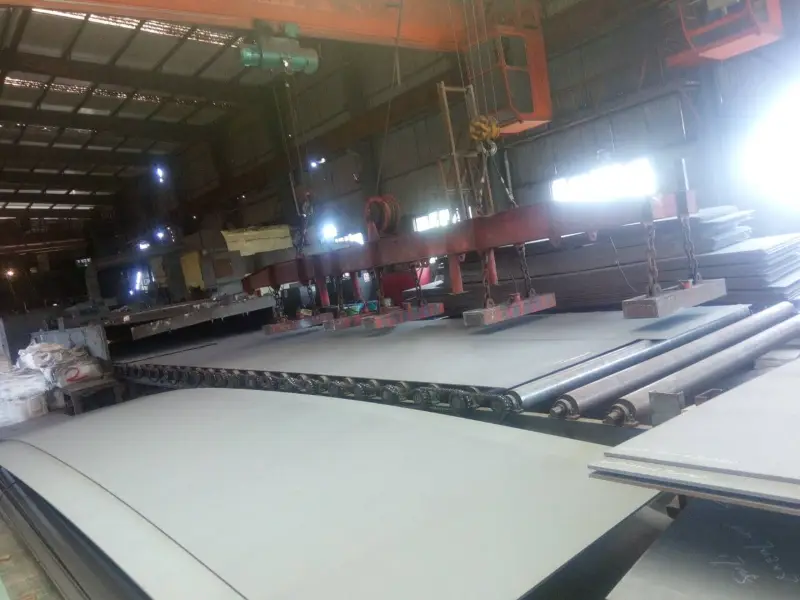
EN10028-6 P355QL2 Pressure Vessels
EN10028-6 P355QL2 Quenched & Tempered Steel for Low-Temperature Pressure Vessels
EN10028-6 P355QL2 is a quenched and tempered fine-grain structural steel for welded pressure vessels and boilers requiring reliable low-temperature toughness down to -40°C. It offers minimum 355 MPa yield strength and excellent weldability.
Hot rolling, quenching and tempering, welding, cutting, cold and hot forming, machining
- Phone : +8618037372205
- Email : [email protected]
- WhatsApp: Contact via Whtsapp
- WeChat: +8618037372205
EN10028-6 P355QL2 Pressure Vessels Introduction
EN10028-6 P355QL2 is a fine-grain structural steel supplied in the quenched and tempered (+QT) condition. It is designed for the construction of welded pressure vessels, boilers and storage tanks intended for low-temperature service. The steel exhibits a guaranteed minimum yield strength of 355 MPa for thicknesses up to 16 mm, combined with good tensile strength and ductility. Its main feature is the high notch toughness at -40°C, provided by a fine-grained microstructure and controlled chemical composition with low sulfur and phosphorus contents. The material offers good weldability under standard procedures and is suitable for post-weld heat treatment (PWHT). Typical applications include offshore pressure equipment, chemical reactors, refrigeration vessels and cryogenic tanks.
- Minimum yield strength: 355 MPa (t ≤ 16 mm)
- Low-temperature impact energy: ≥ 27 J at -40°C
- Quenched and tempered delivery condition
- Fine-grain structure with low carbon equivalent for welding
EN10028-6 P355QL2 Pressure Vessels Chemical Composition
EN 10028-6 specifies the ladle analysis limits for P355QL2. The steel has a low carbon content for good weldability, a manganese range for strength, and micro-alloying elements (Nb, V, Ti) for grain refinement. Nitrogen is controlled and residual elements are strictly limited to ensure toughness.
- Carbon Equivalent (CEV) typically ≤ 0.45 for thicknesses ≤ 63 mm, based on formula CEV = C + Mn/6 + (Cr+Mo+V)/5 + (Ni+Cu)/15.
- Cr+Cu+Mo sum not specifically limited by a single value in the standard; individual limits ensure cleanliness.
| Element | Content (%) | Remarks |
|---|---|---|
| C | ≤ 0.18 | Ladle analysis |
| Si | ≤ 0.50 | |
| Mn | 1.00 - 1.70 | |
| P | ≤ 0.020 | |
| S | ≤ 0.010 | |
| N | ≤ 0.015 | Aluminum or other nitrogen-binding elements are added if sufficient Al is not present |
| B | ≤ 0.005 | |
| Cr | ≤ 0.30 | |
| Cu | ≤ 0.30 | |
| Mo | ≤ 0.10 | |
| Nb | ≤ 0.05 | |
| Ni | ≤ 0.50 | |
| Ti | ≤ 0.03 | |
| V | ≤ 0.06 |
EN10028-6 P355QL2 Pressure Vessels Thermal and Electrical Physical Properties
The following physical properties are typical for quenched and tempered carbon-manganese steel at room temperature and elevated temperatures. These values are not part of the EN 10028-6 specification but are commonly used for design calculations. They can vary slightly depending on the exact heat treatment and chemical composition.
- Density, elastic moduli and Poisson's ratio at 20°C.
- Thermal expansion and conductivity provided for a range of temperatures.
| Property | Typical Value | Unit | Temperature / Condition |
|---|---|---|---|
| Density (ρ) | 7850 | kg/m³ | 20°C |
| Modulus of elasticity (E) | 210 | GPa | 20°C |
| Shear modulus (G) | 81 | GPa | 20°C |
| Poisson's ratio (ν) | 0.3 | - | 20°C |
| Thermal expansion coefficient (α) | 11.5 ×10⁻⁶ | 1/K | 20 - 100°C |
| Thermal expansion coefficient (α) | 12.3 ×10⁻⁶ | 1/K | 20 - 200°C |
| Thermal expansion coefficient (α) | 13.0 ×10⁻⁶ | 1/K | 20 - 300°C |
| Thermal conductivity (λ) | 52 | W/(m·K) | 20°C |
| Thermal conductivity (λ) | 48 | W/(m·K) | 100°C |
| Thermal conductivity (λ) | 42 | W/(m·K) | 200°C |
| Thermal conductivity (λ) | 38 | W/(m·K) | 300°C |
| Specific heat capacity (cp) | 460 | J/(kg·K) | 20°C |
| Specific heat capacity (cp) | 500 | J/(kg·K) | 200°C |
| Specific heat capacity (cp) | 540 | J/(kg·K) | 300°C |
| Electrical resistivity (ρe) | 0.22 ×10⁻⁶ | Ω·m | 20°C |
EN10028-6 P355QL2 Pressure Vessels Mechanical Properties
The mechanical properties are determined on transverse test specimens in the quenched and tempered condition. The yield strength decreases with increasing plate thickness, while elongation requirements vary accordingly. The Charpy V-notch impact test is mandatory at -40°C. Bending tests require a 180° bend without cracks.
- All properties are valid for product thicknesses ≤ 150 mm as per EN 10028-6.
- Impact values are the average of three specimens; one individual value may be lower but not below 20 J.
| Property | Required Value | Unit | Test Condition / Thickness |
|---|---|---|---|
| Yield Strength (ReH) min. | ≥ 355 | MPa | t ≤ 16 mm, transverse, room temperature |
| Yield Strength (ReH) min. | ≥ 345 | MPa | 16 < t ≤ 40 mm |
| Yield Strength (ReH) min. | ≥ 335 | MPa | 40 < t ≤ 60 mm |
| Yield Strength (ReH) min. | ≥ 315 | MPa | 60 < t ≤ 100 mm |
| Yield Strength (ReH) min. | ≥ 295 | MPa | 100 < t ≤ 150 mm |
| Tensile Strength (Rm) | 490 - 630 | MPa | t ≤ 100 mm, transverse |
| Tensile Strength (Rm) | 470 - 610 | MPa | 100 < t ≤ 150 mm |
| Elongation (A) min. | ≥ 20 | % | t ≤ 40 mm, gauge length 5.65√So |
| Elongation (A) min. | ≥ 19 | % | 40 < t ≤ 60 mm |
| Elongation (A) min. | ≥ 19 | % | 60 < t ≤ 100 mm |
| Elongation (A) min. | ≥ 18 | % | 100 < t ≤ 150 mm |
| Bend test (180°) | d = 3a, no cracks | - | All thicknesses, mandrel diameter 3× thickness |
| Charpy-V impact (KV2) min. | ≥ 27 (average) | J | -40°C, transverse, 10×10 mm specimen |
| Charpy-V impact (KV2) min. | ≥ 20 (single) | J | -40°C, transverse |
EN10028-6 P355QL2 Pressure Vessels Completely Equivalent Standards and Replaceable Grades
| Country/Region | Standard | Grade | Remarks |
|---|---|---|---|
| Europe (CEN members) | EN 10028-6:2017 | P355QL2 | Original standard; all CEN countries adopt identical grade |
| Germany | DIN EN 10028-6 | P355QL2 | Adoption of EN standard |
| France | NF A36-205-6 / NF EN 10028-6 | P355QL2 | Adoption of EN standard |
| United Kingdom | BS EN 10028-6 | P355QL2 | Adoption of EN standard; superseded BS 1501 grade |
| Italy | UNI EN 10028-6 | P355QL2 | Adoption of EN standard |
| Spain | UNE EN 10028-6 | P355QL2 | Adoption of EN standard |
| Sweden | SS EN 10028-6 | P355QL2 | Adoption of EN standard |
EN10028-6 P355QL2 Pressure Vessels Application Introduction
P355QL2 is ideally suited for the fabrication of pressure vessels and boilers that must operate safely at low temperatures. Its combination of strength, toughness and weldability enables its use in critical components subjected to static and dynamic loads. The steel can be welded by all common arc processes, and post-weld heat treatment is possible without significant loss of properties. It is often supplied with normalised-and-tempered or quenched-and-tempered condition per client requirements; the Q&T condition ensures consistent mechanical performance through thickness.
Product Applications: Pressure vessel shells and heads, Boiler drums and steam receivers, Low-temperature storage tanks (ammonia, propane, butane), Heat exchangers and condensers, Spherical and cylindrical cargo tanks, Cryogenic pipelines and piping components
Processed into products: Welded ellipsoidal and torispherical heads, Tube sheets and flanges, Nozzle reinforcements and pads, Support skirts and rings, Stiffening rings and internal trays, Welded-in piping connections, Test and inspection ports
Application industries: Oil & Gas (onshore and offshore), Chemical and petrochemical processing, Power generation (conventional and nuclear), Refrigeration and cryogenic engineering, Shipbuilding and marine engineering (LPG/LNG tanks), Industrial gas storage and transportation, Water treatment and desalination equipment
EN10028-6 P355QL2 Pressure Vessels Similar/Alternative Material Recommendations
| Country/Region | Standard | Grade | Remarks |
|---|---|---|---|
| Europe | EN 10028-6 | P355QL1 | Same Q&T steel, impact test at -20°C instead of -40°C; lower low-temperature toughness requirement |
| Europe | EN 10028-6 | P355Q | Q&T steel with impact test at 0°C; suitable for less severe service |
| Europe | EN 10028-6 | P355QH | Q&T steel with higher temperature properties; for elevated temperature applications |
| USA | ASTM A537 / ASME SA-537 | Class 1 | Normalized fine-grain steel; typical yield 345 MPa, tensile 485-620 MPa, but no guaranteed -40°C toughness unless supplementary requirement; not Q&T |
| USA | ASTM A537 / ASME SA-537 | Class 2 | Quenched and tempered; yield 415 MPa min, tensile 550-690 MPa; closer in strength but higher; requires brittle fracture evaluation for sub-zero use |
| Japan | JIS G3115 | SPV450Q | Quenched and tempered pressure vessel steel; yield ≥ 430 MPa, slightly higher strength; similar toughness level |
Notes:
- Steelmaking process: fully killed fine-grain practice, vacuum degassed.
- Welding: pre-heat recommended based on thickness and carbon equivalent; typically 75–150°C. Suitable welding consumables for low-temperature service (e.g., EN ISO 2560-A: E 42 5… or similar).
- Post-weld heat treatment: can be carried out at 530–580°C without tensile or toughness detriment; verify with procedure qualification.
- Ultrasonic testing according to EN 10160 class S2/E2 often specified.
- For sour service (H₂S), additional requirements per NACE MR0175/ISO 15156 must be agreed.
- The product is usually delivered with EN 10204 3.1 inspection certificate.
- Share



