
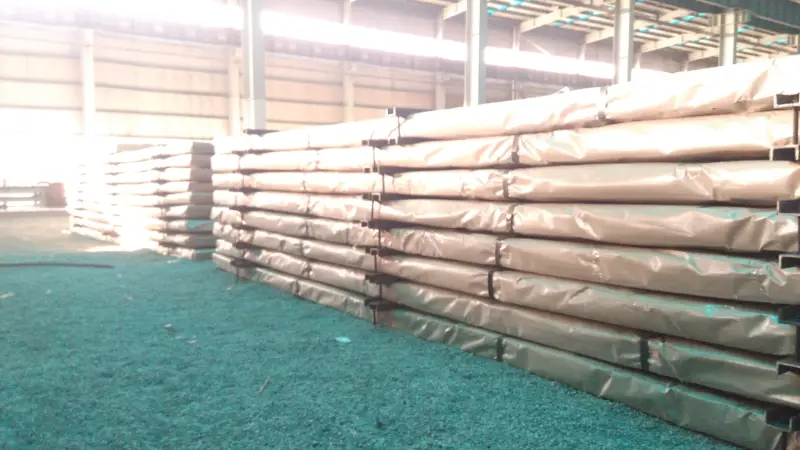
P355QL1 Steel for Pressure Vessels
EN10028-6 P355QL1: High-Strength Low-Temperature Pressure Vessel Steel Plate with Superior Weldability
Comprehensive material data for P355QL1 steel plate to EN10028-6: chemical composition, mechanical properties at ambient and low temperatures, physical constants, international equivalents, and application guidance for pressure equipment subjected to -40°C service.
Hot rolling followed by quenching and tempering; subsequent cutting, cold forming, welding, and machining
- Phone : +8618037372205
- Email : [email protected]
- WhatsApp: Contact via Whtsapp
- WeChat: +8618037372205
P355QL1 Steel for Pressure Vessels Introduction
P355QL1 is a quenched and tempered fine-grain structural steel intended for welded pressure vessels and boilers operating at low temperatures. Specified in EN 10028-6, it guarantees a minimum yield strength of 355 MPa for thicknesses up to 50 mm and is supplied in the Q+T (quenched and tempered) condition.
Key features include:
- Excellent notch toughness down to -40°C (Charpy V-notch impact energy ≥ 27 J)
- High resistance to brittle fracture in cryogenic and pressurized environments
- Good weldability with controlled carbon equivalent (CEV typically ≤ 0.43%)
- Refined, homogeneous microstructure thanks to Al-killed fine-grain practice and microalloying (Nb, V, Ti)
The steel is widely used in the fabrication of storage tanks, reactors, heat exchangers, and pressure vessels for the chemical, petrochemical, and energy industries.
P355QL1 Steel for Pressure Vessels Chemical composition according to EN 10028-6
The steel is fully killed and fine-grain treated. Aluminium, niobium, vanadium, and titanium serve as grain-refining elements. The maximum carbon equivalent (CEV) is typically limited to 0.43% for good weldability. Values are valid for product thickness ≤ 100 mm; for thicker products, slight adjustments may apply per the standard.
| Element | Specified value (max % unless range given) | Notes |
|---|---|---|
| Carbon (C) | ≤ 0.16 | |
| Silicon (Si) | ≤ 0.50 | |
| Manganese (Mn) | ≤ 1.50 | |
| Phosphorus (P) | ≤ 0.025 | |
| Sulfur (S) | ≤ 0.015 | |
| Nitrogen (N) | ≤ 0.015 | Higher N allowed if sufficient nitride-forming elements are present |
| Chromium (Cr) | ≤ 0.30 | |
| Molybdenum (Mo) | ≤ 0.25 | |
| Nickel (Ni) | ≤ 0.50 | |
| Copper (Cu) | ≤ 0.30 | |
| Aluminium (Al total) | ≥ 0.020 | Grain refinement; acid-soluble Al ≥ 0.015 % |
| Vanadium + Niobium + Titanium (V+Nb+Ti) | ≤ 0.05 | Microalloying for strength and grain refinement |
| Carbon equivalent (CEV) | Typically ≤ 0.43 | CEV = C + Mn/6 + (Cr+Mo+V)/5 + (Ni+Cu)/15 |
P355QL1 Steel for Pressure Vessels Typical physical properties
These values are approximate and may vary slightly with heat treatment condition and temperature. They are not mandatory requirements but are useful for engineering calculations.
| Property | Typical value | Unit | Conditions / Temperature |
|---|---|---|---|
| Density (ρ) | 7.85 | g/cm³ | 20°C |
| Modulus of elasticity (E) | 210 | GPa | 20°C |
| Shear modulus (G) | 81 | GPa | 20°C |
| Poisson's ratio (ν) | 0.3 | – | Elastic range |
| Thermal expansion coefficient (α) | 12.0 × 10⁻⁶ | K⁻¹ | 20 – 100°C |
| Thermal expansion coefficient (α) | 12.5 × 10⁻⁶ | K⁻¹ | 20 – 200°C |
| Thermal expansion coefficient (α) | 13.5 × 10⁻⁶ | K⁻¹ | 20 – 400°C |
| Thermal conductivity (λ) | 40 | W/(m·K) | 20°C |
| Specific heat capacity (cₚ) | 460 | J/(kg·K) | 20°C |
| Electrical resistivity (ρₑ) | 0.22 | μΩ·m | 20°C |
P355QL1 Steel for Pressure Vessels Mechanical properties according to EN 10028-6
Properties are guaranteed in the quenched and tempered condition. Values depend on product thickness. Charpy V-notch impact energy is measured at -40°C. Bend tests are performed with the specified mandrel diameter to verify ductility and soundness.
| Property | Specified value | Unit | Test condition / Thickness range |
|---|---|---|---|
| Yield strength (ReH) | ≥ 355 | MPa | t ≤ 50 mm |
| Yield strength (ReH) | ≥ 345 | MPa | 50 < t ≤ 100 mm |
| Yield strength (ReH) | ≥ 325 | MPa | 100 < t ≤ 200 mm |
| Tensile strength (Rm) | 490 – 630 | MPa | t ≤ 100 mm |
| Tensile strength (Rm) | 480 – 630 | MPa | 100 < t ≤ 200 mm |
| Elongation (A) | ≥ 20 | % | t ≤ 40 mm, gauge length 5.65√So |
| Elongation (A) | ≥ 19 | % | 40 < t ≤ 60 mm |
| Elongation (A) | ≥ 18 | % | 60 < t ≤ 100 mm |
| Elongation (A) | ≥ 17 | % | 100 < t ≤ 200 mm |
| Charpy impact energy (KV₂) | ≥ 27 (average of 3 specimens) | J | -40°C, V‑notch, transverse |
| Bend test (mandrel diameter) | 1 × thickness (1t) | – | t ≤ 10 mm, 180° bending |
| Bend test (mandrel diameter) | 1.5 × thickness (1.5t) | – | 10 < t ≤ 20 mm |
| Bend test (mandrel diameter) | 2 × thickness (2t) | – | 20 < t ≤ 30 mm |
P355QL1 Steel for Pressure Vessels Identical standard adoptions
| Country / Region | Standard | Grade | Remarks |
|---|---|---|---|
| Germany | DIN EN 10028-6 | P355QL1 | Identical to EN 10028-6 |
| France | NF EN 10028-6 | P355QL1 | Identical to EN 10028-6 |
| Italy | UNI EN 10028-6 | P355QL1 | Identical to EN 10028-6 |
| United Kingdom | BS EN 10028-6 | P355QL1 | Identical to EN 10028-6 |
| Spain | UNE EN 10028-6 | P355QL1 | Identical to EN 10028-6 |
| Netherlands | NEN EN 10028-6 | P355QL1 | Identical to EN 10028-6 |
| Sweden | SS‑EN 10028-6 | P355QL1 | Identical to EN 10028-6 |
| Poland | PN‑EN 10028-6 | P355QL1 | Identical to EN 10028-6 |
| Austria | ÖNORM EN 10028-6 | P355QL1 | Identical to EN 10028-6 |
P355QL1 Steel for Pressure Vessels Application Introduction
P355QL1 is designed for welded pressure equipment exposed to low temperatures and moderate mechanical loads. Its fine-grain microstructure and guaranteed -40°C toughness make it a primary choice for liquefied gas storage, chemical reactors, and offshore components. The steel is readily welded with proper consumables and preheating, and can be cold formed within the limits specified by the manufacturer.
Product Applications: LPG and LNG storage tanks (cylindrical and spherical), Chemical and catalytic reactors, Heat exchangers and condensers, Steam boilers and steam drums, Industrial gas cylinders and pressure vessels, Offshore platform process columns
Processed into products: Shell courses and vessel heads (elliptical, torispherical), Tube sheets for shell-and-tube heat exchangers, Nozzle reinforcements and flanges, Skirt support rings and base plates, Baffle plates and internal trays, Forged shells and rings when made from plate
Application industries: Oil and gas (offshore and onshore processing plants), Petrochemical and chemical processing, Power generation (conventional and nuclear), Cryogenic liquefied gas storage (LPG, LNG), Pharmaceutical and food processing pressure equipment, Boiler and heat exchanger manufacturing
P355QL1 Steel for Pressure Vessels Comparable grades with similar strength and low-temperature toughness
| Country / Region | Standard | Grade | Remarks (Comparison with P355QL1) |
|---|---|---|---|
| Europe | EN 10028-6 | P355Q | Same base chemical and tensile properties, but impact tested at -20°C instead of -40°C (L1 option missing). Suitable for less severe cold service. |
| Europe | EN 10028-3 | P355NL1 | Normalised fine-grain steel; similar strength and -40°C toughness, but delivered in normalised condition rather than Q+T. Thermo-mechanical processing different. |
| Europe | EN 10028-6 | P460QL1 | Higher yield strength (≥ 460 MPa) while maintaining -40°C toughness. Useful where higher strength allows weight reduction. |
| USA | ASTM A537 / A537M | Class 1 | Quenched and tempered C‑Mn‑Si steel plate for pressure vessels. Typical yield 345 MPa for thickness ≤ 65 mm, Charpy at -30°C or -50°C upon agreement. Very close substitute with minor strength difference. |
| USA | ASTM A516 / A516M | Grade 70 | Normalised carbon steel for moderate/low temperature service. Comparable tensile strength, but impact energy is usually guaranteed at -46°C. Delivery condition is normalised, not Q+T. |
| Japan | JIS G 3115 | SPV 355 | Steel plate for pressure vessels for intermediate temperature service. Quenched and tempered; typical impact temperature -10°C. Not directly equivalent for -40°C toughness without supplementary agreement. |
Notes:
- Welding: Low-hydrogen processes (SMAW, SAW, GMAW) are recommended. Preheating (100–150°C) may be necessary for thicknesses above 20–30 mm. Post-weld heat treatment (PWHT) should follow EN 13445 or project specifications to relieve residual stress.
- Forming: Cold forming limits (radius-to-thickness ratio) must be respected to avoid cracking; hot forming should be followed by a new Q+T heat treatment.
- Testing: Plates are normally supplied with ultrasonic testing per EN 10160 Class S2/E2 or better. Impact tests are documented with each batch.
- Surface condition: Delivered descaled, with edges trimmed; special surface finishes (e.g., blast-cleaned, primer-coated) can be agreed at order.
- Share



