
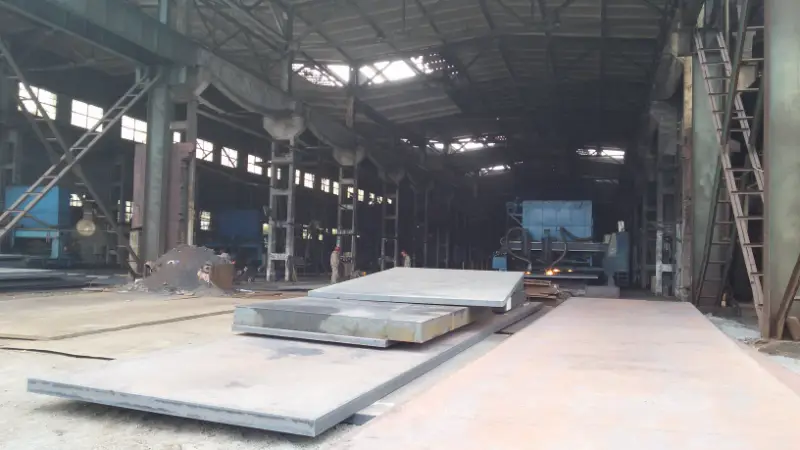
EN 10028-5 P355ML2
EN10028-5 P355ML2 Steel Plate for Pressure Vessels & Boilers at -50°C
Explore detailed data of P355ML2 steel plate under EN 10028-5: weldable fine grain steel for pressure purposes with specified low temperature toughness at -50 °C.
Thermomechanical rolling, cutting, forming, welding, post-weld heat treatment as agreed
- Phone : +8618037372205
- Email : [email protected]
- WhatsApp: Contact via Whtsapp
- WeChat: +8618037372205
EN 10028-5 P355ML2 Introduction
P355ML2 is a thermomechanically rolled weldable fine grain steel grade according to EN 10028-5. It is intended for pressure vessels and boilers operating at low temperatures, offering minimum yield strength of 355 MPa and guaranteed Charpy V-notch impact energy of 27 J at -50 °C (transverse). The steel provides excellent weldability, good toughness, and uniform mechanical properties due to its fine grain structure. It is typically supplied in the thermomechanically rolled condition and is suitable for use in low-temperature pressure equipment, such as cryogenic storage tanks and process vessels.
EN 10028-5 P355ML2 Chemical Composition
The chemical composition limits for P355ML2 according to EN 10028-5 for product thicknesses ≤ 100 mm are shown below. The steel is alloyed with fine grain elements (Nb, V, Ti, Al) and controlled residual elements to ensure good weldability and low-temperature toughness.
| Element | Value (%) | Remarks |
|---|---|---|
| Carbon (C) | ≤ 0.14 | Maximum |
| Silicon (Si) | ≤ 0.50 | Maximum |
| Manganese (Mn) | 1.00 - 1.70 | Range |
| Phosphorus (P) | ≤ 0.020 | Maximum |
| Sulfur (S) | ≤ 0.008 | Maximum |
| Aluminum (Al) total | ≥ 0.020 | Minimum |
| Nitrogen (N) | ≤ 0.015 | Maximum |
| Chromium (Cr) | ≤ 0.30 | Maximum |
| Copper (Cu) | ≤ 0.30 | Maximum |
| Molybdenum (Mo) | ≤ 0.08 | Maximum |
| Nickel (Ni) | ≤ 0.50 | Maximum |
| Niobium (Nb) | ≤ 0.05 | Maximum, fine grain element |
| Vanadium (V) | ≤ 0.08 | Maximum, fine grain element |
| Titanium (Ti) | ≤ 0.05 | Maximum, fine grain element |
EN 10028-5 P355ML2 Thermal and Electrical Physical Properties
The following physical properties are typical reference values for P355ML2 (and similar C-Mn steels) at room temperature unless another temperature is indicated. They are provided for design guidance and are not mandatory in EN 10028-5.
| Property | Typical Value | Unit | Test Condition / Remarks |
|---|---|---|---|
| Density (ρ) | 7.85 | g/cm³ | At 20 °C |
| Modulus of Elasticity (E) | 210 | GPa | At 20 °C |
| Shear Modulus (G) | 81 | GPa | At 20 °C |
| Poisson's Ratio (ν) | 0.3 | - | At 20 °C |
| Thermal Expansion Coefficient (α) | 11.1 | 10⁻⁶/K | 20 - 100 °C |
| Thermal Expansion Coefficient (α) | 12.2 | 10⁻⁶/K | 20 - 200 °C |
| Thermal Expansion Coefficient (α) | 12.9 | 10⁻⁶/K | 20 - 300 °C |
| Thermal Conductivity (λ) | 51 | W/(m·K) | At 20 °C |
| Thermal Conductivity (λ) | 49 | W/(m·K) | At 100 °C |
| Thermal Conductivity (λ) | 46 | W/(m·K) | At 200 °C |
| Specific Heat Capacity (cp) | 460 | J/(kg·K) | At 20 - 100 °C |
| Electrical Resistivity (ρe) | 0.20 | μΩ·m | At 20 °C |
EN 10028-5 P355ML2 Mechanical Properties
Mechanical properties for P355ML2 as required by EN 10028-5. The values vary with product thickness. Testing is performed at room temperature unless otherwise noted. Impact energy is verified at -50 °C on transverse Charpy V-notch specimens. All values are minimum unless stated otherwise.
| Property | Required Value | Unit | Test Condition / Thickness |
|---|---|---|---|
| Yield Strength (ReH) | ≥ 355 | MPa | t ≤ 16 mm |
| Yield Strength (ReH) | ≥ 345 | MPa | 16 mm < t ≤ 40 mm |
| Yield Strength (ReH) | ≥ 335 | MPa | 40 mm < t ≤ 60 mm |
| Yield Strength (ReH) | ≥ 315 | MPa | 60 mm < t ≤ 100 mm |
| Tensile Strength (Rm) | 490 - 630 | MPa | All thicknesses |
| Elongation (A) | ≥ 22 | % | t ≤ 40 mm, L0 = 5.65√S0 |
| Elongation (A) | ≥ 22 | % | 40 mm < t ≤ 60 mm |
| Elongation (A) | ≥ 21 | % | 60 mm < t ≤ 100 mm |
| Impact Energy (KV) at -50 °C | ≥ 27 (transverse) | J | Average of 3 specimens; t ≤ 100 mm |
EN 10028-5 P355ML2 Fully Equivalent Material Standards and Substitutable Grades
| Country/Region | Standard | Grade | Remarks |
|---|---|---|---|
| European Union | EN 10028-5 | P355ML2 | Original grade, same product standard |
| International (ISO) | ISO 9328-2 | P355ML2 | Identical technical delivery requirements |
| Germany | DIN EN 10028-5 | P355ML2 | German implementation of the European standard |
| France | NF EN 10028-5 | P355ML2 | French implementation |
| United Kingdom | BS EN 10028-5 | P355ML2 | British implementation |
EN 10028-5 P355ML2 Application Introduction
P355ML2 is used extensively in the fabrication of welded pressure vessels and boilers that require guaranteed low-temperature performance. Its fine grain structure and controlled chemical composition ensure good toughness and weldability, reducing the risk of brittle fracture in service. Typical design temperature down to -50 °C. The steel can be formed, welded, and post-weld heat treated if necessary, subject to agreement.
Product Applications: Cryogenic storage tanks (LNG, ethylene, LPG), Pressure vessels and reactors, Steam boilers and economizers, Heat exchangers and condensers, Low-temperature process columns, Pipeline components and expansion loops (pressure-rated)
Processed into products: Shell plates and courses of pressure vessels, Hemispherical and ellipsoidal heads, Tube sheets and flanges for low-temperature service, Welded nozzles and reinforcement pads, Stiffening rings and support attachments (low-temperature toughness required), Transition pieces and weld overlays (as base metal)
Application industries: Oil and gas processing, Petrochemical and chemical plants, Cryogenic storage and transportation, Power generation (boilers, heat exchangers), Industrial gas and LNG facilities, Offshore and marine engineering (pressure parts)
EN 10028-5 P355ML2 Similar / Alternative Materials with Comparable Performance
| Country/Region | Standard | Grade | Remarks |
|---|---|---|---|
| European Union | EN 10028-3 | P355NL2 | Normalized fine grain steel for pressure purposes, -50 °C impact, similar strength; used when thermomechanical rolling cannot be applied. |
| European Union | EN 10028-3 | P355NH | Normalized fine grain steel for pressure purposes, -40 °C impact, slightly higher-temperature minimum; may be considered when service temperature allows. |
| International (ISO) | ISO 9328-2 | P355N | Normalized condition, -20 °C impact; less demanding low-temperature toughness. |
| USA | ASTM A537 / A537M | Class 1 (A 537 Cl.1) | As-rolled or normalized C-Mn-Si steel for pressure vessels, -45 °C impact typical; similar strength range but different production route and chemical limits. |
Notes:
Informative: For thicknesses >100 mm, property values must be agreed at the time of enquiry and order. The maximum thickness covered by EN 10028-5 for P355ML2 is 100 mm. Impact test values apply to the standard 10x10 mm Charpy V-notch specimen; for sub-size specimens, minimum values are proportionally reduced according to the standard. Carbon equivalent (CEV) is typically ≤0.45 for weldability assessment, but not mandatory for this grade. The product is usually ultrasonically tested according to EN 10160 class S2/E2 or as agreed. PWHT (Post Weld Heat Treatment) can be applied, but the effect on mechanical properties must be verified. Comparison between P355ML2 and P355NL2: both have same minimum yield strength and -50 °C impact requirement, but P355NL2 is a normalized grade from EN 10028-3, often with more restrictive phosphorus and sulfur limits; both can be considered equivalent in many applications after careful review.
- Share



