
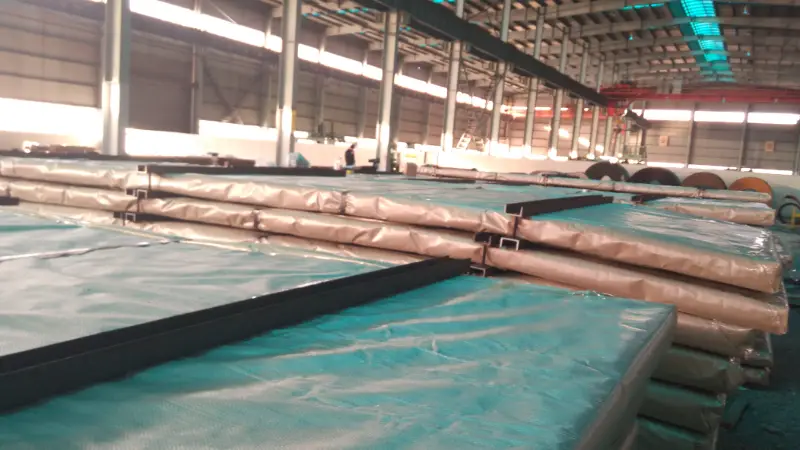
EN 10028-5 P355ML1 Steel Plate
EN 10028-5 P355ML1 Pressure Vessel Steel Plate – Thermo-Mechanically Rolled, Fine Grain, Low Temperature Toughness
Comprehensive material data for EN 10028-5 P355ML1 steel plate for pressure vessels and boilers, including chemical composition, mechanical and physical properties, international equivalents, and application guidelines.
Thermo-mechanically rolled; may be supplied in as-rolled, normalized rolled, or tempered condition; suitable for hot forming, cold forming, welding, cutting, machining
- Phone : +8618037372205
- Email : [email protected]
- WhatsApp: Contact via Whtsapp
- WeChat: +8618037372205
EN 10028-5 P355ML1 Steel Plate Introduction
P355ML1 is a thermo-mechanically rolled weldable fine grain steel intended for pressure vessels and boilers, specified in EN 10028-5. The designation indicates a minimum yield strength of 355 MPa (for thicknesses ≤ 16 mm) at room temperature, and the suffix ML1 denotes low-temperature properties with guaranteed impact energy at -40 °C. This grade offers excellent weldability, high strength, and good toughness, making it suitable for pressurized equipment operating at moderate temperatures. Its fine-grained structure is achieved through a controlled rolling process without additional heat treatment beyond tempering, ensuring consistent mechanical properties across thicknesses.
EN 10028-5 P355ML1 Steel Plate Chemical Composition
Chemical composition according to EN 10028-5:2017 for P355ML1. Values refer to heat analysis. For product analysis, tolerances according to the standard apply. Microalloying elements such as Nb, Ti, V may be added singly or in combination to achieve fine grain structure and required strength.
- Carbon Equivalent (CEV) based on heat analysis is normally limited to guarantee weldability, typically ≤ 0.43%, but exact maximum depends on product thickness agreement.
| Element | Standard Value (max % unless range) | Remarks |
|---|---|---|
| Carbon (C) | ≤ 0.14 | |
| Silicon (Si) | ≤ 0.50 | |
| Manganese (Mn) | ≤ 1.60 | Minimum Mn content depends on thickness, typically ≥ 0.90% |
| Phosphorus (P) | ≤ 0.020 | |
| Sulfur (S) | ≤ 0.010 | |
| Aluminium (Al) total | ≥ 0.020 | Minimum required for fine grain practice |
| Nitrogen (N) | ≤ 0.012 | |
| Chromium (Cr) | ≤ 0.30 | |
| Copper (Cu) | ≤ 0.30 | |
| Molybdenum (Mo) | ≤ 0.08 | |
| Niobium (Nb) | ≤ 0.05 | Microalloy optional |
| Nickel (Ni) | ≤ 0.50 | |
| Titanium (Ti) | ≤ 0.05 | Microalloy optional |
| Vanadium (V) | ≤ 0.10 | Microalloy optional |
| Nickel + Copper + Chromium + Molybdenum | ≤ 0.70 | Combined limit |
EN 10028-5 P355ML1 Steel Plate Thermal and Electrical Physical Properties
Typical physical properties for P355ML1 grade steel at ambient and elevated temperatures. These values are for general guidance and not part of the standard specification. Actual values may vary slightly depending on precise composition and processing. Thermal expansion and thermal conductivity influence design for temperature service. Electrical resistivity may be used for induction heating calculations.
| Property | Typical Value | Unit | Test Condition / Remarks |
|---|---|---|---|
| Density (ρ) | 7.85 | kg/dm³ | At 20 °C |
| Elastic Modulus (E) | 210 | GPa | At 20 °C |
| Shear Modulus (G) | 81 | GPa | At 20 °C |
| Poisson's Ratio (ν) | 0.3 | — | At 20 °C |
| Thermal Expansion Coefficient (α) | 12.0 | 10⁻⁶/K | Between 20 °C and 100 °C |
| Thermal Expansion Coefficient (α) | 12.5 | 10⁻⁶/K | Between 20 °C and 200 °C |
| Thermal Expansion Coefficient (α) | 13.0 | 10⁻⁶/K | Between 20 °C and 300 °C |
| Thermal Expansion Coefficient (α) | 13.6 | 10⁻⁶/K | Between 20 °C and 400 °C |
| Thermal Conductivity (λ) | 48 | W/(m·K) | At 20 °C |
| Thermal Conductivity (λ) | 45 | W/(m·K) | At 200 °C |
| Thermal Conductivity (λ) | 39 | W/(m·K) | At 400 °C |
| Specific Heat Capacity | 460 | J/(kg·K) | At 20 °C |
| Specific Heat Capacity | 510 | J/(kg·K) | At 200 °C |
| Specific Heat Capacity | 550 | J/(kg·K) | At 400 °C |
| Electrical Resistivity (ρ_e) | 0.23 | Ω·mm²/m | At 20 °C |
EN 10028-5 P355ML1 Steel Plate Mechanical Properties
Mechanical properties according to EN 10028-5:2017 for P355ML1 at ambient temperature. Requirements are valid for transverse test pieces.
- For thicknesses above 60 mm, properties may be agreed upon.
- Impact energy (KV₂) values are for longitudinal test pieces; for transverse test pieces, minimum values are 70% of those listed.
- Tensile testing at elevated temperature properties can be agreed separately.
| Property | Standard Requirement | Unit | Test Condition / Remarks |
|---|---|---|---|
| Yield Strength (ReH) min. | 355 | MPa | Thickness ≤ 16 mm |
| Yield Strength (ReH) min. | 345 | MPa | 16 mm < thickness ≤ 40 mm |
| Yield Strength (ReH) min. | 335 | MPa | 40 mm < thickness ≤ 60 mm |
| Yield Strength (ReH) min. | 325 | MPa | 60 mm < thickness ≤ 100 mm |
| Tensile Strength (Rm) | 490 – 630 | MPa | Thickness ≤ 100 mm |
| Elongation (A) min. | 22 | % | 5.65√S₀ proportional test piece; thickness ≤ 16 mm |
| Elongation (A) min. | 21 | % | thickness > 16 mm to 40 mm |
| Elongation (A) min. | 20 | % | thickness > 40 mm to 60 mm |
| Elongation (A) min. | 20 | % | thickness > 60 mm to 100 mm |
| Impact Energy (KV₂) longitudinal min. | 40 | J | At -40 °C |
| Impact Energy (KV₂) transverse min. | 27 | J | At -40 °C (70% of longitudinal) |
| Bend test (mandrel diameter) | No cracks | Through 180° bend with mandrel diameter = 1.5 x thickness for s ≤ 12.5 mm; = 2.5 x thickness for s > 12.5 mm, unless otherwise agreed |
EN 10028-5 P355ML1 Steel Plate Exact Equivalent Standards and Replaceable Grades
| Country/Region | Standard | Grade | Remarks |
|---|---|---|---|
| International | ISO 9328-2 | Fe510D1 (P355ML1) | Exact match for P355ML1 in ISO system; same chemical and mechanical requirements |
| European | EN 10028-5 | P355ML1 | Original designation |
| United Kingdom | BS EN 10028-5 | P355ML1 | Adopted European standard, identical |
| Germany | DIN EN 10028-5 | P355ML1 | Identical to EN |
| France | NF EN 10028-5 | P355ML1 | Identical to EN |
EN 10028-5 P355ML1 Steel Plate Application Introduction
P355ML1 is specifically designed for welded pressure vessels and boilers operating at moderate temperatures and requiring reliable low-temperature toughness. Its thermo-mechanical rolling provides a fine grain structure that ensures good strength and ductility without the need for extensive heat treatment. Typical applications include:
Industries:
- Chemical and petrochemical processing
- Oil & gas (upstream and downstream)
- Power generation (conventional and nuclear)
- Industrial gas storage and transport
- Shipbuilding (pressure components)
- Food processing (pressure equipment)
Product Applications: Pressure vessels (reactors, separators, columns), Industrial boilers and superheaters, Heat exchangers (shell and tube, plate type), Storage tanks for liquefied gases (ammonia, LPG, CO₂), Autoclaves and sterilizers, Pipeline fittings and flanges for moderate temperature, Offshore platform process equipment
Processed into products: Vessel shell courses and heads (dished ends), Nozzles and manways, Tube sheets for heat exchangers, Support skirts and saddles, Flanges and blind covers, Baffle plates and internals, Welded structural parts for pressure enclosures
Application industries: Chemical and petrochemical plants, Oil and gas extraction and refining, Power generation (boilers, heat recovery steam generators), Industrial gas manufacturing and storage, Shipbuilding (LPG/chemical tankers, pressure hulls), Pharmaceutical and food processing (sterilization vessels)
EN 10028-5 P355ML1 Steel Plate Closely Similar or Alternative Material Recommendations
| Country/Region | Standard | Grade | Remarks |
|---|---|---|---|
| USA | ASTM A537 | Class 1 | Similar strength; nominal yield 345 MPa, impact at -40 °C; normalized. Check CEV compatibility. |
| USA | ASTM A516 | Grade 65 (450-585 MPa TS) | Lower yield strength, but often used for same applications. Requires thickness adaptation. |
| USA | ASTM A516 | Grade 70 (485-620 MPa TS) | Tensile strength close to P355ML1; impact properties differ (usually at -45 °C). |
| Japan | JIS G3115 | SPV355 | Pressure vessel steel with min. yield 355 MPa, similar chemistry; check low-temp spec. |
| China | GB/T 6654 | 16MnDR (Q345DR) | Minimum yield 345 MPa; designated for low temperature (DR), impact at -40 °C. Slight compositional differences. |
| International | ISO 9328-2 | Fe460D1 (P355NL1 approach) | Higher strength grade but similar toughness class; may be used with design adjustment. |
Notes:
Welding: P355ML1 has excellent weldability with low carbon equivalent (CEV ≤ 0.43 typically). Preheating is usually not required for moderate thicknesses but may be applied for thick sections (above 30 mm) to avoid hydrogen cracking. Post-weld heat treatment (PWHT) may be performed to relieve stresses; the tempering temperature should not exceed 600 °C to preserve mechanical properties.
Forming: Cold and hot forming is possible. Hot forming should be carried out within 850–950 °C; after forming, a normalizing or tempering treatment may be necessary.
Inspection: Ultrasonic testing and impact testing at -40 °C are standard acceptance criteria per EN 10028-5. Simulated post-weld heat treatment testing may be agreed upon.
- Share



