
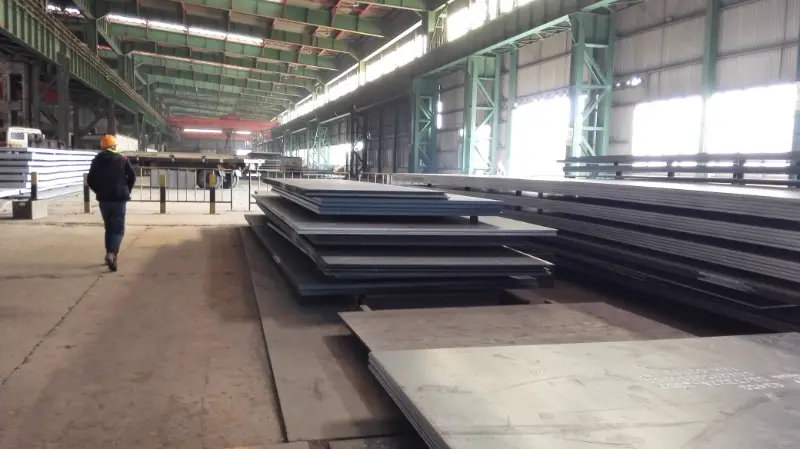
P355QH Quenched & Tempered Pressure Vessel Steel Plate
P355QH Quenched & Tempered Pressure Vessel Steel Plate - EN10028-6 Grade
Detailed material data for EN10028-6 P355QH, a fine-grain structural steel with high yield strength, excellent toughness and good weldability, supplied in the quenched and tempered condition for elevated temperature pressure vessels and boilers.
Hot rolled, normalized or quenched and tempered, then cut, formed, welded, and machined. Suitable for hot forming followed by re-heat treatment.
- Phone : +8618037372205
- Email : [email protected]
- WhatsApp: Contact via Whtsapp
- WeChat: +8618037372205
P355QH Quenched & Tempered Pressure Vessel Steel Plate Introduction
P355QH is a weldable fine-grain structural steel grade specified in EN 10028-6 for pressure vessels and boilers. Supplied in the quenched and tempered (Q+T) condition, it offers a minimum yield strength of 355 MPa at room temperature and is well suited for service at elevated temperatures.
Key characteristics:
- High strength combined with good ductility and toughness, even at low temperatures.
- Excellent weldability due to low carbon equivalent (CEV).
- Guaranteed impact properties (KV at -20 °C ≥ 40 J transverse).
- Available in a wide range of thicknesses (up to 150 mm according to EN 10028-6).
- Used extensively in the construction of pressure vessels, storage tanks, boiler drums and process equipment for the oil & gas, chemical and power generation industries.
P355QH Quenched & Tempered Pressure Vessel Steel Plate Chemical composition – EN 10028-6 P355QH
The chemical composition ensures the required mechanical properties while maintaining good weldability and toughness. All values are maximum unless a range is specified. CEV (carbon equivalent value) is controlled to limit hardening in the heat-affected zone.
| Element | Value (%) | Notes |
|---|---|---|
| Carbon (C) | ≤ 0.18 | |
| Silicon (Si) | ≤ 0.50 | |
| Manganese (Mn) | 1.00 – 1.70 | |
| Phosphorus (P) | ≤ 0.020 | |
| Sulfur (S) | ≤ 0.010 | |
| Aluminium total (Al) | ≥ 0.020 | Acid soluble aluminium ≥ 0.015 % |
| Nitrogen (N) | ≤ 0.015 | |
| Chromium (Cr) | ≤ 0.30 | |
| Copper (Cu) | ≤ 0.30 | |
| Molybdenum (Mo) | ≤ 0.10 | |
| Niobium (Nb) | ≤ 0.05 | |
| Nickel (Ni) | ≤ 0.50 | |
| Titanium (Ti) | ≤ 0.03 | |
| Vanadium (V) | ≤ 0.06 | |
| CEV (Ceq) | ≤ 0.45 | CEV = C + Mn/6 + (Cr+Mo+V)/5 + (Ni+Cu)/15 |
P355QH Quenched & Tempered Pressure Vessel Steel Plate Physical properties
Physical properties are not part of EN 10028-6 requirements but are typical for the C-Mn micro-alloyed steel family. These values can be used for engineering calculations. The data tend to vary slightly with actual heat treatment and thickness.
| Property | Value | Unit | Condition / Reference |
|---|---|---|---|
| Density (ρ) | 7850 | kg/m³ | at 20 °C |
| Modulus of elasticity (E) | 210 | GPa | at 20 °C |
| Shear modulus (G) | 81 | GPa | at 20 °C |
| Poisson's ratio (ν) | 0.3 | — | at 20 °C |
| Thermal expansion coefficient (α) | 12.0 × 10⁻⁶ | /K | 20–100 °C |
| Thermal expansion coefficient (α) | 12.5 × 10⁻⁶ | /K | 20–200 °C |
| Thermal expansion coefficient (α) | 13.0 × 10⁻⁶ | /K | 20–300 °C |
| Thermal conductivity (λ) | 50 | W/(m·K) | at 20 °C |
| Thermal conductivity (λ) | 48 | W/(m·K) | at 100 °C |
| Thermal conductivity (λ) | 44 | W/(m·K) | at 200 °C |
| Specific heat capacity (cₚ) | 460 | J/(kg·K) | at 20–100 °C |
| Electrical resistivity (ρₑ) | 0.25 | µΩ·m | at 20 °C |
P355QH Quenched & Tempered Pressure Vessel Steel Plate Mechanical properties – EN 10028-6 P355QH
The mechanical properties are guaranteed in the quenched and tempered (+QT) condition. Impact energy is tested at -20 °C on Charpy-V specimens. Unless otherwise agreed, the tensile test is carried out on transverse samples. All values apply for product thickness up to 100 mm; for thicknesses 100–150 mm slightly reduced values are specified.
| Property | Value | Unit | Test condition |
|---|---|---|---|
| Yield strength (ReH) | ≥ 355 | MPa | thickness ≤ 50 mm |
| Yield strength (ReH) | ≥ 335 | MPa | 50 < thickness ≤ 100 mm |
| Yield strength (ReH) | ≥ 315 | MPa | 100 < thickness ≤ 150 mm |
| Tensile strength (Rm) | 490 – 630 | MPa | thickness ≤ 150 mm |
| Elongation (A, 5.65√S₀) | ≥ 22 | % | thickness ≤ 40 mm; longitudinal |
| Elongation (A, 5.65√S₀) | ≥ 22 | % | 40 < thickness ≤ 100 mm; longitudinal |
| Elongation (A, 5.65√S₀) | ≥ 20 | % | 100 < thickness ≤ 150 mm; longitudinal |
| Impact energy (KV₂, -20°C) | ≥ 40 (average) | J | transverse; specimen 10×10 mm |
| Impact energy (KV₂, -20°C) | ≥ 27 (individual) | J | transverse; specimen 10×10 mm |
| Bend test (180°) | No cracks | — | d = 3a (d: mandrel diameter, a: thickness) up to 50 mm |
P355QH Quenched & Tempered Pressure Vessel Steel Plate Identical standard equivalents and directly replaceable grades
| Region / Standard | Standard and Grade | De- signation | Remarks |
|---|---|---|---|
| International / ISO | ISO 9328-6 | P355QH | Technically identical to EN 10028-6. Same chemical and mechanical requirements. |
P355QH Quenched & Tempered Pressure Vessel Steel Plate Application Introduction
P355QH is optimized for welded pressure equipment where high strength at moderate temperatures is required. The quenched and tempered microstructure gives a good strength-to-weight ratio, and the controlled chemical composition ensures robustness against brittle fracture.
Weldability: Excellent; low CEV allows welding without preheating up to moderate thicknesses, though for thick sections preheat and post-weld heat treatment (PWHT) may be recommended.
Typical processing: Hot formed heads and shells may require subsequent re-tempering to restore properties.
Product Applications: Pressure vessels (vertical/horizontal, columns, reactors), Boiler drums and steam receivers, Spherical storage tanks (for LPG, propylene etc.), Shell-and-tube heat exchangers, Export gas cylinders and accumulators, Process piping and manifolds
Processed into products: Vessel shells and courses, Dished heads and hemispheres, Tube sheets and baffles, Nozzles and flanges (forgings may be used), Support skirts and legs, Internal trays and diaphragms
Application industries: Oil & Gas (refineries, pipelines, storage tanks), Chemical and petrochemical plants, Power generation (conventional and nuclear), Boiler and heat exchanger manufacturing, Pressure vessel fabrication, Hydrocarbon processing industry
P355QH Quenched & Tempered Pressure Vessel Steel Plate Similar or alternative steel grades with comparable properties
| Region / Standard | Standard and Grade | De- signation | Remarks |
|---|---|---|---|
| USA / ASTM | ASTM A537 / ASME SA537 | Class 2 | C-Mn-Si steel, quenched & tempered. Yield strength ≥ 315–360 MPa (depending on thickness). Impact toughness at -20°C, similar to P355QH; often used interchangeably with agreement. |
| USA / ASTM | ASTM A516 / ASME SA516 | Grade 70 | Standard pressure vessel quality carbon steel, normally supplied in normalized condition. Lower strength (ReH ≥ 260 MPa) but widely available. Not a direct replacement for quenched & tempered applications. |
| Europe / EN | EN 10028-3 | P355NH / P355NL1 / P355NL2 | Normalized fine-grain steel. Yield strength comparable but toughness levels differ (NL1: -40°C, NL2: -50°C). Suitable when higher toughness or different delivery condition is acceptable. |
| China / GB | GB/T 713.2 | Q345R (quenched & tempered) | Chinese pressure vessel steel with similar chemistry and strength. Q345R QT can achieve properties close to P355QH, but requires additional testing for full equivalency. |
Notes:
Heat treatment: The standard delivery condition is quenched and tempered (+QT). If the plate is subjected to hot forming, a subsequent quenching and tempering treatment (or at least stress relieving followed by verification of properties) is advised.
Post-weld heat treatment (PWHT): When PWHT is applied, the holding temperature is typically 530–580 °C; the exact temperature must be selected to avoid reduction in strength. Consult EN 13445 or construction code for PWHT requirements.
Testing and inspection: Ultrasonic testing to EN 10160 (class S2/E2 or better) is commonly required. Impact testing at -20°C is mandatory unless lower temperatures are agreed. Simulated PWHT tests may be needed for thick components.
Certification: Material is supplied with EN 10204 inspection certificate 3.1 as a minimum.
- Share



