
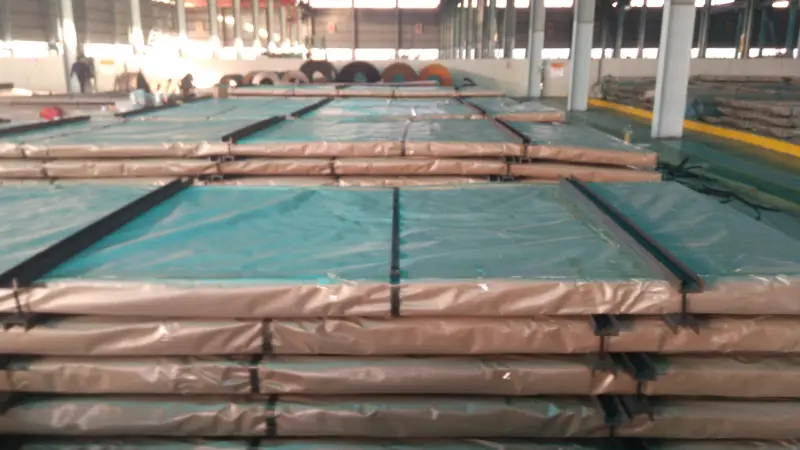
EN 10028-6 P355Q Steel Plate for Pressure Vessels and Boilers
EN 10028-6 P355Q Steel Plate for Pressure Vessels and Boilers - Quenched & Tempered Fine Grain Steel
Detailed material data sheet for P355Q fine grain steel according to EN 10028-6, including chemical composition, mechanical properties, and physical performance for high-strength pressure vessels and boilers.
Welding, cutting, cold and hot forming, machining
- Phone : +8618037372205
- Email : [email protected]
- WhatsApp: Contact via Whtsapp
- WeChat: +8618037372205
EN 10028-6 P355Q Steel Plate for Pressure Vessels and Boilers Introduction
P355Q is a quenched and tempered weldable fine grain steel plate intended for pressure purposes, as specified in EN 10028-6. It offers minimum yield strengths from 295 to 355 MPa depending on thickness, with tensile strengths between 500 and 670 MPa. The QT condition ensures a balanced combination of strength, toughness, and weldability.
- Excellent low-temperature impact toughness down to -20°C (min. 27 J)
- Uniform mechanical properties through thickness up to 150 mm
- Good formability and weldability with appropriate procedures
- Widely used in the petrochemical, power generation, and offshore industries
EN 10028-6 P355Q Steel Plate for Pressure Vessels and Boilers Chemical Composition
The steel is fully killed and fine-grained. Alloying elements are controlled to ensure high strength and toughness after quenching and tempering. Residual elements are kept low to avoid temper embrittlement and to maintain weldability. Limits according to EN 10028-6:2017.
| Element | Standard Value (max unless range) | Remarks |
|---|---|---|
| Carbon (C) | ≤ 0.18 % | |
| Silicon (Si) | ≤ 0.50 % | |
| Manganese (Mn) | ≤ 1.70 % | |
| Phosphorus (P) | ≤ 0.025 % | |
| Sulfur (S) | ≤ 0.015 % | |
| Nitrogen (N) | ≤ 0.015 % | |
| Aluminium (Al) | ≥ 0.015 % | Grain refining element |
| Chromium (Cr) | ≤ 0.50 % | |
| Copper (Cu) | ≤ 0.30 % | |
| Molybdenum (Mo) | ≤ 0.50 % | |
| Nickel (Ni) | ≤ 0.50 % | |
| Niobium (Nb) | ≤ 0.05 % | |
| Titanium (Ti) | ≤ 0.03 % | |
| Vanadium (V) | ≤ 0.08 % | |
| Nb+Ti+V | ≤ 0.12 % |
EN 10028-6 P355Q Steel Plate for Pressure Vessels and Boilers Physical and Thermal Properties
The following data represent typical physical constants for quenched and tempered fine grain steel grade P355Q. They are not mandatory requirements but are useful for engineering design. Values may vary slightly depending on exact chemical composition and heat treatment.
| Property | Typical Value | Unit | Condition / Temperature |
|---|---|---|---|
| Density (ρ) | 7850 | kg/m³ | 20 °C |
| Modulus of elasticity (E) | 210 | GPa | 20 °C |
| Shear modulus (G) | 81 | GPa | Calculated, 20 °C |
| Poisson's ratio (ν) | 0.3 | — | 20 °C |
| Thermal expansion (α) | 11.7 | 10⁻⁶/K | 20 – 100 °C |
| Thermal expansion (α) | 12.2 | 10⁻⁶/K | 20 – 200 °C |
| Thermal expansion (α) | 12.8 | 10⁻⁶/K | 20 – 300 °C |
| Thermal expansion (α) | 13.2 | 10⁻⁶/K | 20 – 400 °C |
| Thermal conductivity (λ) | 48 | W/(m·K) | 20 °C |
| Thermal conductivity (λ) | 47 | W/(m·K) | 100 °C |
| Thermal conductivity (λ) | 44 | W/(m·K) | 200 °C |
| Thermal conductivity (λ) | 40 | W/(m·K) | 300 °C |
| Thermal conductivity (λ) | 37 | W/(m·K) | 400 °C |
| Specific heat capacity (Cp) | 460 | J/(kg·K) | 20 – 100 °C |
| Electrical resistivity (ρ_e) | 0.25 | 10⁻⁶ Ω·m | 20 °C |
EN 10028-6 P355Q Steel Plate for Pressure Vessels and Boilers Mechanical Properties
Tensile and impact tests are performed on transverse specimens except where longitudinally is noted. Yield strength varies with product thickness; the table presents the minimum values as per EN 10028-6. Charpy V‑notch impact energy is guaranteed at -20°C (longitudinal).
| Property | Standard Requirement (min / range) | Unit | Test Condition / Thickness |
|---|---|---|---|
| Yield strength (ReH) | ≥ 355 | MPa | Thickness ≤ 16 mm |
| Yield strength (ReH) | ≥ 345 | MPa | 16 mm < t ≤ 40 mm |
| Yield strength (ReH) | ≥ 335 | MPa | 40 mm < t ≤ 60 mm |
| Yield strength (ReH) | ≥ 315 | MPa | 60 mm < t ≤ 100 mm |
| Yield strength (ReH) | ≥ 295 | MPa | 100 mm < t ≤ 150 mm |
| Tensile strength (Rm) | 520 – 670 | MPa | Thickness ≤ 70 mm |
| Tensile strength (Rm) | 510 – 660 | MPa | 70 mm < t ≤ 100 mm |
| Tensile strength (Rm) | 500 – 650 | MPa | 100 mm < t ≤ 150 mm |
| Elongation (A5, transverse) | ≥ 20 | % | Thickness ≤ 40 mm |
| Elongation (A5, transverse) | ≥ 20 | % | 40 mm < t ≤ 70 mm |
| Elongation (A5, transverse) | ≥ 20 | % | 70 mm < t ≤ 100 mm |
| Elongation (A5, transverse) | ≥ 20 | % | 100 mm < t ≤ 150 mm |
| Impact energy (KV, longitudinal) | ≥ 27 (average) | J | At -20 °C; sub-size specimens as per standard |
| Bend test (bending angle 180°) | D = 3 a | — | Mandrel diameter; a = specimen thickness, no cracks |
EN 10028-6 P355Q Steel Plate for Pressure Vessels and Boilers Equivalent Material Standards and Substitutable Designations
| Country / Region | Standard | Grade | Remarks |
|---|---|---|---|
| EU / EFTA | EN 10028-6:2017 | P355Q (1.8866) | Original specification; quenched & tempered fine grain steel |
| International (ISO) | ISO 9328-6:2018 | P355Q | Technically identical to EN 10028-6 |
| Germany | DIN EN 10028-6 | P355Q | European standard adopted as DIN |
| France | NF EN 10028-6 | P355Q | European standard adopted as NF |
| Italy | UNI EN 10028-6 | P355Q | European standard adopted as UNI |
| United Kingdom | BS EN 10028-6:2017 | P355Q | British standard adoption of EN |
EN 10028-6 P355Q Steel Plate for Pressure Vessels and Boilers Application Introduction
P355Q is specifically designed for welded pressure-bearing equipment operating at low to moderate temperatures where high strength and good notch toughness are essential. Its quenched and tempered microstructure provides a uniform combination of properties, making it suitable for critical components exposed to static and cyclic loads.
- Follow established welding procedures with low-hydrogen consumables to avoid cold cracking.
- Preheating and post-weld heat treatment (PWHT) may be required depending on thickness and service conditions – consult EN 13445 or relevant design codes.
- Can be cold formed within limits; hot forming should be followed by a new normalizing or QT treatment.
Product Applications: Pressure vessels (horizontal and vertical), Boilers and steam drums, Heat exchangers and condensers, Reactors and columns, Spherical storage tanks (e.g., LPG, propylene), High-pressure pipework and manifolds
Processed into products: Cylindrical shells and courses, Ellipsoidal and hemispherical heads, Flanges and blind flanges, Tube sheets and baffle plates, Nozzles and reinforcement pads, Support skirts and saddles
Application industries: Oil & gas (upstream and downstream), Petrochemical and chemical processing, Power generation (boilers, steam drums), Nuclear energy (secondary circuit components), Offshore platforms and FPSO structures, Industrial gas storage and handling
EN 10028-6 P355Q Steel Plate for Pressure Vessels and Boilers Closely Related Alternative Grades
| Country / Region | Standard | Grade | Remarks |
|---|---|---|---|
| USA | ASTM A537 / ASME SA537 | Class 2 | Quenched & tempered C-Mn-Si steel; lower min. yield strength (315 MPa at ≤ 65 mm), check toughness requirements |
| Japan | JIS G3115 | SPV450Q | SPV450Q is a comparable QT grade (yield ≥ 265 MPa); strength levels differ, need to assess design suitability |
| China | GB/T 713 | 12Cr1MoVR | Cr-Mo-V alloy steel for pressure vessels; similar strength level but higher alloy content, used at elevated temperatures |
| Russia | GOST 5520 | 09G2S (with QT treatment) | Low-alloy structural steel; achievable strength after QT close to P355Q, but not covered by same standard, project-specific qualification required |
Notes:
- Ultrasonic testing to EN 10160 or similar is normally performed on P355Q plates to guarantee internal soundness.
- Material certificates to EN 10204 Type 3.1 or 3.2 are standard delivery.
- Through-thickness properties (Z-quality) can be specified according to EN 10164 when required for welded joints subject to high restraint.
- PWHT may cause a slight drop in tensile properties; the manufacturer can supply simulated post-weld heat-treated test results.
- Share



