
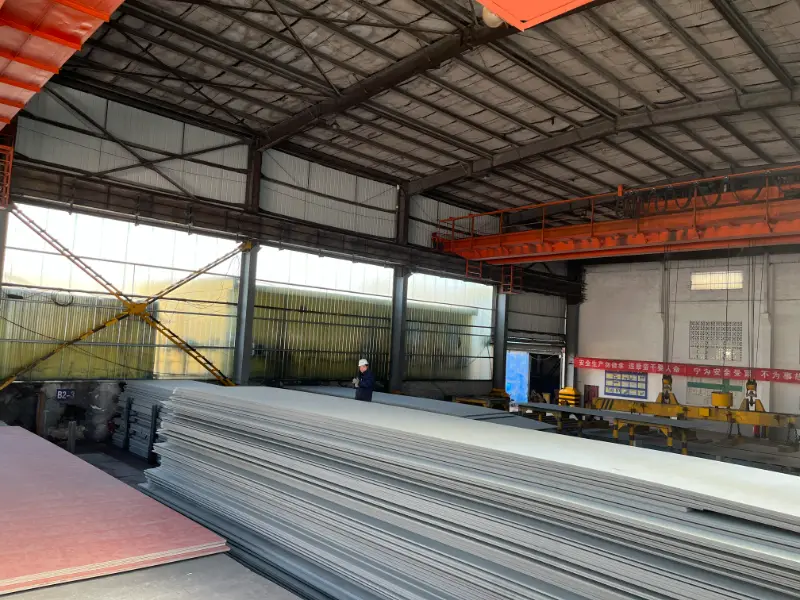
P460QL1 Steel Plate for Pressure Vessels
P460QL1 Steel Plate for Pressure Vessels: EN 10028-6 Standard, Properties & Equivalent Grades
Comprehensive technical data for P460QL1 steel plate under EN 10028-6, including chemical composition, mechanical properties, physical properties, international equivalents, and application guidance for pressure vessel and boiler construction.
Hot rolling, controlled rolling, quenching + tempering, cold forming (limited), welding, machining
- Phone : +8618037372205
- Email : [email protected]
- WhatsApp: Contact via Whtsapp
- WeChat: +8618037372205
P460QL1 Steel Plate for Pressure Vessels Introduction
P460QL1 is a high-strength fine-grain structural steel intended for pressure vessels and boilers according to EN 10028-6. It is delivered in the quenched and tempered (Q) condition and classified as a low-temperature (L1) grade with guaranteed impact energy at -60 °C. The material combines excellent weldability with high yield strength (minimum 460 MPa) and good toughness at sub-zero temperatures, making it suitable for critical components in the petrochemical, energy, and offshore industries. Its fine-grain microstructure, achieved through controlled rolling and heat treatment, ensures reliable performance under high pressure and in aggressive environments.
P460QL1 Steel Plate for Pressure Vessels Chemical Composition
The chemical composition of P460QL1 is specified in EN 10028-6:2017 to ensure a fine-grain structure and superior toughness at low temperatures. Maximum limits apply unless a range is given. The sum of niobium, vanadium, and titanium is restricted to enhance weldability and maintain grain refinement.
| Element | Standard Value (max %) | Remarks |
|---|---|---|
| Carbon (C) | 0.20 | Ladle analysis |
| Silicon (Si) | 0.50 | Ladle analysis |
| Manganese (Mn) | 1.70 | Ladle analysis |
| Phosphorus (P) | 0.020 | Ladle analysis |
| Sulfur (S) | 0.005 | Ladle analysis; lower limit for improved toughness |
| Nitrogen (N) | 0.020 | Ladle analysis |
| Aluminium (Altot) | ≥ 0.015 | Total aluminium, necessary for grain refinement |
| Chromium (Cr) | 0.50 | Ladle analysis, residual element |
| Copper (Cu) | 0.50 | Ladle analysis, residual element |
| Molybdenum (Mo) | 0.50 | Ladle analysis, residual element |
| Nickel (Ni) | 1.5 | Ladle analysis; enhances low-temperature toughness |
| Niobium (Nb) | 0.06 | Microalloying element for grain refinement |
| Vanadium (V) | 0.10 | Microalloying element for precipitation strengthening |
| Titanium (Ti) | 0.05 | Microalloying element for grain refinement |
| Nb + V + Ti | 0.22 | Sum of microalloying elements to maintain weldability |
P460QL1 Steel Plate for Pressure Vessels Physical Properties
Physical properties are not mandatory in EN 10028-6 but are typical for quenched and tempered fine-grain steel of this type. Values are provided for general engineering calculations and may vary slightly with heat treatment condition.
| Property | Typical Value | Unit | Condition / Temperature |
|---|---|---|---|
| Density (ρ) | 7.85 | g/cm³ | 20 °C |
| Modulus of Elasticity (E) | 210 | GPa | 20 °C |
| Shear Modulus (G) | 81 | GPa | 20 °C |
| Poisson's Ratio (ν) | 0.3 | — | 20 °C |
| Thermal Expansion Coefficient (α) | 11.1 | 10⁻⁶/K | 20 – 100 °C |
| Thermal Expansion Coefficient (α) | 12.2 | 10⁻⁶/K | 20 – 200 °C |
| Thermal Expansion Coefficient (α) | 13.0 | 10⁻⁶/K | 20 – 300 °C |
| Thermal Conductivity (λ) | 38 | W/(m·K) | 20 °C |
| Thermal Conductivity (λ) | 36 | W/(m·K) | 100 °C |
| Thermal Conductivity (λ) | 33 | W/(m·K) | 200 °C |
| Specific Heat Capacity (cp) | 460 | J/(kg·K) | 20 °C |
| Electrical Resistivity (ρe) | 0.22 | μΩ·m | 20 °C |
P460QL1 Steel Plate for Pressure Vessels Mechanical Properties
The mechanical properties are valid for quenched and tempered condition as per EN 10028-6. Minimum yield strength depends on product thickness. Impact energy is guaranteed at -60 °C. Tensile testing is performed on transverse specimens.
| Property | Required Value | Unit | Test Condition / Thickness Range |
|---|---|---|---|
| Yield Strength (ReH) | ≥ 460 | MPa | t ≤ 50 mm |
| Yield Strength (ReH) | ≥ 440 | MPa | 50 mm < t ≤ 100 mm |
| Yield Strength (ReH) | ≥ 400 | MPa | 100 mm < t ≤ 150 mm |
| Tensile Strength (Rm) | 550 – 720 | MPa | t ≤ 150 mm |
| Elongation after fracture (A) | ≥ 17 | % | Gauge length L0 = 5.65√S0, transverse |
| Impact Energy (KV₂) | ≥ 27 | J | -60 °C, transverse test pieces |
| Bend Test (mandrel diameter) | D = 3a (180°) | — | t ≤ 16 mm; no cracks allowed |
P460QL1 Steel Plate for Pressure Vessels Fully Equivalent Material Standards and Substitutable Grades
| Country/Region | Standard | Grade | Remarks |
|---|---|---|---|
| European Union | EN 10028-6:2017 | P460QL1 | Original standard; delivered in quenched and tempered condition. |
| International | ISO 9328-2:2011 | P460QL1 | Identical chemical and mechanical requirements for pressure equipment. |
| Germany | DIN EN 10028-6 | P460QL1 | German adoption of the European standard. |
| United Kingdom | BS EN 10028-6 | P460QL1 | British adoption, formerly BS 1501-224-490B, but now aligned with EN. |
| France | NF A36-206 | P460QL1 | French standard identical to EN 10028-6. |
| Italy | UNI EN 10028-6 | P460QL1 | Italian implementation. |
| Spain | UNE EN 10028-6 | P460QL1 | Spanish implementation. |
| Netherlands | NEN EN 10028-6 | P460QL1 | Dutch implementation. |
P460QL1 Steel Plate for Pressure Vessels Application Introduction
P460QL1 is engineered for heavy-duty pressure equipment operating at low temperatures, where high strength and crack resistance are essential. Its weldability without post-weld heat treatment (in many cases) reduces fabrication costs. The material is widely adopted across the energy, chemical, and process industries.
Product Applications: Pressure vessels (columns, separators, flare stacks), Boilers and steam drums, Cryogenic storage tanks (LNG, liquid nitrogen, etc.), Heat exchangers and condensers, Reactors and autoclaves, Piping components (flanges, fittings) when cut from plate, Offshore platform structural nodes and legs
Processed into products: Shell courses and heads of pressure vessels, Tube sheets for heat exchangers, Stiffening rings and support skirts, Weld-in nozzles and manways, Baffle plates and internals, Load-bearing brackets and lifting lugs, Base plates for heavy equipment
Application industries: Oil & Gas (upstream and downstream), Petrochemical and chemical processing, Power generation (conventional and nuclear), Cryogenic gas storage and transportation, Offshore and marine engineering, Industrial gas production (LNG, LPG, ethylene), Heavy machinery and mining
P460QL1 Steel Plate for Pressure Vessels Comparable / Alternative Materials with Similar Properties
| Country/Region | Standard | Grade | Remarks |
|---|---|---|---|
| USA | ASTM A537 / ASME SA537 | A537 Class 2 | Similar quenched and tempered pressure vessel steel with comparable strength; impact test temperature -60 °C may need supplementary requirement S5. |
| Japan | JIS G3115 | SPV450Q | Quenched and tempered steel for pressure vessels; yield 450 MPa, low-temperature toughness comparable with appropriate specification. |
| China | GB 19189 | 12MnNiVR | Chinese quenched and tempered pressure vessel steel; similar Ni content, designed for cryogenic service. |
| European Union | EN 10028-6 | P460Q | Quenched and tempered steel with same yield strength but impact test temperature -20 °C (Q) instead of -60 °C (QL1). |
| European Union | EN 10028-3 | P460NL1 | Normalized fine-grain steel; lower strength and different toughness behavior; may be used where heat input limitations apply. |
Notes:
Additional requirements: Per EN 10028-6, supplementary testing for simulated post-weld heat treatment (PWHT) may be specified. Plates are normally ultrasonically tested according to EN 10160 class S1E1 or per order. Surface condition and dimensional tolerances comply with EN 10029. For sour service or hydrogen-induced cracking (HIC) resistance, special chemistries (low S, Ca treatment) and testing to NACE TM0284 may be required. Always refer to the latest edition of the standard and the purchaser's specification for full compliance.
- Share



