
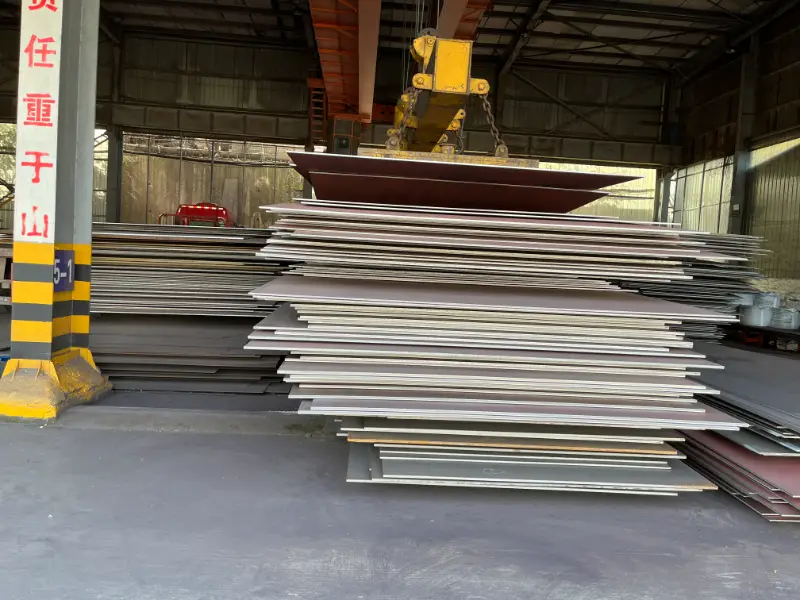
P460QL2 Pressure Vessel Steel Plate
P460QL2 Pressure Vessel Steel Plate | EN 10028-6 Properties & Equivalents
Detailed material data for P460QL2 steel according to EN 10028-6: chemical composition, mechanical properties at different thicknesses, thermal and electrical properties, international equivalents, and application guide for pressure vessel and boiler manufacturing.
Welding, hot forming, cold forming (limited), machining, flame cutting
- Phone : +8618037372205
- Email : [email protected]
- WhatsApp: Contact via Whtsapp
- WeChat: +8618037372205
P460QL2 Pressure Vessel Steel Plate Introduction
P460QL2 is a quenched and tempered fine-grain structural steel specified in EN 10028-6, designed for welded pressure vessels and boilers operating at elevated or low temperatures. It offers a minimum yield strength of 460 MPa for thicknesses up to 50 mm, combined with excellent low-temperature toughness (guaranteed impact energy of 27 J at -40 °C). The 'QL2' designation indicates enhanced through-thickness properties and suitability for demanding low-temperature service. The steel is microalloyed with elements such as Nb, V, Ti and Al to achieve grain refinement and high strength after quenching and tempering. Its fine-grained microstructure ensures good weldability, formability, and resistance to brittle fracture, making it a preferred choice for critical pressure equipment in the oil & gas, chemical, and power generation industries.
P460QL2 Pressure Vessel Steel Plate Chemical Composition
The chemical composition conforms to EN 10028-6:2017. All values are maximum unless a range or minimum is given. The steel is fully killed and contains fine-grain elements. The carbon equivalent (CEV) is usually controlled to ensure good weldability, typically CEV ≤ 0.50 % for thicknesses up to 50 mm.
| Element | Standard Value (%) | Remarks |
|---|---|---|
| Carbon (C) | ≤ 0.18 | Heat analysis |
| Silicon (Si) | ≤ 0.50 | |
| Manganese (Mn) | ≤ 1.70 | |
| Phosphorus (P) | ≤ 0.020 | |
| Sulfur (S) | ≤ 0.010 | |
| Aluminium (Al total) | ≥ 0.020 | Minimum for fine-grain practice |
| Nitrogen (N) | ≤ 0.015 | |
| Niobium (Nb) | ≤ 0.05 | Microalloying element |
| Vanadium (V) | ≤ 0.08 | Microalloying element |
| Titanium (Ti) | ≤ 0.05 | Microalloying element |
| Chromium (Cr) | ≤ 0.50 | |
| Copper (Cu) | ≤ 0.30 | |
| Molybdenum (Mo) | ≤ 0.50 | |
| Nickel (Ni) | ≤ 0.80 | Improves toughness at low temperatures |
| Boron (B) | Optional | May be added for hardenability; not specified by default |
P460QL2 Pressure Vessel Steel Plate Thermal and Electrical Physical Properties
The following physical properties are typical for quenched and tempered P460QL2 steel at room temperature unless otherwise indicated. Actual values may vary slightly depending on the exact heat treatment and composition. Thermal properties are essential for design calculations involving heat transfer (e.g., in boilers and heat exchangers).
| Property | Standard Value | Unit | Test Condition |
|---|---|---|---|
| Density (ρ) | ~7850 | kg/m³ | At 20 °C |
| Modulus of elasticity (E) | ~205 | GPa | At 20 °C |
| Shear modulus (G) | ~80 | GPa | At 20 °C |
| Poisson's ratio (ν) | ~0.30 | – | At 20 °C |
| Thermal expansion coefficient (α) | ~11.1 × 10⁻⁶ | K⁻¹ | 20 °C to 100 °C |
| Thermal conductivity (λ) | ~41 | W/(m·K) | At 20 °C |
| Specific heat capacity (c) | ~460 | J/(kg·K) | At 20 °C |
| Electrical resistivity (ρₑ) | ~0.18 × 10⁻⁶ | Ω·m | At 20 °C |
P460QL2 Pressure Vessel Steel Plate Mechanical Properties
The mechanical properties are valid for quenched and tempered condition according to EN 10028-6. Values depend on the nominal product thickness (t). The tensile test specimen orientation is usually transverse. Impact energy is verified on Charpy V-notch specimens at -40 °C for QL2 grade. Bending test, if required, is performed with a mandrel diameter equal to 3 times the specimen thickness (3a) for nominal thickness ≤ 25 mm.
| Property | Standard Requirement | Unit | Test Condition |
|---|---|---|---|
| Yield strength (ReH) | ≥ 460 | MPa | t ≤ 50 mm |
| Yield strength (ReH) | ≥ 440 | MPa | 50 < t ≤ 100 mm |
| Yield strength (ReH) | ≥ 400 | MPa | 100 < t ≤ 150 mm |
| Tensile strength (Rm) | 570 – 730 | MPa | t ≤ 50 mm |
| Tensile strength (Rm) | 560 – 720 | MPa | 50 < t ≤ 100 mm |
| Tensile strength (Rm) | 550 – 710 | MPa | 100 < t ≤ 150 mm |
| Elongation after fracture (A) | ≥ 17 | % | t ≤ 50 mm, gauge length 5.65√S₀ |
| Elongation after fracture (A) | ≥ 16 | % | 50 < t ≤ 100 mm |
| Elongation after fracture (A) | ≥ 16 | % | 100 < t ≤ 150 mm |
| Impact energy (KV₂) | ≥ 27 | J | At -40 °C, transverse, average of 3 specimens |
| Bend test (if required) | No cracks | – | 180° bend, mandrel diameter 3a (t ≤ 25 mm) |
P460QL2 Pressure Vessel Steel Plate Equivalent Standards and Substitutable Grades
The following table lists standards and grades that are fully equivalent or considered as direct substitutes for EN 10028-6 P460QL2. These designations refer to quenched and tempered fine-grain pressure vessel steels with similar minimum yield strength and low-temperature toughness.
| Country / Region | Standard | Grade | Remarks |
|---|---|---|---|
| International | ISO 4978-2 | P460QL2 | Identical technical requirements |
| Europe | EN 10028-6 | P460QL2 | Original specification |
| USA | ASTM A537/A537M | Class 2 | Closest match; quenched and tempered, similar strength, impact energy at lower temperature possible |
| USA (ASME) | ASME SA537/SA537M | Class 2 | Equivalent to ASTM A537 Class 2 for ASME BPVC |
| China | GB/T 19189 | Q460Q | Quenched and tempered; same minimum yield strength, similar toughness |
| Japan | JIS G3115 | SPV490Q | Higher minimum tensile strength 490 MPa; often used interchangeably for design |
P460QL2 Pressure Vessel Steel Plate Application Introduction
P460QL2 is specifically designed for heavy-walled pressure vessels and boilers where high strength, excellent weldability, and reliable low-temperature toughness are required. The steel is produced with strict internal quality control to ensure integrity under cyclic thermal and pressure loads. It can be formed into complex shapes, welded with conventional methods, and is often supplied with ultrasonic testing and enhanced through-thickness properties (Z-quality) on request.
Product Applications: Pressure vessels (columns, separators, drums), Industrial boilers and steam generators, Spherical and cylindrical storage tanks (LNG, ammonia, ethylene), Heat exchangers and condensers, Process piping and penstocks, Offshore platform structures (legs, nodes), Reactors and autoclaves
Processed into products: Shell courses and heads (dished, elliptical), Nozzles and reinforcements, Flanges and bolted covers, Skirts and support structures, Tube sheets for heat exchangers, Stiffening rings and stiffeners, Integral attachment lugs and lifting devices
Application industries: Oil & Gas (upstream and downstream), Petrochemical and Chemical Processing, Power Generation (conventional and nuclear), Offshore and Marine Engineering, Cryogenic Storage (LNG, LPG), Paper and Pulp Industry, Water Treatment and Desalination Plants
P460QL2 Pressure Vessel Steel Plate Similar / Alternative Materials and Analysis
The following steels offer comparable performance but may differ in impact temperature rating, thickness capability, or small composition adjustments. They can be considered when exact P460QL2 is not available, after verifying the specific service requirements.
| Country / Region | Standard | Grade | Remarks |
|---|---|---|---|
| Europe | EN 10028-6 | P460QL1 | Quenched and tempered, same strength but impact test at -20 °C instead of -40 °C; suitable for less severe low temperature applications |
| Europe | EN 10028-6 | P460Q | Basic quenched and tempered grade without guaranteed low-temperature impact energy; may be used for ambient temperature pressure vessels |
| Europe | EN 10028-6 | P500QL2 | Higher yield strength (min. 500 MPa), similar low-temperature toughness at -40 °C; can be used for weight reduction or higher pressure ratings |
| USA | ASTM A514/A517 | Grade Q / Type Q | Higher strength (yield ≥ 620 MPa), quenched and tempered, but requires careful welding procedures |
| China | GB/T 3531 | Q460D | Normalized or thermo-mechanically rolled steel for low-temperature pressure vessels; similar yield but not quenched and tempered; toughness to -20 °C or -40 °C depending on subtype |
| Japan | JIS G3128 | SHY685 | High yield strength quenched and tempered steel, used for pressure vessels in Japan; higher strength but requires evaluation of weldability |
Notes:
Welding and fabrication: P460QL2 exhibits good weldability with low cracking sensitivity. Preheating (typically 100–150 °C) may be required depending on plate thickness and hydrogen content. A post-weld heat treatment (PWHT) is often applied to reduce residual stresses in accordance with pressure vessel codes.
Carbon equivalent (CEV): Usually supplied with CEV ≤ 0.50% for thickness up to 50 mm; higher thicknesses may require a slightly higher CEV, subject to agreement.
Testing and certification: Mill test certificates (EN 10204 Type 3.1 or 3.2) are standard. Additional tests such as ultrasonic examination, through-thickness tensile (Z35), and elevated temperature strength values are available on request.
- Share



