
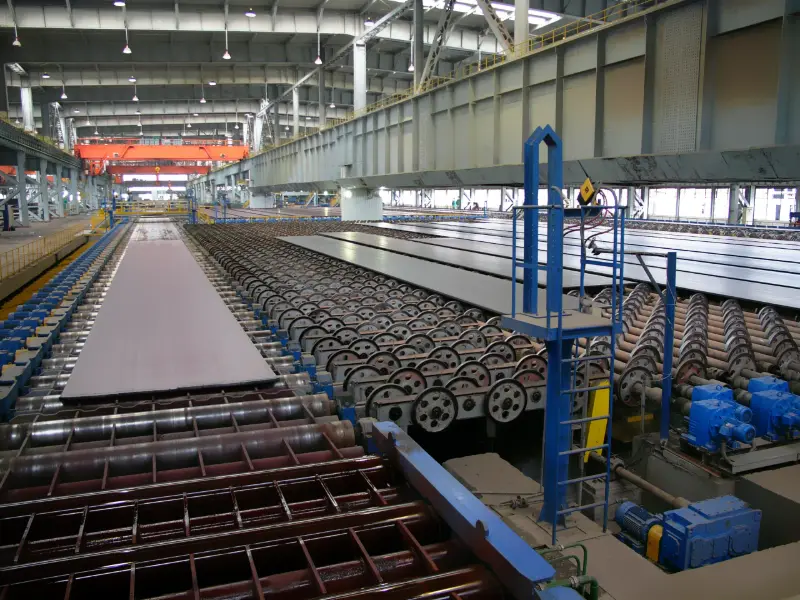
EN10028-6 P500Q Steel Plate
EN10028-6 P500Q Steel Plate - High-Strength Quenched & Tempered Steel for Pressure Vessels & Boilers
Comprehensive datasheet for EN10028-6 P500Q steel covering chemical composition, mechanical properties, thermal and electrical data, and international equivalents for pressure vessel and boiler applications.
Hot rolling + quenching and tempering; cold forming is possible with proper consideration of the high strength level; welding with low-hydrogen processes and preheating when required.
- Phone : +8618037372205
- Email : [email protected]
- WhatsApp: Contact via Whtsapp
- WeChat: +8618037372205
EN10028-6 P500Q Steel Plate Introduction
EN10028-6 P500Q is a weldable fine-grain structural steel delivered in the quenched and tempered condition, specifically designed for pressure vessels and boilers. It belongs to the group of steels with a minimum yield strength of 500 MPa in thicknesses up to 50 mm. The steel exhibits an excellent combination of high strength, good toughness at low temperatures (tested at -20 °C for the base quality), and reliable weldability.
- Key characteristics: fine-grained microstructure ensures uniform mechanical properties; controlled low sulphur and phosphorus content enhances ductility and resistance to brittle fracture.
- The steel is suitable for operating temperatures down to -20 °C and can be supplied with enhanced low-temperature toughness grades (QL1, QL2) upon agreement.
- Typical applications include welded pressure vessels, steam boilers, storage tanks, and high-pressure pipelines where high strength and safety are paramount.
EN10028-6 P500Q Steel Plate Chemical Composition
The chemical composition as per EN 10028-6:2017 for grade P500Q. Values apply to product thickness ≤ 100 mm. The steel is fully killed and fine-grain treated with sufficient amount of nitrogen-binding elements (Al, Nb, V, Ti). Maximum limits are specified unless a range is given. Microalloying elements may be added singly or in combination to achieve the required mechanical properties.
| Element | Mass Fraction (%) | Remarks |
|---|---|---|
| Carbon (C) | ≤ 0.20 | |
| Silicon (Si) | ≤ 0.50 | |
| Manganese (Mn) | 1.00 – 1.70 | |
| Phosphorus (P) | ≤ 0.020 | |
| Sulfur (S) | ≤ 0.010 | |
| Nitrogen (N) | ≤ 0.015 | Total N; if Al, Nb, V or Ti are added, nitrogen binding shall be verified |
| Boron (B) | ≤ 0.005 | If intentionally added |
| Chromium (Cr) | ≤ 0.70 | |
| Copper (Cu) | ≤ 0.30 | |
| Molybdenum (Mo) | ≤ 0.50 | |
| Niobium (Nb) | ≤ 0.05 | |
| Nickel (Ni) | ≤ 1.50 | |
| Titanium (Ti) | ≤ 0.05 | |
| Vanadium (V) | ≤ 0.08 | |
| Niobium + Vanadium + Titanium | ≤ 0.12 | Combined content |
| Zirconium (Zr) | ≤ 0.15 | If added |
| Aluminium (Altotal) | ≥ 0.015 | Minimum for fine-grain practice; usually 0.020 – 0.060 |
EN10028-6 P500Q Steel Plate Thermal and Electrical Physical Properties
Physical properties are typical for low-alloy quenched and tempered steels with similar chemistry. These values are not part of the EN 10028-6 standard but are widely accepted engineering references.
- Properties may vary slightly with actual heat treatment and composition; for critical design, measured values on the supplied material are recommended.
- The thermal expansion coefficient and thermal conductivity are temperature-dependent; values at higher temperatures are available upon request.
| Property | Value | Unit | Condition / Remark |
|---|---|---|---|
| Density (ρ) | 7.85 | g/cm³ | At 20 °C |
| Modulus of Elasticity (E) | 210 | GPa | At 20 °C, longitudinal |
| Shear Modulus (G) | 81 | GPa | At 20 °C, torsional test |
| Poisson's Ratio (ν) | 0.3 | - | Elastic range |
| Thermal Expansion Coefficient (α) | 11.1 × 10⁻⁶ | K⁻¹ | Between 20 °C and 100 °C |
| Thermal Conductivity (λ) | 40 | W/(m·K) | At 20 °C |
| Specific Heat Capacity (cp) | 460 | J/(kg·K) | At 20 °C |
| Electrical Resistivity (ρe) | 0.22 | Ω·mm²/m | At 20 °C |
EN10028-6 P500Q Steel Plate Mechanical Properties
Mechanical properties specified by EN 10028-6:2017 for the quenched and tempered condition. The values apply to transverse test specimens unless otherwise agreed.
- Yield strength and tensile strength depend on product thickness; values for thickness >100 mm and ≤150 mm are given where available.
- Impact energy is for Charpy V-notch test on longitudinal specimens at -20 °C. The values represent the minimum average of three tests; one individual value may be below the average, but not below 70% of that value.
- Bend test performed with mandrel diameter D = 3a (a = specimen thickness) for thickness up to 63 mm, bending angle 180° without cracking.
| Property | Value | Unit | Condition / Thickness Range |
|---|---|---|---|
| Yield Strength (ReH) | ≥ 500 | MPa | t ≤ 50 mm |
| Yield Strength (ReH) | ≥ 480 | MPa | 50 < t ≤ 100 mm |
| Yield Strength (ReH) | ≥ 460 | MPa | 100 < t ≤ 150 mm |
| Tensile Strength (Rm) | 590 – 770 | MPa | t ≤ 100 mm |
| Tensile Strength (Rm) | 590 – 750 | MPa | 100 < t ≤ 150 mm |
| Elongation (A5, L0=5.65√S0) | ≥ 17 | % | t ≤ 50 mm, transverse |
| Elongation (A5, L0=5.65√S0) | ≥ 17 | % | 50 < t ≤ 100 mm, transverse |
| Elongation (A5, L0=5.65√S0) | ≥ 17 | % | 100 < t ≤ 150 mm, transverse |
| Impact Energy (KV2) | ≥ 27 | J | At -20 °C, longitudinal, t ≤ 150 mm |
| Bend Test (Mandrel Diameter) | D = 3a | Bending angle 180°, t ≤ 63 mm |
EN10028-6 P500Q Steel Plate Completely Equivalent Material Standards & Replaceable Grades
| Country / Region | Standard | Grade | Remarks |
|---|---|---|---|
| International (ISO) | ISO 4950-2:1995 / ISO 630-6:2023 | E500QL (t≤50 mm) / E500Q | Closest composition and mechanical match; ISO E500QL is tested at -40 °C; P500Q base grade tested at -20 °C. |
| China | GB/T 19189-2011 | 12MnNiVR (Q500R as comparable strength) | Similar quenched and tempered pressure vessel steel; check impact temperature and minor element limits. |
| Germany (original EN) | DIN EN 10028-6 | P500Q | Identical to the requested standard; the original adoption. |
| USA | ASME SA-517 (Section II, Part A) | Grade E or Grade F (mod.) | Comparable strength level (690 MPa tensile class), but alloy content differs; requires engineering approval for substitution. |
EN10028-6 P500Q Steel Plate Application Introduction
EN10028-6 P500Q is engineered for high-stress pressure components where weight reduction and reliability are critical. Its high yield strength allows thinner wall thicknesses, reducing material and fabrication costs. The steel is weldable with established procedures and exhibits good resistance to brittle fracture at low ambient temperatures.
- Fabrication: Can be cut, welded, and cold formed (with suitable bend radii). Preheating (typically 100–175 °C) and post-weld heat treatment may be necessary depending on thickness and service conditions.
- Service environment: Suitable for aggressive environments when used with appropriate corrosion allowance; not inherently resistant to hydrogen-induced cracking in sour service (NACE MR0175 compliance must be specially ordered).
Product Applications: Welded pressure vessels (ASME VIII, EN 13445), Steam boiler shells and drums, Spherical storage tanks for liquefied gases, High-pressure hydraulic cylinders, Reactor vessels for chemical processes
Processed into products: Shell courses and heads (hemispherical, ellipsoidal, torispherical), Tube sheets and baffles for heat exchangers, Manway and nozzle forgings, Flanges and bolted cover plates, Stiffening rings and support skirts, Transition pieces and cone sections, Integrally reinforced branch connections
Application industries: Oil & Gas (refineries, LNG storage, separators), Power Generation (fossil-fuel boiler drums, heat recovery steam generators), Chemical & Petrochemical (reactors, columns, heat exchangers), Water & Energy (penstocks, high-pressure pipelines), Shipbuilding and Offshore (pressure accumulators, buoyancy tanks)
EN10028-6 P500Q Steel Plate Similar / Alternative Materials with Close Performance
| Country / Region | Standard | Grade | Remarks |
|---|---|---|---|
| European Union | EN 10028-6 | P500QL1 / P500QL2 | Same base chemistry with enhanced low-temperature toughness (-40 °C and -60 °C Charpy test). Suitable for lower operating temperatures. |
| International | ISO 4950-2 | E500QL / E500QL1 / E500QL2 | Direct parallel to EN 10028-6 P500Q series; QL1 and QL2 correspond to improved toughness. |
| USA | ASME SA-537 | Class 2 (Normalized) | Similar yield strength but normalized condition; allowable stress values differ; may be used where quenching and tempering is not required. |
| Japan | JIS G3115 | SPV490Q (t≤50 mm) | Quenched and tempered pressure vessel steel; yield ≥490 MPa; often considered a close match for P500Q with similar weldability. |
| Germany | DIN EN 10210-3 / EN 10219-3 | S500Q / S500QL | Fine-grain structural steel for hollow sections with similar strength and toughness; check application limitations for pressure equipment. |
Notes:
- Ultrasonic testing: Plates are normally supplied with ultrasonic examination to EN 10160 or agreed upon specification (e.g., SEL 072).
- Heat treatment after welding: Post-weld heat treatment (PWHT) shall be carried out in accordance with the pressure vessel code; the steel retains its properties after stress relieving at 550–600 °C. A simulated test may be required to verify that the minimum properties are met after PWHT.
- Delivery conditions: The material is certified according to EN 10204 type 3.1 or 3.2 with complete chemical and tensile test results and Charpy V-notch impact values. Plates are supplied with mill edges or trimmed edges as agreed.
- Tolerances: Thickness tolerances to EN 10029, flatness to EN 10029 class N or S (standard), surface condition according to EN 10163-2 class A or B.
- Share



