
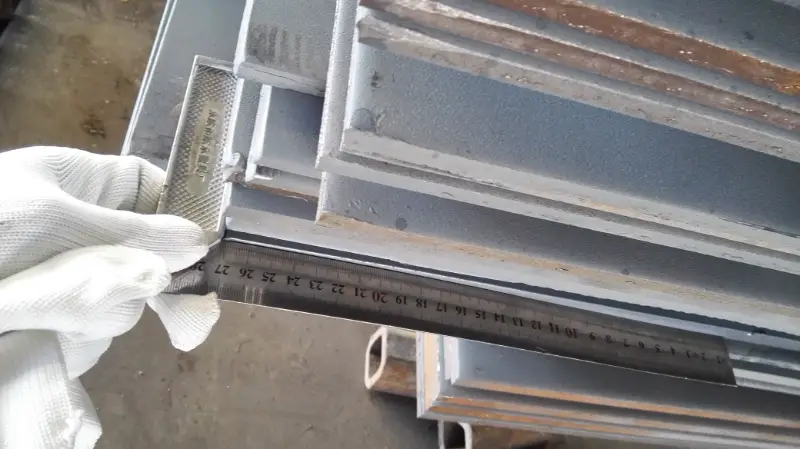
EN 10028-6 P500QH
EN 10028-6 P500QH: High-Strength Quenched & Tempered Steel for Pressure Vessels and Boilers
Detailed material data for EN 10028-6 P500QH, a high-strength quenched and tempered fine-grain steel for pressure vessels and boilers, including chemical composition, mechanical and physical properties, international equivalents, and application guidance.
Hot rolling, quenching and tempering, welding, cold forming (limited), machining
- Phone : +8618037372205
- Email : [email protected]
- WhatsApp: Contact via Whtsapp
- WeChat: +8618037372205
EN 10028-6 P500QH Introduction
P500QH is a high-strength, weldable fine-grain structural steel specified in EN 10028-6 for pressure purposes. It is supplied in the quenched and tempered condition, offering excellent toughness and elevated temperature properties. The 'H' suffix indicates enhanced performance for high-temperature service. Typical applications include steam boilers, pressure vessels, and heat exchangers operating under demanding conditions. The steel exhibits a minimum yield strength of 500 MPa in thicknesses up to 50 mm, combined with good ductility and reliable notch toughness at low temperatures. Its balanced chemical composition, featuring additions of nickel, chromium, and molybdenum, ensures deep hardenability and uniform mechanical properties in heavy sections. P500QH meets stringent requirements for pressure equipment according to the PED (Pressure Equipment Directive) and other international codes.
EN 10028-6 P500QH Chemical Composition
The chemical composition of P500QH is carefully balanced to achieve high strength and toughness after quenching and tempering. Microalloying elements such as niobium, vanadium, and titanium are used for grain refinement and precipitation strengthening. The steel is fully killed and fine-grained. All values are according to EN 10028-6:2017 (heat analysis).
| Element | Standard Value (%) | Remarks |
|---|---|---|
| Carbon (C) | ≤ 0.20 | Max |
| Silicon (Si) | ≤ 0.60 | Max |
| Manganese (Mn) | ≤ 1.70 | Max |
| Phosphorus (P) | ≤ 0.025 | Max |
| Sulfur (S) | ≤ 0.015 | Max |
| Chromium (Cr) | ≤ 1.50 | Max |
| Molybdenum (Mo) | ≤ 0.70 | Max |
| Nickel (Ni) | ≤ 2.0 | Max |
| Copper (Cu) | ≤ 0.30 | Max |
| Aluminium (Al total) | ≥ 0.020 | Min, typically for grain refinement |
| Niobium (Nb) | ≤ 0.06 | Max |
| Vanadium (V) | ≤ 0.12 | Max |
| Titanium (Ti) | ≤ 0.05 | Max |
| Zirconium (Zr) | ≤ 0.15 | Max |
| Nitrogen (N) | ≤ 0.015 | Max |
| Boron (B) | ≤ 0.005 | Max |
EN 10028-6 P500QH Physical & Thermal Properties
The following values are typical for quenched and tempered low-alloy steels like P500QH. They are provided for engineering guidance and may vary slightly depending on exact composition and microstructure. These are not mandatory requirements of EN 10028-6.
| Property | Typical Value | Unit | Test Condition / Remarks |
|---|---|---|---|
| Density (ρ) | 7.85 | g/cm³ | At 20°C |
| Modulus of Elasticity (E) | 210 | GPa | At 20°C |
| Shear Modulus (G) | 81 | GPa | At 20°C |
| Poisson's Ratio (ν) | 0.3 | - | At 20°C |
| Thermal Expansion Coefficient (α) | 11.1 × 10⁻⁶ | K⁻¹ | 20 - 100°C |
| Thermal Expansion Coefficient (α) | 12.1 × 10⁻⁶ | K⁻¹ | 20 - 200°C |
| Thermal Expansion Coefficient (α) | 12.9 × 10⁻⁶ | K⁻¹ | 20 - 300°C |
| Thermal Conductivity (λ) | 42 | W/(m·K) | At 20°C |
| Thermal Conductivity (λ) | 38 | W/(m·K) | At 200°C |
| Thermal Conductivity (λ) | 34 | W/(m·K) | At 300°C |
| Specific Heat Capacity (cp) | 460 | J/(kg·K) | At 20 - 100°C |
| Electrical Resistivity (ρ_e) | 0.22 × 10⁻⁶ | Ω·m | At 20°C |
EN 10028-6 P500QH Mechanical Properties
The mechanical properties are guaranteed for the quenched and tempered delivery condition. Values vary with product thickness as indicated. Impact test requirements are for transverse Charpy V-notch specimens at -20°C, with a minimum average absorbed energy of 27 J. Bending tests may be required with mandrel diameters depending on thickness and specification. All data comply with EN 10028-6.
| Property | Required Value | Unit | Test Condition / Remarks |
|---|---|---|---|
| Yield Strength (ReH) | ≥ 500 | MPa | Thickness ≤ 50 mm |
| Yield Strength (ReH) | ≥ 480 | MPa | 50 mm < thickness ≤ 100 mm |
| Yield Strength (ReH) | ≥ 460 | MPa | 100 mm < thickness ≤ 150 mm |
| Tensile Strength (Rm) | 590 - 770 | MPa | Thickness ≤ 100 mm |
| Tensile Strength (Rm) | 570 - 750 | MPa | 100 mm < thickness ≤ 150 mm |
| Elongation (A5) | ≥ 17 | % | Gauge length = 5.65√S0, transverse |
| Impact Energy (KV₂) | ≥ 27 (average) | J | At -20°C, transverse, individual min 19 J |
| Bend Test | No cracks | - | Mandrel diameter according to specification, 180° bend |
EN 10028-6 P500QH Completely Equivalent Material Standards & Replaceable Grades
| Country/Region | Standard | Designation | Remarks |
|---|---|---|---|
| Europe | EN 10028-6 | P500QH | Original specification, 1.8873 steel number |
| International | ISO 9328-4 | P500QH | Identical properties and chemical concept |
| Germany | DIN EN 10028-6 | P500QH | Transposed European standard |
| France | NF EN 10028-6 | P500QH | Transposed European standard |
| United Kingdom | BS EN 10028-6 | P500QH | Transposed European standard |
| Italy | UNI EN 10028-6 | P500QH | Transposed European standard |
| Spain | UNE EN 10028-6 | P500QH | Transposed European standard |
EN 10028-6 P500QH Application Introduction
P500QH is specifically designed for welded pressure equipment. Its high strength-to-weight ratio allows for thinner wall thicknesses compared to conventional boiler steels, leading to material and fabrication cost savings. Excellent weldability and good toughness at both low and elevated temperatures make it a preferred choice for critical components. Typical application areas include:
- High-pressure steam boilers
- Hot water boilers
- Chemical reactor vessels
- Heat exchangers
- Liquefied gas storage tanks
- Offshore and onshore process equipment
Product Applications: Steam drums and boiler shells, Pressure vessel shells and heads, Heat exchanger tube sheets, Reactors and columns, LPG/NH3 storage bullets, High-pressure piping components (when formed from plate)
Processed into products: Cylindrical and spherical vessel courses, Ellipsoidal and torispherical heads, Flanges and blind flanges, Baffle plates, Reinforcing pads, Nozzle forgings (when machined from heavy plate), Support skirts and structural attachments
Application industries: Power generation (conventional and nuclear), Oil & gas (upstream, midstream, downstream), Petrochemical and chemical processing, Industrial boiler manufacturing, Heavy engineering and machinery, Offshore engineering
EN 10028-6 P500QH Similar or Comparable Alternative Materials
| Country/Region | Standard | Designation | Remarks |
|---|---|---|---|
| USA | ASTM A517 / A517M | Grade Q | Higher strength (min 690 MPa yield), similar Ni-Cr-Mo-V concept, requires careful welding evaluation |
| USA | ASTM A517 / A517M | Grade B | Yield 620 MPa min, different alloy balance, may be considered with design adjustments |
| Germany (historical) | DIN 17102 | StE500V | Obsolete standard, similar yield level but different toughness requirements |
| China | GB/T 19189 | 12Cr1MoVR | Quenched and tempered Cr-Mo-V steel for pressure vessels, yield ~440 MPa, lower strength |
| Japan | JIS G 3115 | SPV490 | Quenched and tempered, yield ≥490 MPa, for pressure vessels, similar strength range |
Notes:
Welding: P500QH exhibits good weldability with appropriate preheating and interpass temperature control. Post-weld heat treatment (PWHT) may be required depending on thickness and service conditions, but care must be taken to avoid temper embrittlement. Consumables should match the strength and toughness level. Inspection & Testing: The steel is supplied with EN 10204 type 3.1 or 3.2 certification. Ultrasonic testing per EN 10160 and toughness verification are standard. Forming: Cold forming is feasible for moderate deformation; hot forming above 900°C followed by new quenching and tempering may be necessary for heavy dishing. Consult the steel manufacturer for detailed fabrication guidelines.
- Share



