
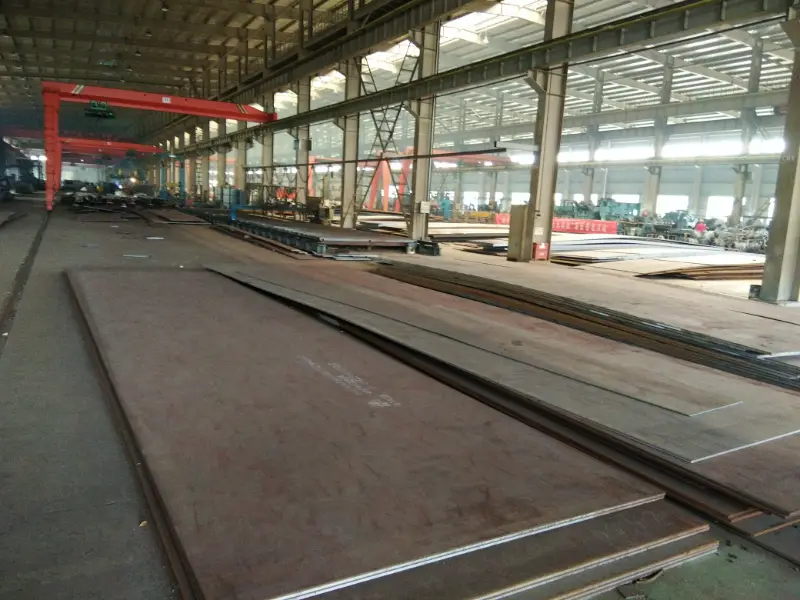
EN 10028-6 P500QL1 Pressure Vessel & Boiler Steel Plate
EN 10028-6 P500QL1 Pressure Vessel & Boiler Steel Plate - Specifications & Data
Complete material data sheet for EN 10028-6 P500QL1 steel: chemistry, mechanics, thermal properties, and global equivalents.
Welding, hot forming, cold forming, drilling, milling
- Phone : +8618037372205
- Email : [email protected]
- WhatsApp: Contact via Whtsapp
- WeChat: +8618037372205
EN 10028-6 P500QL1 Pressure Vessel & Boiler Steel Plate Introduction
P500QL1 is a high-strength, quenched and tempered fine grain steel designed for pressure vessels and boilers according to European standard EN 10028-6. It achieves a minimum yield strength of 500 MPa (thickness ≤50 mm) and offers excellent notch toughness down to -40°C (L1 quality). The steel is characterized by good weldability thanks to its low carbon content and controlled microalloying. It is widely used in the petrochemical, power generation, and offshore industries for the construction of welded pressure components subject to moderate temperatures.
EN 10028-6 P500QL1 Pressure Vessel & Boiler Steel Plate Chemical Composition
The chemical composition according to EN 10028-6:2017 for grade P500QL1 is given below. Maximum limits apply unless a range is indicated. The steel is microalloyed with Nb, V, Ti to achieve fine grain size and high strength. Ceq (carbon equivalent) is controlled to ensure weldability.
| Element | Max. Value (%) | Notes |
|---|---|---|
| C | 0.20 | |
| Si | 0.60 | |
| Mn | 1.70 | |
| P | 0.020 | |
| S | 0.010 | |
| N | 0.015 | |
| Al total | ≥0.020 | Min. |
| Nb | 0.06 | |
| V | 0.12 | |
| Ti | 0.05 | |
| Cr | 0.50 | |
| Ni | 0.50 | |
| Mo | 0.30 | |
| Cu | 0.30 | |
| Ceq | ≤0.50 | for thickness ≤50 mm, product analysis |
EN 10028-6 P500QL1 Pressure Vessel & Boiler Steel Plate Physical & Thermal Properties
These physical properties are typical for quenched and tempered structural steels and may vary slightly depending on exact chemical composition and heat treatment. They are provided for engineering reference.
| Property | Typical Value | Unit | Conditions |
|---|---|---|---|
| Density (ρ) | 7850 | kg/m³ | at 20°C |
| Elastic Modulus (E) | 205 - 210 | GPa | at 20°C |
| Shear Modulus (G) | ~80 | GPa | calculated (E/(2(1+ν))) |
| Poisson's Ratio (ν) | 0.3 | - | at 20°C |
| Thermal Expansion (α) | 12.0 ×10⁻⁶ | /K | 20 - 100°C |
| Thermal Expansion (α) | 12.5 ×10⁻⁶ | /K | 20 - 200°C |
| Thermal Conductivity (λ) | 42 | W/(m·K) | at 20°C |
| Specific Heat Capacity | 460 | J/(kg·K) | at 20°C |
| Electrical Resistivity (ρe) | 0.20 - 0.25 | µΩ·m | at 20°C |
EN 10028-6 P500QL1 Pressure Vessel & Boiler Steel Plate Mechanical Properties
The following tensile and impact properties are guaranteed in the quenched and tempered condition. Specimens are taken transverse to the rolling direction (unless longitudinal specified). Values vary with plate thickness.
| Property | Value | Unit | Condition/Thickness |
|---|---|---|---|
| Yield Strength (ReH) | ≥500 | MPa | Thk ≤50 mm |
| Yield Strength (ReH) | ≥480 | MPa | 50 < Thk ≤100 mm |
| Yield Strength (ReH) | ≥460 | MPa | 100 < Thk ≤150 mm |
| Tensile Strength (Rm) | 590 - 770 | MPa | Thk ≤100 mm |
| Tensile Strength (Rm) | 540 - 720 | MPa | Thk >100 mm |
| Elongation (A, Lo=5.65√So) | ≥17 | % | Thk ≤100 mm |
| Elongation (A, Lo=5.65√So) | ≥16 | % | Thk >100 mm |
| Impact Energy (KV, -40°C) | ≥27 | J | L1 quality, longitudinal, thickness ≤150 mm |
EN 10028-6 P500QL1 Pressure Vessel & Boiler Steel Plate Direct Equivalent Standards & Grades
| Region | Standard | Grade | Remarks |
|---|---|---|---|
| International | ISO 4978 | P500QL1 | Identical to EN 10028-6 P500QL1 |
EN 10028-6 P500QL1 Pressure Vessel & Boiler Steel Plate Application Introduction
P500QL1 is primarily employed in the fabrication of welded pressure vessels and boilers operating at moderate temperatures and where good notch toughness at sub-zero conditions is essential. Its high strength allows reduced wall thickness, leading to lower weight and cost. The steel is easily weldable with standard procedures provided preheating and post-weld heat treatment are applied as recommended. Common applications include:
Product Applications: Pressure vessels (reactors, separators, columns), Industrial boilers, Steam drums, Heat exchangers, LPG / ammonia storage tanks, Penstocks and water turbines
Processed into products: Cylindrical / spherical shells, Dished heads (elliptical, torispherical, hemispherical), Flanges (weld neck, blind), Nozzles and reinforcements, Support brackets and skirts, Baffle plates and tube sheets
Application industries: Oil & gas processing, Petrochemical plants, Power generation (conventional and nuclear), Offshore engineering, Chemical processing, Hydrocarbon storage
EN 10028-6 P500QL1 Pressure Vessel & Boiler Steel Plate Similar or Alternative Materials
| Region | Standard | Grade | Remarks |
|---|---|---|---|
| Europe | EN 10028-6 | P500Q | Basic Q&T grade without low-temperature guarantee (L0); less tough |
| Europe | EN 10028-6 | P500QL2 | Higher toughness at -50°C (L2 quality) |
| Europe | EN 10025-6 | S500QL1 | Structural steel, not for pressure vessels; similar strength and toughness but different certification |
| USA | ASTM A517/A517M | Grade Q | Quenched and tempered alloy steel for pressure vessels; min yield 620 MPa for thin plates – stronger, but requires careful welding. Not a direct substitute. |
| USA | ASTM A514/A514M | Grade S | High yield structural steel, not for pressure equipment without code approval. |
Notes:
Additional Considerations:
- Ultrasonic testing according to EN 10160 may be specified to guarantee internal soundness.
- For thicknesses above 50 mm, a step-cooling test (e.g., per SEP 1390) may be required to avoid temper embrittlement.
- Post-weld heat treatment is recommended to relieve residual stresses; time and temperature to comply with applicable pressure vessel codes (e.g., EN 13445, ASME VIII).
- The steel is typically supplied with EN 10204 Inspection Certificate 3.1 or 3.2.
- Share



