
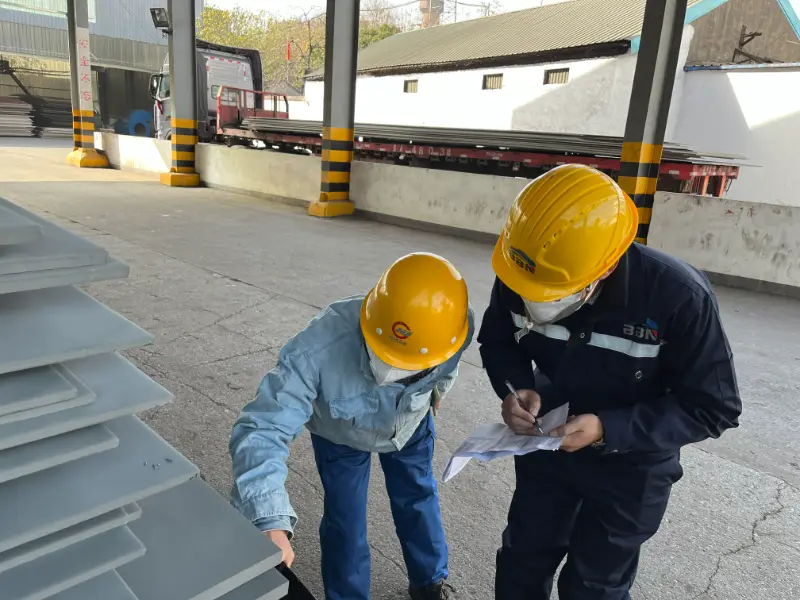
EN10028-6 P500QL2 Pressure Vessel And Boiler Steel Plate
EN 10028-6 P500QL2 Quenched and Tempered Fine Grain Steel for Pressure Vessels
Comprehensive material profile of P500QL2, a high-strength weldable fine grain steel for pressure purposes with minimum yield strength 500 MPa and guaranteed impact toughness at -20 °C.
Welding, bending, flame cutting, cold forming (limited), machining
- Phone : +8618037372205
- Email : [email protected]
- WhatsApp: Contact via Whtsapp
- WeChat: +8618037372205
EN10028-6 P500QL2 Pressure Vessel And Boiler Steel Plate Introduction
P500QL2 is a high-strength quenched and tempered fine grain steel specified in EN 10028-6 for pressure vessels and boilers. It offers a minimum yield strength of 500 MPa and excellent low-temperature toughness down to -20 °C (designation L2). The fine grain structure is achieved by a combination of controlled rolling and heat treatment, ensuring good weldability and resistance to brittle fracture. Typical applications include storage tanks, reactors, and heat exchangers in the petrochemical and energy industries. The steel is delivered in the quenched and tempered condition, with mandatory impact testing and strict controls on chemical composition, including carbon equivalent limits. It is suitable for welded fabrication under demanding service conditions.
EN10028-6 P500QL2 Pressure Vessel And Boiler Steel Plate Chemical Composition
The chemical composition of P500QL2 is designed to provide high strength while maintaining good weldability and low-temperature toughness. Microalloying elements (Nb, V, Ti) and a minimum total aluminium content ensure a fine grain structure. Phosphorus and sulfur are kept at very low levels to improve ductility and impact properties. The carbon equivalent value (CEV) is restricted depending on thickness.
| Chemical Element | Specified Value (wt %) | Remarks |
|---|---|---|
| Carbon (C) | ≤0.20 | |
| Silicon (Si) | ≤0.80 | |
| Manganese (Mn) | ≤1.70 | |
| Phosphorus (P) | ≤0.020 | |
| Sulfur (S) | ≤0.010 | |
| Nitrogen (N) | ≤0.015 | |
| Boron (B) | ≤0.005 | |
| Chromium (Cr) | ≤1.50 | |
| Copper (Cu) | ≤0.50 | May be higher by agreement |
| Molybdenum (Mo) | ≤0.70 | |
| Niobium (Nb) | ≤0.06 | |
| Nickel (Ni) | ≤2.0 | |
| Titanium (Ti) | ≤0.05 | |
| Vanadium (V) | ≤0.12 | |
| Zirconium (Zr) | ≤0.15 | |
| Aluminium (Al total) | ≥0.018 | Minimum for fine grain practice |
| Carbon Equivalent CEV | According to formula, max. typically 0.47–0.53 | Depends on thickness, as agreed |
EN10028-6 P500QL2 Pressure Vessel And Boiler Steel Plate Thermal and Electrical Physical Properties
The physical properties listed below are typical for low-alloy quenched and tempered steels of this strength class and are based on published technical literature. Actual values may vary with exact composition and temperature.
| Property | Typical Value | Unit | Test Condition / Temperature |
|---|---|---|---|
| Density (ρ) | 7850 | kg/m³ | Room temperature |
| Modulus of Elasticity (E) | 210 | GPa | Room temperature |
| Shear Modulus (G) | 80 | GPa | Room temperature (estimated) |
| Poisson's Ratio (ν) | 0.3 | — | Room temperature |
| Thermal Expansion Coefficient (α) | 11.5 ×10⁻⁶ | K⁻¹ | 20–100 °C |
| Thermal Expansion Coefficient (α) | 12.0 ×10⁻⁶ | K⁻¹ | 20–200 °C |
| Thermal Expansion Coefficient (α) | 12.5 ×10⁻⁶ | K⁻¹ | 20–300 °C |
| Thermal Conductivity (λ) | 45 | W/(m·K) | 20 °C |
| Thermal Conductivity (λ) | 40 | W/(m·K) | 200 °C |
| Specific Heat Capacity | 460 | J/(kg·K) | 20–100 °C (estimated) |
| Electrical Resistivity (ρₑ) | 0.16 ×10⁻⁶ | Ω·m | 20 °C (typical for low-alloy steel) |
EN10028-6 P500QL2 Pressure Vessel And Boiler Steel Plate Mechanical Properties
Mechanical properties are verified on quenched and tempered material. Yield strength and tensile strength decrease with increasing thickness, while minimum elongation remains at 17%. Charpy V-notch impact energy is guaranteed at -20 °C. Bend tests confirm the material's ductility.
| Property | Required Value | Unit | Test Condition / Remarks |
|---|---|---|---|
| Yield Strength (ReH) | ≥500 | MPa | Plate thickness ≤50 mm |
| Yield Strength (ReH) | ≥480 | MPa | 50 mm < thickness ≤100 mm |
| Yield Strength (ReH) | ≥460 | MPa | 100 mm < thickness ≤150 mm |
| Tensile Strength (Rm) | 590–770 | MPa | Plate thickness ≤100 mm |
| Tensile Strength (Rm) | 560–750 | MPa | 100 mm < thickness ≤150 mm |
| Elongation (A) | ≥17 | % | Gauge length 5.65√S₀, transverse, thickness ≤100 mm |
| Elongation (A) | ≥17 | % | Transverse, thickness 100–150 mm |
| Charpy Impact Energy (KV₂) | ≥27 | J | -20 °C, transverse, 10x10 mm specimen, thickness ≤60 mm |
| Charpy Impact Energy (KV₂) | Adjusted values apply | J | -20 °C, transverse, subsize specimens for thickness >60 mm |
| Bend Test | 180°; min. bending mandrel diameter = 3t | — | Thickness ≤50 mm; larger thicknesses by agreement |
EN10028-6 P500QL2 Pressure Vessel And Boiler Steel Plate Fully Equivalent Material Standards and Substitutable Grades
| Country/Region | Standard | Grade | Remarks |
|---|---|---|---|
| European Union | EN 10028-6:2017 | P500QL2 | Original designation |
| International | ISO 9328-4:2018 | P500QL2 | Identical technical content |
| Germany | DIN EN 10028-6 | P500QL2 | National adoption |
| France | NF EN 10028-6 | P500QL2 | National adoption |
| United Kingdom | BS EN 10028-6 | P500QL2 | National adoption |
| Italy | UNI EN 10028-6 | P500QL2 | National adoption |
| Spain | UNE EN 10028-6 | P500QL2 | National adoption |
| Sweden | SS-EN 10028-6 | P500QL2 | National adoption |
| Austria | ÖNORM EN 10028-6 | P500QL2 | National adoption |
| Poland | PN-EN 10028-6 | P500QL2 | National adoption |
EN10028-6 P500QL2 Pressure Vessel And Boiler Steel Plate Application Introduction
P500QL2 is engineered for welded pressure vessels and boilers that operate at low temperatures or require high strength-to-weight ratios. It is widely used in the petrochemical, energy, and process industries. The steel can be cold formed to a limited extent and shows excellent weldability when proper preheating and interpass temperatures are applied. Typical final products include storage spheres, gas cylinders, separators, and high-pressure reactors. Post-weld heat treatment may be required depending on the design code and service conditions.
Product Applications: Pressure vessels (vertical/horizontal separators, knock-out drums), Boilers and steam drums, Liquefied gas storage tanks (LPG, LEG, LNG), Spherical storage spheres (Horton spheres), Heat exchangers (shell-and-tube, plate type), Chemical reactors and autoclaves, High-pressure pipeline components (pipes, fittings when made from plate), Hydrocarbon storage and transport tanks
Processed into products: Shell courses and transition sections of large vessels, Hemispherical and ellipsoidal heads (dished ends), Tube sheets for heat exchangers, Flanges and blind flanges (when machined from plate), Stiffening rings and support skirts, Structural reinforcements and lifting lugs, Internal trays, baffles, and distributors (fabricated from plate), Base plates and anchor rings for tall columns
Application industries: Oil & Gas (upstream, midstream, downstream), Petrochemical & Chemical Processing, Power Generation (conventional and nuclear), Renewable Energy (hydrogen storage, biomass), Marine and Offshore Engineering, Industrial Gas Production and Storage, Heavy Fabrication / Boilermaking
EN10028-6 P500QL2 Pressure Vessel And Boiler Steel Plate Similar or Closely Related Substitute Materials
| Country/Region | Standard | Grade | Remarks / Key Difference |
|---|---|---|---|
| European Union | EN 10028-6 | P460QL2 | Lower yield strength (460 MPa), same low-temperature class L2 (-20 °C) |
| European Union | EN 10028-6 | P500QL1 | Same strength, tested at -40 °C (L1) – superior toughness |
| European Union | EN 10028-6 | P500Q | Same strength, impact tested at 0 °C – lower low-temperature toughness |
| European Union | EN 10025-6 | S500Q | Structural steel, similar strength and QT condition, but not intended for pressure vessels |
| USA | ASTM A517 / A517M | Grade B | Quenched and tempered alloy steel plate for pressure vessels, similar strength level, composition differs (e.g., Cr-Mo-V) |
| USA | ASTM A537 / A537M | Class 2 | Pressure vessel steel, quenched and tempered, yield strength approx. 414 MPa; lower strength than P500QL2 |
| Japan | JIS G3115 | SPV490 | Pressure vessel steel, yield strength 490 MPa, impact test at -10 °C – slightly lower strength and toughness |
Notes:
- Welding must follow qualified welding procedure specifications (WPS) in accordance with relevant pressure vessel codes (e.g., EN 13445, ASME BPVC). Preheat and controlled interpass temperatures are typically required; low-hydrogen consumables are recommended.
- The material is susceptible to hydrogen-induced cracking (HIC) in sour service; for such environments, HIC testing as per NACE TM0284 may be ordered additionally.
- Ultrasonic examination and simulated post-weld heat treatment (SPWHT) specimens are often required for critical components.
- For thicknesses above 150 mm, the mechanical properties and delivery condition must be specially agreed with the manufacturer.
- CEV limits apply; the maximum CEV depends on the thickness and is specified in the standard (typically 0.47–0.53%).
- Share



