
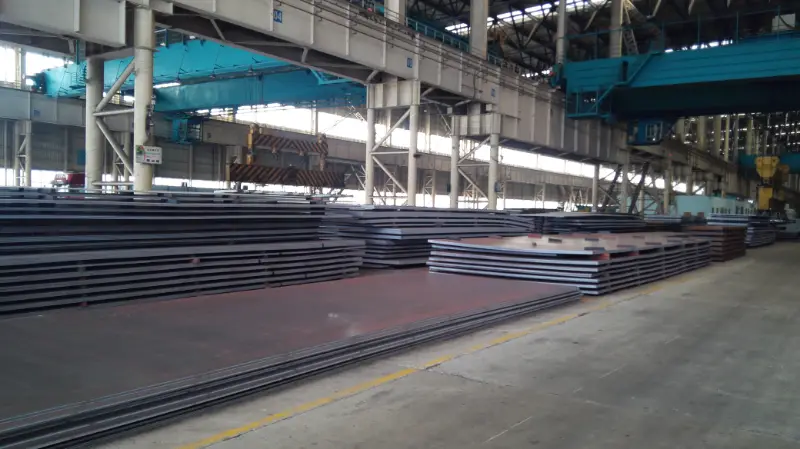
EN 10028-6 P690Q Pressure Vessel Steel
EN 10028-6 P690Q Pressure Vessel Steel: High-Strength Quenched & Tempered Plate
Comprehensive technical data for EN 10028-6 P690Q, a high-strength quenched and tempered fine-grain steel for pressure vessels, including chemical composition, mechanical properties, physical properties, and equivalent grades.
Hot rolling followed by quenching and tempering (QT); weldable; cold forming possible with limitations; suitable for hot forming under controlled conditions.
- Phone : +8618037372205
- Email : [email protected]
- WhatsApp: Contact via Whtsapp
- WeChat: +8618037372205
EN 10028-6 P690Q Pressure Vessel Steel Introduction
P690Q is a high-strength quenched and tempered fine-grain steel specified in EN 10028-6 for the construction of pressure vessels and boilers. It offers a minimum yield strength of 690 MPa in thicknesses up to 50 mm, combined with excellent toughness and good weldability. The steel is produced via electric arc furnace or basic oxygen process, followed by quenching and tempering to achieve a fine bainitic/martensitic microstructure. Key features include:
- High strength-to-weight ratio, enabling lighter vessel designs
- Good low-temperature impact toughness (minimum 27 J at -20°C)
- Guaranteed through-thickness properties for critical applications
- Excellent weldability with low carbon equivalent (CEV typically ≤0.58%)
P690Q is widely used in the chemical, petrochemical, and power generation industries for storage tanks, reactors, heat exchangers, and high-pressure piping.
EN 10028-6 P690Q Pressure Vessel Steel Chemical Composition
The chemical composition of P690Q is carefully balanced to achieve high strength after quenching and tempering while maintaining good weldability and toughness. The maximum allowed contents for most elements ensure low susceptibility to cracking and excellent HAZ properties. Fine-grain elements (Al, Nb, Ti, V) are controlled to guarantee a minimum grain size. The carbon equivalent (CEV) is usually limited to 0.58% (typical, not mandatory but often agreed).
| Element | Standard Value (max. unless indicated) | Remarks |
|---|---|---|
| Carbon (C) | 0.20% | Maximum |
| Silicon (Si) | 0.80% | Maximum |
| Manganese (Mn) | 1.70% | Maximum |
| Phosphorus (P) | 0.020% | Maximum |
| Sulfur (S) | 0.010% | Maximum |
| Aluminium (Al_total) | ≥0.018% | Minimum, for grain refinement |
| Nitrogen (N) | 0.015% | Maximum |
| Chromium (Cr) | 1.50% | Maximum |
| Copper (Cu) | 0.50% | Maximum |
| Molybdenum (Mo) | 0.70% | Maximum |
| Niobium (Nb) | 0.06% | Maximum |
| Nickel (Ni) | 2.50% | Maximum |
| Titanium (Ti) | 0.05% | Maximum |
| Vanadium (V) | 0.12% | Maximum |
| Zirconium (Zr) | 0.15% | Maximum |
| Boron (B) | 0.005% | Maximum |
| Niobium + Vanadium + Titanium (Nb+V+Ti) | 0.12% | Maximum sum for grain refinement control |
| Carbon Equivalent (CEV) | Typically ≤0.58% | CEV = C + Mn/6 + (Cr+Mo+V)/5 + (Ni+Cu)/15; agreed at time of order |
EN 10028-6 P690Q Pressure Vessel Steel Thermal and Electrical Physical Properties
The physical properties represent average values for quenched and tempered low-alloy steels of this strength class. These data are indicative and may slightly vary depending on the exact chemical composition and heat treatment condition. They are suitable for design calculations involving heat transfer, thermal expansion, and electromagnetic effects.
| Property | Standard Value | Unit | Test Condition |
|---|---|---|---|
| Density (ρ) | 7.85 | g/cm³ | 20°C |
| Modulus of Elasticity (E) | 210 | GPa | 20°C |
| Shear Modulus (G) | 80 | GPa | 20°C |
| Poisson's Ratio (ν) | 0.3 | – | 20°C |
| Thermal Expansion Coefficient (α) | 11.1 × 10⁻⁶ | K⁻¹ | Mean value, 20–100°C |
| Thermal Conductivity (λ) | 40 | W/(m·K) | 20°C |
| Specific Heat Capacity | 460 | J/(kg·K) | 20°C |
| Electrical Resistivity (ρ_e) | 0.25 | μΩ·m | 20°C |
EN 10028-6 P690Q Pressure Vessel Steel Mechanical Properties
The mechanical properties are verified at room temperature unless otherwise stated. Tensile testing is performed according to EN 10002-1. Impact energy is measured on Charpy-V specimens. Minimum values apply to transverse test pieces, which are standard for pressure vessel plates. For thicknesses above 150 mm, properties must be agreed upon at the time of inquiry and order.
| Property | Standard Requirement | Unit | Test Condition |
|---|---|---|---|
| Yield Strength (ReH) | ≥690 | MPa | Thickness ≤50 mm, room temperature |
| Yield Strength (ReH) | ≥670 | MPa | Thickness >50 ≤100 mm |
| Yield Strength (ReH) | ≥630 | MPa | Thickness >100 ≤150 mm |
| Tensile Strength (Rm) | 770 – 940 | MPa | Thickness ≤50 mm |
| Tensile Strength (Rm) | 770 – 940 | MPa | Thickness >50 ≤100 mm |
| Tensile Strength (Rm) | 700 – 900 | MPa | Thickness >100 ≤150 mm |
| Elongation (A) | ≥14 | % | All thicknesses, gauge length 5.65√So |
| Impact Energy (KV) | ≥27 | J | -20°C, Charpy-V transverse |
EN 10028-6 P690Q Pressure Vessel Steel Fully Equivalent Material Standards and Substitutable Designations
| Country/Region | Standard | Designation | Remarks |
|---|---|---|---|
| Europe / International | ISO 9328-2:2018 | P690Q | Technically identical to EN 10028-6 P690Q, same chemical and mechanical requirements. |
| Germany | DIN EN 10028-6 | P690Q | German adoption of EN 10028-6, identical grade. |
| United Kingdom | BS EN 10028-6 | P690Q | British adoption, same specification. |
| France | NF EN 10028-6 | P690Q | French adoption, fully equivalent. |
| Italy | UNI EN 10028-6 | P690Q | Italian adoption, technically identical. |
EN 10028-6 P690Q Pressure Vessel Steel Application Introduction
P690Q is indispensable for high-pressure, elevated-temperature environments where weight reduction without sacrificing safety is critical. Its high yield strength enables thinner wall thicknesses in vessel design, lowering fabrication and transportation costs. The steel is suitable for welded construction, and with proper welding procedures, achieves excellent joint integrity. Common applications include:
- Chemical and Petrochemical: Reactors, columns, separators, and high-pressure piping systems.
- Power Generation: Boiler drums, steam receivers, and penstocks for hydropower plants.
- Offshore and Marine: Welded frameworks, pressure housings, and heavy-lift structures exposed to low temperatures.
- Industrial Gas Storage: Spherical and cylindrical storage tanks for LPG, LNG, and other pressurized gases.
Product Applications: Pressure vessels (reactors, separators, scrubbers), Boilers and steam drums, Heat exchangers and condensers, High-pressure storage tanks (LPG, ammonia, hydrogen), Penstocks and spiral casings, Liquefied gas carriers and ISO tank containers
Processed into products: Heads (dished ends) – hot or cold formed, Shell rings and cones – rolled and welded, Tube plates and flanges – machined from plate, Nozzles and reinforcement pads, External stiffener rings and support brackets, High-pressure pipe elbows and tees (hot formed)
Application industries: Chemical and petrochemical processing, Oil and gas (upstream and downstream), Power generation (thermal, nuclear, hydro), Offshore engineering, Industrial gas and cryogenics, Heavy machinery and hydraulic equipment
EN 10028-6 P690Q Pressure Vessel Steel Similar or Comparable Alternative Materials
| Country/Region | Standard | Designation | Remarks |
|---|---|---|---|
| Europe | EN 10028-6 | P690QL1 / P690QL2 | Higher low-temperature toughness variants (P690QL1: -40°C; P690QL2: -60°C), otherwise similar strength and chemistry. Can replace P690Q when lower temperature toughness is required. |
| Europe | EN 10025-6 | S690QL | Structural steel with similar yield strength but different carbon and alloy limits; not intended for pressure vessels. May substitute in non-pressure structural applications. |
| USA | ASTM A517 / A517M | Grade Q | Quenched and tempered alloy steel plate for pressure vessels. Comparable 690 MPa strength but with higher Cr, Mo, and different Ni limits. Requires careful evaluation for substitution. |
| International | ISO 4950-3 | S690Q | Structural steel, roughly equivalent in mechanicals but aimed at general construction; not specifically for pressure purposes. |
Notes:
Welding: P690Q is readily weldable by all common methods (SMAW, SAW, GMAW). Low-hydrogen consumables and controlled heat input (typically 1.0–3.0 kJ/mm) are recommended. Preheat temperature depends on plate thickness and carbon equivalent; normally 100–175°C. Post-weld heat treatment (PWHT) should be carried out when required by vessel codes, but the tempering temperature during QT is normally above PWHT temperature to avoid strength loss. Forming: Cold forming must respect minimum bending radii (typically 3×t for transverse bends) and may require intermediate stress-relief or re-quenching if strain exceeds 5%. Hot forming should be performed within the temperature range 900–950°C and followed by a new quenching and tempering treatment. NDT: Ultrasonic examination according to EN 10160 is commonly required for pressure vessel applications; strip off the plate margins should be removed to eliminate lamination defects. Certification: Inspection certificates 3.1 according to EN 10204 are usually supplied; specific testing (e.g., high-temperature tensile tests, through-thickness testing) can be agreed on ordering.
- Share



