
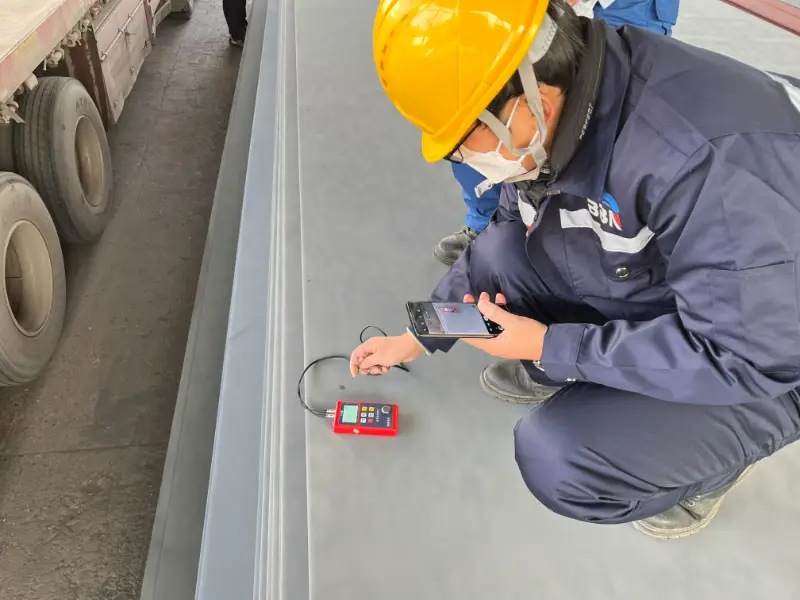
EN 10028-6 P690QH Pressure Vessel Steel Plate
EN 10028-6 P690QH Pressure Vessel Steel Plate - High Strength Quenched & Tempered Fine Grain Steel
Detailed material data for EN 10028-6 P690QH pressure vessel and boiler steel plate including chemical composition, mechanical and physical properties, international equivalents, and application guidance.
Hot rolling, quenching, tempering
- Phone : +8618037372205
- Email : [email protected]
- WhatsApp: Contact via Whtsapp
- WeChat: +8618037372205
EN 10028-6 P690QH Pressure Vessel Steel Plate Introduction
EN 10028-6 P690QH is a high-strength, quenched and tempered fine grain structural steel specifically intended for pressure vessels and boilers. It offers a minimum yield strength of 690 MPa in thicknesses up to 50 mm, combined with excellent toughness at sub-zero temperatures (guaranteed transverse impact energy ≥27 J at -20°C). The microalloyed composition (Nb, V, Ti) and low impurity levels deliver good weldability, high resistance to brittle fracture, and reliable performance under static and dynamic loading. The steel is supplied in the quenched and tempered condition and is designed for heavy walled components where weight reduction and high safety margins are critical.
EN 10028-6 P690QH Pressure Vessel Steel Plate Chemical Composition
The table below gives the maximum limits for alloying and impurity elements as specified in EN 10028-6 for grade P690QH. Values are valid for product thicknesses typically covered by the standard. For exact product analysis, slight deviations may apply according to the standard. Elements like Nb, V, and Ti are used for grain refinement and precipitation strengthening.
| Element | Standard Value (max, unless otherwise stated) | Remarks |
|---|---|---|
| C | 0.20 | max |
| Si | 0.80 | max |
| Mn | 1.70 | max |
| P | 0.025 | max |
| S | 0.015 | max |
| Altotal | ≥0.015 | min, acid-soluble or total |
| N | 0.015 | max |
| B | 0.005 | max |
| Cr | 1.50 | max |
| Cu | 0.50 | max |
| Mo | 0.70 | max |
| Nb | 0.06 | max |
| Ni | 2.00 | max |
| Ti | 0.05 | max |
| V | 0.12 | max |
| Zr | 0.15 | max |
EN 10028-6 P690QH Pressure Vessel Steel Plate Thermal and Electrical Physical Properties
The following physical properties are typical for P690QH type high-strength quenched and tempered steels. They are not mandatory requirements in product standards but are representative for this alloy group and can be used for design calculations. Values are valid at room temperature unless stated otherwise.
| Property | Typical Value | Unit | Test Condition / Remarks |
|---|---|---|---|
| Density (ρ) | 7.85 | g/cm³ | 20°C |
| Elastic modulus (E) | 205 | GPa | 20°C |
| Shear modulus (G) | 80 | GPa | 20°C (estimated) |
| Poisson's ratio (ν) | 0.3 | – | Ambient temperature |
| Thermal expansion coefficient (α) | 12.0 × 10⁻⁶ | K⁻¹ | 20 – 100°C |
| Thermal expansion coefficient (α) | 12.5 × 10⁻⁶ | K⁻¹ | 20 – 200°C |
| Thermal conductivity (λ) | 40 | W/(m·K) | 20°C |
| Thermal conductivity (λ) | 39 | W/(m·K) | 100°C |
| Specific heat capacity (cp) | 460 | J/(kg·K) | 20°C |
| Electrical resistivity (ρe) | 0.25 × 10⁻⁶ | Ω·m | 20°C |
EN 10028-6 P690QH Pressure Vessel Steel Plate Mechanical Properties
Mechanical property data according to EN 10028-6 for P690QH in quenched and tempered state. Values for yield strength and tensile strength vary with product thickness. Impact energy is tested on transverse Charpy V-notch specimens at -20°C. Bending tests performed on flat samples with 180° bend angle.
| Property | Standard Requirement | Unit | Test Condition |
|---|---|---|---|
| Yield strength (ReH) | ≥690 | MPa | Thickness t ≤ 50 mm |
| Yield strength (ReH) | ≥670 | MPa | 50 mm < t ≤ 100 mm |
| Yield strength (ReH) | ≥630 | MPa | 100 mm < t ≤ 150 mm |
| Tensile strength (Rm) | 770 – 940 | MPa | t ≤ 50 mm |
| Tensile strength (Rm) | 770 – 940 | MPa | 50 mm < t ≤ 100 mm |
| Tensile strength (Rm) | 700 – 900 | MPa | 100 mm < t ≤ 150 mm |
| Elongation after fracture (A) | ≥14 | % | Longitudinal or transverse (gauge length 5.65√S₀) |
| Charpy V impact energy (KV₂) | ≥27 | J | Transverse specimens, -20°C |
| Bend test (bend angle 180°) | d = 3t | – | Mandrel diameter, t = plate thickness |
EN 10028-6 P690QH Pressure Vessel Steel Plate Completely Equivalent Material Standards - Direct Substitutes
| Country/Region | Standard | Grade | Note |
|---|---|---|---|
| EU | EN 10028-6 | P690QH | Original designation |
| International | ISO 4950-3 (withdrawn) | P690QH | Replaced by EN 10028-6 |
| USA | ASTM A517/A517M | Grade S | Quenched and tempered high-strength alloy steel for pressure vessels – similar chemistry, minimum 690 MPa yield |
| USA (ASME BPVC) | ASME SA-517/SA-517M | Grade S | Boiler and pressure vessel code version of ASTM A517 |
EN 10028-6 P690QH Pressure Vessel Steel Plate Application Introduction
EN 10028-6 P690QH is engineered for high-pressure containment where high strength, excellent toughness, and weldability are essential. Its fine grain structure and low impurity content ensure reliable service in critical environments. The material can be hot formed (followed by new Q+T treatment) or cold formed within specified limits. Welding requires low-hydrogen processes, appropriate preheat, and post-weld heat treatment recommendations per the standard or relevant codes (e.g., EN 13445).
Product Applications: Pressure vessels and reactors, Industrial boilers, Heat exchangers, LPG and LNG storage tanks, High-pressure piping and penstocks, Autoclaves and digesters
Processed into products: Shell plates and courses, Dished heads, elliptical and hemispherical heads, Flanges and tube sheets, Nozzle reinforcements and manway covers, Transition pieces and thick-walled welded parts, Wind turbine tower sections (when designed as hybrid structures)
Application industries: Oil and gas (upstream, midstream, downstream), Chemical and petrochemical plants, Power generation (conventional and nuclear), Boiler and pressure vessel manufacturing, Shipbuilding and offshore engineering, Renewable energy (e.g., hydrogen storage)
EN 10028-6 P690QH Pressure Vessel Steel Plate Similar / Comparable Materials
| Country/Region | Standard | Grade | Remarks |
|---|---|---|---|
| EU | EN 10028-6 | P500QH | Lower strength (500 MPa yield) but similar Q&T fine grain steel; suitable where lower load capacity is acceptable |
| EU | EN 10028-6 | P460QH | Further reduced strength; often used for thicker sections |
| EU | EN 10025-6 | S690QL/S690QL1 | Structural steel with comparable yield level; may not satisfy all pressure vessel toughness and elevated temperature requirements, but often used as a reference |
| USA | ASTM A514/A514M | Grade H | High strength quenched and tempered steel for structural applications; similar 690 MPa yield, but not specifically for pressure vessels |
| Japan | JIS G 3115 | SPV490 | Pressure vessel steel with ~490 MPa tensile; significantly lower strength than P690QH, used for less demanding conditions |
Notes:
Post-weld heat treatment (PWHT) may reduce strength; please refer to the manufacturer's datasheet and the appropriate design code. For service at elevated temperatures, the yield strength is derated; the standard specifies elevated temperature proof strength values up to approx. 200°C. When ordering, the purchaser should specify the required thickness, whether the steel shall be delivered with improved low-temperature properties (e.g., -40°C or -60°C variant P690QH-L1 or -L2), and any supplementary testing (e.g., HIC, SSC, or through-thickness properties).
- Share



