
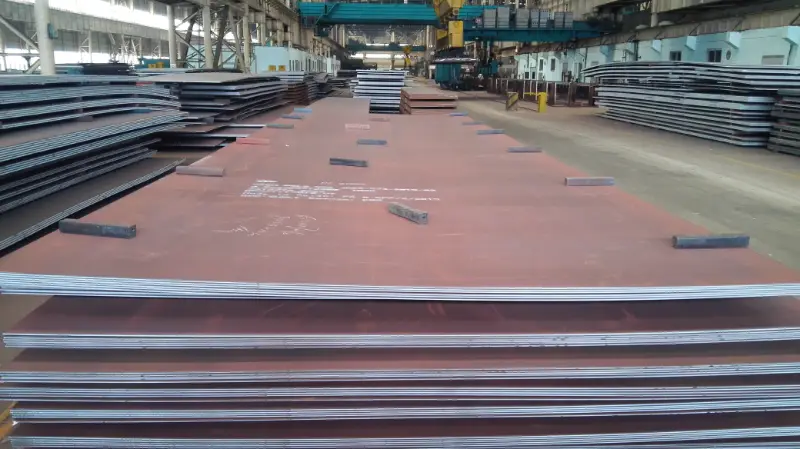
EN10028-6 P690QL1 Quenched & Tempered Pressure Vessel Steel Plate
EN10028-6 P690QL1 Quenched & Tempered Pressure Vessel Steel Plate - Full Data & Equivalents
Complete material specification for P690QL1 pressure vessel steel to EN 10028-6, covering chemical, mechanical, thermal, and electrical properties, plus international equivalents.
Hot rolling, quenching, tempering, welding, cutting (flame, plasma, laser), cold forming (limited by minimum bending radius), machining
- Phone : +8618037372205
- Email : [email protected]
- WhatsApp: Contact via Whtsapp
- WeChat: +8618037372205
EN10028-6 P690QL1 Quenched & Tempered Pressure Vessel Steel Plate Introduction
P690QL1 is a high‑strength, weldable fine‑grain structural steel supplied in the quenched and tempered condition, intended for pressure vessels and boilers under EN 10028‑6. The grade offers a minimum yield strength of 690 MPa in thicknesses up to 50 mm, excellent low‑temperature toughness (down to -60 °C), and good weldability. Typical applications include heavy‑wall reactors, columns, and storage spheres in the petrochemical and power generation industries.
EN10028-6 P690QL1 Quenched & Tempered Pressure Vessel Steel Plate Chemical composition per EN 10028-6
The table lists the permissible maximum or range for each element as specified in the standard. Note: Certain elements may be added for grain refinement or deoxidation; total aluminium content is mandatory. The carbon equivalent value (CEV) must not exceed 0.65%.
| Element | Standard value (max, %) | Remarks |
|---|---|---|
| C | 0.20 | |
| Si | 0.80 | |
| Mn | 1.70 | |
| P | 0.020 | |
| S | 0.010 | |
| N | 0.015 | |
| B | 0.005 | If agreed, B may be added |
| Cr | 1.50 | |
| Cu | 0.50 | |
| Mo | 0.70 | |
| Nb | 0.06 | |
| Ni | 2.50 | |
| Ti | 0.05 | |
| V | 0.12 | |
| Zr | 0.15 | If agreed, Zr may be added |
| Al (total) | ≥ 0.018 | Mandatory for fine grain practice |
| Nb+V+Ti | ≤ 0.12 | If two or three of these are present, the sum shall not exceed 0.12% |
| Mo+Cr+Cu | ≤ 2.50 |
EN10028-6 P690QL1 Quenched & Tempered Pressure Vessel Steel Plate Thermal and electrical physical properties
These values are not mandated by EN 10028‑6 but are representative for quenched and tempered low‑alloy steels of this type. They can be used for design calculations. Note: Temperature dependence is moderate; values are given at room temperature unless otherwise indicated.
| Property | Typical value | Unit | Test condition |
|---|---|---|---|
| Density (ρ) | 7850 | kg/m³ | 20 °C |
| Elastic modulus (E) | 210 | GPa | 20 °C |
| Shear modulus (G) | 80 | GPa | 20 °C |
| Poisson's ratio (ν) | 0.30 | – | 20 °C |
| Thermal expansion (α) | 12.0 | 10⁻⁶/K | 20–100 °C |
| Thermal expansion (α) | 12.8 | 10⁻⁶/K | 20–200 °C |
| Thermal expansion (α) | 13.4 | 10⁻⁶/K | 20–400 °C |
| Thermal conductivity (λ) | 35 | W/(m·K) | 20 °C |
| Thermal conductivity (λ) | 32 | W/(m·K) | 400 °C |
| Specific heat capacity (cp) | 460 | J/(kg·K) | 20 °C |
| Specific heat capacity (cp) | 530 | J/(kg·K) | 400 °C |
| Electrical resistivity (ρe) | 0.22 | µΩ·m | 20 °C |
EN10028-6 P690QL1 Quenched & Tempered Pressure Vessel Steel Plate Mechanical properties per EN 10028-6
Values apply to quenched and tempered plates tested at ambient temperature. Impact energy is given for longitudinal and transverse specimens at -60 °C. Bend test is performed with a mandrel diameter dependent on thickness and the angle is 180°. The properties are thickness‑dependent; three ranges are shown.
| Property | Minimum / range | Unit | Test condition / thickness |
|---|---|---|---|
| Yield strength (ReH) | 690 | MPa | t ≤ 50 mm |
| Yield strength (ReH) | 670 | MPa | 50 < t ≤ 100 mm |
| Yield strength (ReH) | 630 | MPa | 100 < t ≤ 150 mm |
| Tensile strength (Rm) | 770–940 | MPa | t ≤ 50 mm |
| Tensile strength (Rm) | 750–920 | MPa | 50 < t ≤ 100 mm |
| Tensile strength (Rm) | 700–900 | MPa | 100 < t ≤ 150 mm |
| Elongation (A) | 14 (long.), 12 (trans.) | % | t ≤ 50 mm, L0 = 5.65√S0 |
| Elongation (A) | 14 (long.), 12 (trans.) | % | 50 < t ≤ 100 mm |
| Elongation (A) | 14 (long.), 12 (trans.) | % | 100 < t ≤ 150 mm |
| Impact energy (KV, -60 °C) | ≥ 27 (average), ≥ 19 (single) | J | Longitudinal, 10x10 mm specimen |
| Impact energy (KV, -60 °C) | ≥ 16 (average), ≥ 12 (single) | J | Transverse, 10x10 mm specimen |
| Bend test (180°) | ≥ 3 x thickness | – | t ≤ 30 mm |
| Bend test (180°) | ≥ 4 x thickness | – | 30 < t ≤ 100 mm |
EN10028-6 P690QL1 Quenched & Tempered Pressure Vessel Steel Plate Fully equivalent material standards and replaceable grades
| Country/Region | Standard | Grade | Remarks |
|---|---|---|---|
| International | ISO 4978 | P690QL1 | Direct equivalent, same strength and impact class |
| USA | ASTM A517 | Grade Q | Pressure vessel QT steel, yield ≥ 690 MPa, impact temp depends on supplementary requirement |
| Japan | JIS G3128 | SHY685 | Similar high‑tensile QT steel, but impact test temperature may differ; verify |
EN10028-6 P690QL1 Quenched & Tempered Pressure Vessel Steel Plate Application Introduction
P690QL1 is used where high strength, weldability, and low‑temperature toughness are essential. It allows reducing wall thickness in pressure vessels, saving weight and welding costs. Typical applications include:
Product Applications: Pressure vessels (ASME VIII or EN 13445), Boiler drums and headers, High‑pressure pipes and fittings, Offshore structural nodes, Storage spheres and bullets
Processed into products: Welded vessel shells and heads, Flanges and reinforcement pads, Nozzle forgings (matching material), Support skirts and saddles, Bolt‑on cover plates
Application industries: Oil & gas (upstream platforms, refinery vessels), Chemical & petrochemical (reactors, columns, heat exchangers), Power generation (steam drums, boiler drums, pressurisers), Hydroelectric (penstocks, spiral casings), Heavy machinery (hydraulic cylinders, mining equipment)
EN10028-6 P690QL1 Quenched & Tempered Pressure Vessel Steel Plate Similar / substitute materials recommendation
| Country/Region | Standard | Grade | Remarks |
|---|---|---|---|
| Europe | EN 10028-6 | P690Q | Same base strength, no designated low‑temp impact requirement |
| Europe | EN 10028-6 | P690QL2 | Same strength, impact at -40 °C (less demanding than L1) |
| Europe | EN 10028-6 | P690QH | Same strength, impact at -20 °C |
| International | ISO 4978 | P690Q / QL2 / QH | Family of grades with different toughness levels |
| USA | ASTM A514 | Grade B / Q | Structural QT steel, yield ≥ 690 MPa, not specifically for pressure vessels |
Notes:
Welding: Preheating (typically 100‑150 °C) and controlled interpass temperature are recommended. Post‑weld heat treatment (PWHT) may be required by design codes but must be carefully controlled to avoid loss of strength. Forming: Cold forming is limited; hot forming should respect the original tempering temperature to avoid softening. Service temperature: The L1 suffix guarantees adequate toughness down to -60 °C, making it suitable for arctic and cryogenic applications within the scope of the design code.
- Share



