
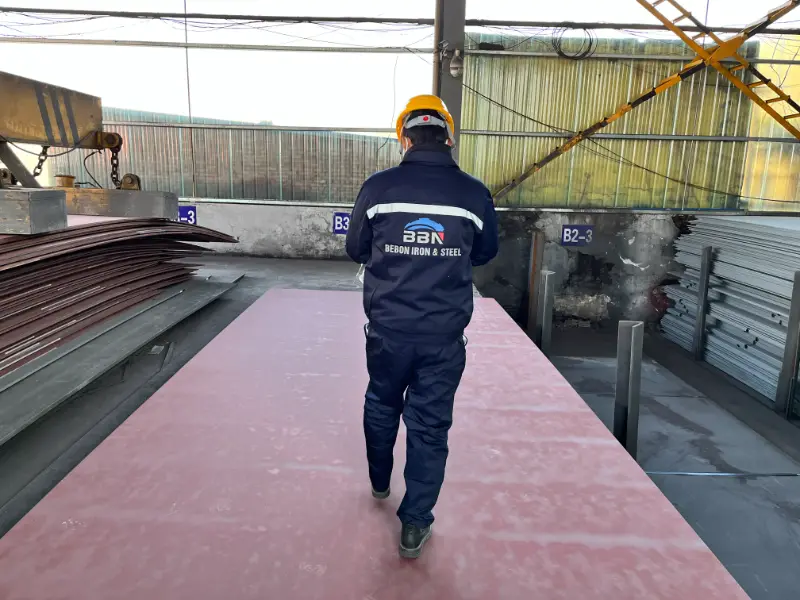
EN10028-6 P690QL2
EN 10028-6 P690QL2 Pressure Vessel Steel: Quenched & Tempered High-Strength Plate
Complete material data for P690QL2 steel plate according to EN 10028-6, including chemical composition, mechanical properties at various thicknesses, thermal and electrical physical properties, and international equivalent standards for pressure vessels and boilers.
Hot rolling, quenching, tempering, cutting, welding, cold forming (limited)
- Phone : +8618037372205
- Email : [email protected]
- WhatsApp: Contact via Whtsapp
- WeChat: +8618037372205
EN10028-6 P690QL2 Introduction
P690QL2 is a quenched and tempered fine-grain structural steel intended for pressure vessels and boilers, specified in EN 10028-6. The designation indicates:
- P – for pressure purposes
- 690 – minimum yield strength of 690 MPa
- Q – quenched and tempered condition
- L2 – low-temperature impact toughness at -60°C (27 J minimum)
It offers high strength combined with excellent toughness and weldability, suitable for heavy-wall pressure equipment operating at low temperatures. The steel is delivered in the normalized or quenched and tempered condition, primarily as plate. Typical applications include storage tanks, reactors, penstocks, and offshore structures.
EN10028-6 P690QL2 Chemical Composition
The chemical composition of P690QL2 as per EN 10028-6 limits key elements to ensure strength, toughness and weldability. Additional restrictions apply to the sum of Cr+Mo+Cu ≤ 0.60%. The nitrogen and boron contents are tightly controlled for fine grain practice and hardenability.
| Element | Standard Value (max. %) | Remarks |
|---|---|---|
| Carbon (C) | 0.20 | For thickness ≤ 50 mm; may be adjusted for larger thickness |
| Silicon (Si) | 0.80 | |
| Manganese (Mn) | 1.70 | |
| Phosphorus (P) | 0.020 | |
| Sulfur (S) | 0.010 | |
| Nitrogen (N) | 0.015 | |
| Boron (B) | 0.005 | |
| Chromium (Cr) | 1.50 | Cr+Mo+Cu ≤ 0.60% |
| Copper (Cu) | 0.50 | Cr+Mo+Cu ≤ 0.60% |
| Molybdenum (Mo) | 0.70 | Cr+Mo+Cu ≤ 0.60% |
| Niobium (Nb) | 0.06 | |
| Nickel (Ni) | 2.50 | |
| Titanium (Ti) | 0.05 | |
| Vanadium (V) | 0.12 | |
| Zirconium (Zr) | 0.15 |
EN10028-6 P690QL2 Thermal and Electrical Physical Properties
Physical properties of quenched and tempered high-strength steel at room temperature and elevated temperatures. These values are typical for this steel class and are not mandatory requirements but are essential for design calculations involving thermal stress, heat transfer, and electromagnetic compatibility.
| Property | Typical Value | Unit | Test Condition / Temperature |
|---|---|---|---|
| Density (ρ) | 7.85 | g/cm³ | at 20°C |
| Modulus of elasticity (E) | 205 | GPa | at 20°C |
| Shear modulus (G) | 80 | GPa | at 20°C |
| Poisson's ratio (ν) | 0.3 | — | at 20°C |
| Thermal expansion coefficient (α) | ~12.0 | ×10^-6 /K | 20°C to 100°C |
| Thermal expansion coefficient (α) | ~13.0 | ×10^-6 /K | 20°C to 200°C |
| Thermal conductivity (λ) | ~45 | W/(m·K) | at 20°C |
| Specific heat capacity (cp) | ~460 | J/(kg·K) | at 20°C |
| Electrical resistivity (ρe) | ~0.20 | μΩ·m | at 20°C |
EN10028-6 P690QL2 Mechanical Properties
Mechanical properties according to EN 10028-6 depend on plate thickness. The table below lists minimum yield strength (ReH), tensile strength (Rm), elongation (A), and impact energy (KV2) at -60°C. The transverse test pieces are used for impact testing. Bending test requirements are included for reference.
| Property | Required Value | Unit | Test Condition / Thickness |
|---|---|---|---|
| Yield strength (ReH) | ≥ 690 | MPa | Plate thickness ≤ 50 mm, transverse |
| Yield strength (ReH) | ≥ 670 | MPa | 50 mm < thickness ≤ 100 mm, transverse |
| Yield strength (ReH) | ≥ 630 | MPa | 100 mm < thickness ≤ 150 mm, transverse |
| Tensile strength (Rm) | 770 – 940 | MPa | Thickness ≤ 50 mm, transverse |
| Tensile strength (Rm) | 770 – 940 | MPa | 50 mm < thickness ≤ 100 mm, transverse |
| Tensile strength (Rm) | 720 – 900 | MPa | 100 mm < thickness ≤ 150 mm, transverse |
| Elongation after fracture (A) | ≥ 17 | % | Thickness ≤ 50 mm, gauge length L0 = 5.65√S0, longitudinal |
| Elongation after fracture (A) | ≥ 14 | % | 50 mm < thickness ≤ 100 mm, longitudinal |
| Elongation after fracture (A) | ≥ 14 | % | 100 mm < thickness ≤ 150 mm, longitudinal |
| Charpy V-notch impact energy (KV2) | ≥ 27 | J | -60°C, transverse test piece |
| Bend test (bend angle 180°) | Mandrel diameter 3a | - | Thickness ≤ 50 mm, a = thickness |
| Bend test (bend angle 180°) | Mandrel diameter 4a | - | 50 mm < thickness ≤ 150 mm, a = thickness |
EN10028-6 P690QL2 Fully Equivalent Material Standards and Replaceable Grades
| Country/Region | Standard | Grade | Remarks |
|---|---|---|---|
| International | ISO 9328-4:2018 | P690QL2 | Identical grade for pressure purpose flat products |
| European Union | EN 10028-6:2017 | P690QL2 | Original specification |
EN10028-6 P690QL2 Application Introduction
P690QL2 is primarily used in the construction of welded pressure vessels, boilers, and storage tanks where high strength and guaranteed low-temperature toughness are required. In combination with its excellent weldability after proper preheating, it enables lighter designs compared to conventional lower-strength steels.
Product Applications: Pressure vessels and their shells, Industrial boilers and heat exchangers, Penstocks and waterway pipes for hydroelectric plants, Liquefied gas (LNG/LPG) storage tanks, Offshore structural nodes and heavy lifting equipment
Processed into products: Shell plates and dished heads of high-pressure reactors, Tube sheets for shell-and-tube heat exchangers, Welded girders and diaphragms in penstocks, Load-bearing members of offshore cranes and jack-up rigs, Components requiring post-weld heat treatment (PWHT) with attention to toughness
Application industries: Oil and gas (refinery vessels, LPG storage), Chemical and petrochemical (reactors, columns), Power generation (boiler drums, penstocks, hydropower), Offshore engineering (platform structures, pressure hulls), Transport (cryogenic tankers, gas carriers)
EN10028-6 P690QL2 Similar/Comparable Substitute Materials
| Country/Region | Standard | Grade | Remarks |
|---|---|---|---|
| European Union | EN 10028-6:2017 | P690Q / P690QL1 | Same strength level; less demanding low-temperature toughness (QL1 requires -40°C, Q requires -20°C) – may be substituted if impact requirements allow. |
| USA | ASME SA-517 / ASTM A517 | Grade F | Quenched and tempered alloy steel plate for pressure vessels; yield strength ≥ 690 MPa, but not an exact match in chemistry range. Verify weldability and thickness range. |
| Japan | JIS G3115 | SPV490 | Yield strength ≥ 490 MPa, lower strength but sometimes used in similar applications; not a direct substitute for 690 MPa design. |
Notes:
- For thicknesses above 150 mm, properties shall be agreed at the time of enquiry and order.
- Carbon equivalent (CEV) values should be calculated and limited according to the standard for adequate weldability.
- Post-weld heat treatment (PWHT) may affect mechanical properties; consult steel supplier for recommendations.
- The values in thermal table are typical for this class of quenched and tempered steel and may vary slightly with actual composition and heat treatment. They are not part of the EN 10028-6 mandatory requirements.
- Share



