
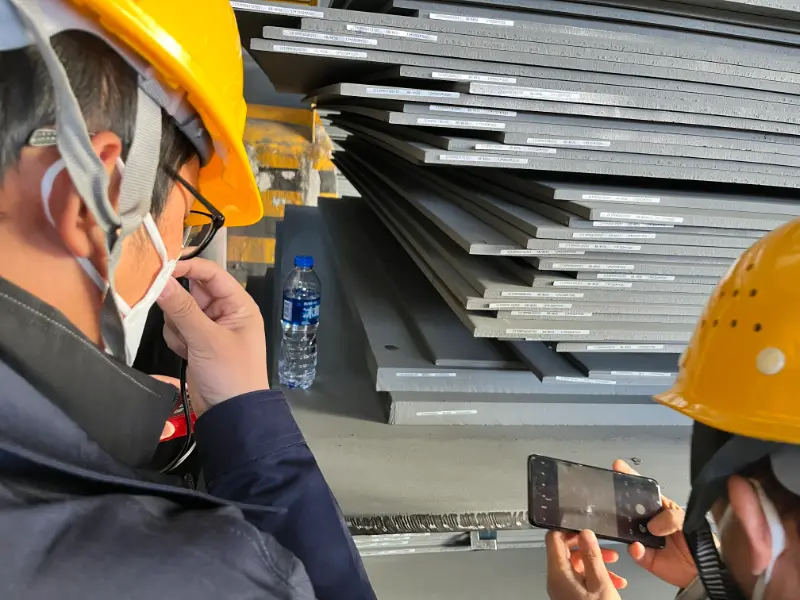
EN 10028-3 P275NH Steel
EN 10028-3 P275NH Steel: High-Strength Normalized Fine-Grain Plate for Pressure Vessels & Boilers
Detailed material data for P275NH normalized fine-grain steel according to EN 10028-3, including chemical composition, mechanical properties, physical properties, and international equivalents for pressure equipment engineering.
Hot rolling followed by normalizing heat treatment; welding, bending, cutting, and forming after supply
- Phone : +8618037372205
- Email : [email protected]
- WhatsApp: Contact via Whtsapp
- WeChat: +8618037372205
EN 10028-3 P275NH Steel Introduction
EN 10028-3 P275NH is a weldable fine-grain structural steel supplied in the normalized condition, primarily used for pressure vessels, boilers, and storage tanks operating at elevated temperatures or under low-temperature toughness requirements. It offers a minimum yield strength of 275 MPa for thicknesses up to 16 mm, good ductility, and excellent notch impact toughness down to -20°C. The steel is microalloyed with aluminum and optionally niobium, vanadium, and titanium to achieve fine-grain refinement, which ensures reliable mechanical properties across a wide thickness range. P275NH conforms to the European standard EN 10028-3 and is widely accepted in chemical, petrochemical, and power generation industries. Its balanced composition also provides good weldability without excessive preheat when standard welding procedures are followed. Typical delivery condition is normalized (+N) with the possibility of a normalizing rolling process under agreement.
EN 10028-3 P275NH Steel Chemical Composition
The chemical composition of P275NH is defined in EN 10028-3:2017 Table 2. The steel is fully killed and fine-grain treated with a minimum total aluminum content. The sum of niobium, vanadium, and titanium is restricted to ≤0.12% to ensure consistent grain refinement without excessive precipitation hardening. Low phosphorus and sulfur levels are mandatory for good toughness and weldability. Note: Unless otherwise agreed, the elements not included in this table shall not be intentionally added.
- Nb+V+Ti ≤ 0.12 %
- Al total ≥ 0.020 % or Als ≥ 0.015 %
| Element | Standard Value (wt.%) | Remarks |
|---|---|---|
| C | ≤ 0.16 | Carbon |
| Si | ≤ 0.40 | Silicon |
| Mn | 0.80 – 1.50 | Manganese |
| P | ≤ 0.025 | Phosphorus |
| S | ≤ 0.010 | Sulfur |
| Al (total) | ≥ 0.020 | Total aluminum; acid-soluble Al ≥ 0.015 |
| N | ≤ 0.012 | Nitrogen |
| Cr | ≤ 0.30 | Chromium |
| Cu | ≤ 0.30 | Copper |
| Mo | ≤ 0.08 | Molybdenum |
| Nb | ≤ 0.05 | Niobium |
| Ni | ≤ 0.50 | Nickel |
| Ti | ≤ 0.03 | Titanium |
| V | ≤ 0.05 | Vanadium |
| Nb+V+Ti | ≤ 0.12 | Sum of niobium, vanadium, titanium |
| Cr+Cu+Mo | ≤ 0.45 | Sum of chromium, copper, molybdenum (guideline) |
EN 10028-3 P275NH Steel Physical Properties
The physical properties listed are typical for normalized carbon-manganese steels similar to P275NH. They are provided as engineering reference values and may vary slightly with exact composition and heat treatment. These data are not audited by the product standard but are commonly used in design calculations.
- Density: 7850 kg/m³
- Poisson's ratio: 0.30
- Thermal and electrical properties depend on temperature; values at 20°C are given unless otherwise stated.
| Property | Typical Value | Unit | Test Condition / Remarks |
|---|---|---|---|
| Density (ρ) | 7850 | kg/m³ | At 20 °C |
| Elastic modulus (E) | 210 | GPa | At 20 °C |
| Shear modulus (G) | 81 | GPa | At 20 °C |
| Poisson's ratio (ν) | 0.30 | – | At 20 °C, within elastic range |
| Thermal expansion coefficient (α) | 11.1 | 10⁻⁶/K | 20–100 °C |
| Thermal expansion coefficient (α) | 12.0 | 10⁻⁶/K | 20–200 °C |
| Thermal expansion coefficient (α) | 13.2 | 10⁻⁶/K | 20–400 °C |
| Thermal conductivity (λ) | 51 | W/(m·K) | At 20 °C |
| Specific heat capacity (cp) | 460 | J/(kg·K) | At 20 °C (approx.) |
| Electrical resistivity (ρe) | 0.22 | μΩ·m | At 20 °C |
EN 10028-3 P275NH Steel Mechanical Properties at Room Temperature
The mechanical properties below are the minimum values required by EN 10028-3:2017 for P275NH in the normalized condition. Tensile test specimens are taken transverse to the rolling direction. For thicknesses over 150 mm, properties shall be agreed at the time of enquiry and order. Impact test values apply to Charpy V-notch specimens taken transverse; the average of three tests shall be ≥ 27 J, with one individual value not less than 20 J. Bend test: No cracks or defects shall appear after bending through 180° around the specified mandrel diameter.
| Property | Required Value | Unit | Test Condition / Thickness |
|---|---|---|---|
| Yield strength (ReH) | ≥ 275 | MPa | t ≤ 16 mm |
| Yield strength (ReH) | ≥ 265 | MPa | 16 < t ≤ 40 mm |
| Yield strength (ReH) | ≥ 255 | MPa | 40 < t ≤ 60 mm |
| Yield strength (ReH) | ≥ 235 | MPa | 60 < t ≤ 100 mm |
| Yield strength (ReH) | ≥ 225 | MPa | 100 < t ≤ 150 mm |
| Tensile strength (Rm) | 390 – 530 | MPa | t ≤ 60 mm |
| Tensile strength (Rm) | 370 – 510 | MPa | 60 < t ≤ 100 mm |
| Tensile strength (Rm) | 360 – 500 | MPa | 100 < t ≤ 150 mm |
| Elongation (A) | ≥ 24 | % | t ≤ 60 mm, gauge length 5.65√So (L0 = 5d) |
| Elongation (A) | ≥ 23 | % | 60 < t ≤ 100 mm |
| Elongation (A) | ≥ 22 | % | 100 < t ≤ 150 mm |
| Impact energy (KV) | ≥ 27 (average) | J | Transverse, -20 °C |
| Bend test | 180° bend, no cracks | – | t ≤ 16 mm, mandrel diameter = 1a |
| Bend test | 180° bend, no cracks | – | 16 < t ≤ 100 mm, mandrel diameter = 2a |
EN 10028-3 P275NH Steel Internationally Equivalent Standards and Replaceable Grade
| Country / Region | Standard | Grade | Notes |
|---|---|---|---|
| European Union / CEN | EN 10028-3:2017 | P275NH | Original standard; directly applicable in all EU/EFTA member states. |
| International (ISO) | ISO 9328-2:2018 | P275NH | Identical technical content; internationally recognized for pressure equipment. |
| Germany | DIN EN 10028-3 | P275NH | German adoption; identical to EN 10028-3. |
| France | NF EN 10028-3 | P275NH | French adoption; identical to EN 10028-3. |
| United Kingdom | BS EN 10028-3 | P275NH | British adoption; identical to EN 10028-3. |
EN 10028-3 P275NH Steel Application Introduction
P275NH is designed for welded pressure equipment subjected to moderate to high stresses and requiring guaranteed notch toughness at sub-zero temperatures. The normalized structure provides a fine grain size and uniform mechanical properties through the thickness, making it suitable for critical components in the following industries and products.
Product Applications: Pressure vessels (vertical and horizontal, single-wall and multi-wall), Boilers (fire-tube and water-tube), Heat exchangers (shell-and-tube, plate-and-frame), Storage tanks for liquefied gases, ammonia, LPG (with low-temperature toughness), Distillation columns and chemical reactors, Autoclaves and high-pressure accumulators
Processed into products: Shell courses and heads (dished, elliptical, hemispherical), Nozzles and reinforcement pads, Tube sheets and baffles, Flanges and bolted covers, Support skirts and saddles, Internal structural parts requiring structural integrity
Application industries: Chemical and petrochemical processing, Oil & gas upstream and downstream (storage, processing), Power generation (conventional and nuclear secondary systems), Food and beverage processing (hygienic pressure vessels), Water treatment and pressure piping, Industrial gas (air separation units, nitrogen/oxygen storage)
EN 10028-3 P275NH Steel Similar / Substitute Materials with Comparable Performance
| Country / Region | Standard | Grade | Remarks |
|---|---|---|---|
| USA | ASTM A516/A516M | Grade 65 | Carbon-manganese pressure vessel plate with similar strength (Rm 450–585 MPa, Re ≥240 MPa). Impact test temperature and toughness may need alignment. Often accepted as substitute with careful welding procedure. |
| Japan | JIS G3115 | SPV315 | Pressure vessel steel with min. yield 315 MPa (thicker sections may have lower yield). Composition and toughness similar, but verify thickness effect. |
| China | GB/T 713 | Q245R | Pressure vessel fine-grain steel; min. yield 245 MPa, tensile 400–520 MPa. Lower yield but comparable toughness; suitable for less demanding designs. |
| Old European | DIN 17102 (withdrawn) | StE 285 | Previously used for similar applications; now replaced by EN 10028-3 P275NH. |
Notes:
Additional information and ordering guidelines:
- Normalizing heat treatment shall be performed after rolling. If normalizing rolling is agreed, this must be clearly stated in the order.
- Supplementary requirements (e.g., simulated post-weld heat treatment, higher impact test temperatures, ultrasonic testing) can be ordered as per EN 10028-1 and EN 10028-3, Options.
- For thicknesses >150 mm, mechanical properties and chemical composition may be subject to agreement between manufacturer and purchaser.
- Welding: Preheating is generally not required for thicknesses up to 30 mm when using low-hydrogen processes; for thicker sections or high restraint, a preheat of 75–150 °C is recommended. Post-weld heat treatment (PWHT) may be necessary according to pressure vessel codes.
- The material can be hot formed or cold formed; for cold forming with a deformation ratio >5%, stress relieving should be considered.
- Share



