
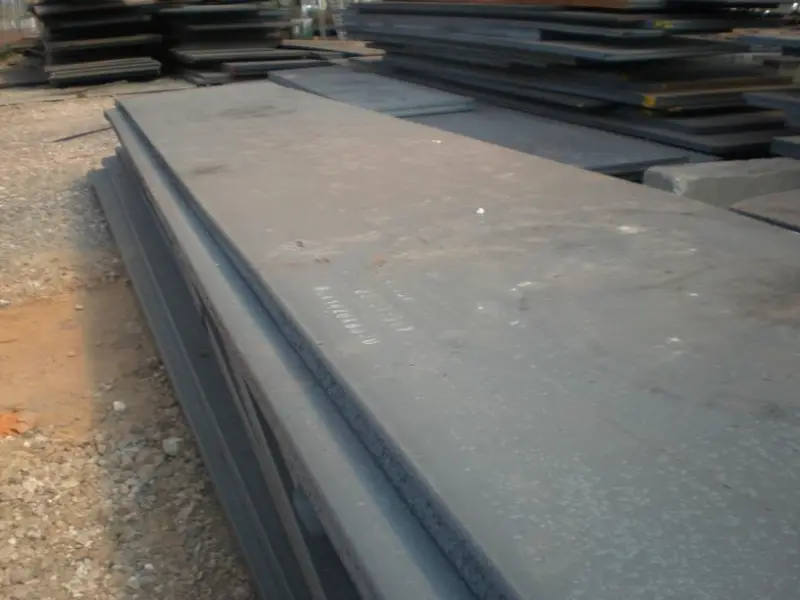
EN10028-5 P420ML2
EN10028-5 P420ML2: High-Strength Thermomechanical Steel for Pressure Vessels and Boilers
Detailed material data for EN10028-5 P420ML2, a weldable fine grain steel with minimum yield strength 420 MPa, used in pressure vessels and boilers. Includes chemical composition, mechanical properties, physical properties, and international equivalents.
Hot rolling, thermomechanical rolling, cutting, forming, welding, machining
- Phone : +8618037372205
- Email : [email protected]
- WhatsApp: Contact via Whtsapp
- WeChat: +8618037372205
EN10028-5 P420ML2 Introduction
EN10028-5 P420ML2 is a weldable fine grain structural steel grade produced by thermomechanical rolling, specifically designed for pressure vessels and boiler construction. It belongs to the family of steels covered by the European standard EN 10028-5:2017. Characterised by a minimum yield strength of 420 MPa and excellent toughness at low temperatures (designated ML2 for -20°C impact testing), it offers good weldability and formability. The thermomechanical rolling process refines the grain structure, resulting in improved mechanical properties compared to normalised grades. This steel is suitable for service temperatures down to -20°C and is widely used in the fabrication of storage tanks, reactors, and other pressurised equipment where reliability and safety are critical. Its balanced chemical composition ensures good resistance to brittle fracture and allows for efficient fabrication processes, including welding without extensive preheating under controlled conditions.
EN10028-5 P420ML2 Chemical Composition
The chemical composition limits for P420ML2 are defined in EN 10028-5. All values are maximum unless otherwise stated. Fine grain practice is ensured by sufficient aluminium (Altotal ≥ 0.020%) and optionally microalloying elements such as Nb, Ti, V. The sum of Nb+Ti+V is limited to 0.22% to maintain weldability. Carbon equivalent (CEV) values are specified based on product thickness to ensure good welding performance without cold cracking.
| Element | Value (%) | Remarks |
|---|---|---|
| C | ≤ 0.17 | max |
| Si | ≤ 0.50 | max |
| Mn | ≤ 1.70 | max |
| P | ≤ 0.020 | max |
| S | ≤ 0.010 | max |
| Al total | ≥ 0.020 | min |
| N | ≤ 0.020 | max |
| Cr | ≤ 0.50 | max |
| Cu | ≤ 0.70 | max |
| Mo | ≤ 0.50 | max |
| Nb | ≤ 0.05 | max |
| Ni | ≤ 1.0 | max |
| Ti | ≤ 0.05 | max |
| V | ≤ 0.12 | max |
| Nb+Ti+V | ≤ 0.22 | max |
| CEV (typical) | ≤ 0.45 (t ≤ 16mm) ≤ 0.47 (16mm < t ≤ 40mm) ≤ 0.48 (40mm < t ≤ 63mm) ≤ 0.50 (63mm < t ≤ 100mm) | CEV = C+Mn/6+(Cr+Mo+V)/5+(Ni+Cu)/15 |
EN10028-5 P420ML2 Thermal and Electrical Physical Properties
The following physical properties are typical for P420ML2 type carbon-manganese steel at room temperature and elevated temperatures. These values are not specified in the material standard but are provided for design and engineering purposes. Properties such as thermal expansion, conductivity, and specific heat vary with temperature, and typical data are given for a range up to 500°C. The density is assumed as standard for low-alloy steel.
| Property | Typical Value | Unit | Condition / Temperature |
|---|---|---|---|
| Density (ρ) | 7850 | kg/m³ | 20°C |
| Modulus of Elasticity (E) | 210 | GPa | 20°C |
| Shear Modulus (G) | 81 | GPa | 20°C |
| Poisson's Ratio (ν) | 0.3 | 20°C | |
| Thermal Expansion (α) | 11.1 | 10&supminus;&sup6;/K | 20 – 100°C |
| Thermal Expansion (α) | 11.9 | 10&supminus;&sup6;/K | 20 – 200°C |
| Thermal Expansion (α) | 12.5 | 10&supminus;&sup6;/K | 20 – 300°C |
| Thermal Expansion (α) | 12.9 | 10&supminus;&sup6;/K | 20 – 400°C |
| Thermal Expansion (α) | 13.3 | 10&supminus;&sup6;/K | 20 – 500°C |
| Thermal Conductivity (λ) | 50 | W/(m⋅K) | 20°C |
| Thermal Conductivity (λ) | 49 | W/(m⋅K) | 100°C |
| Thermal Conductivity (λ) | 47 | W/(m⋅K) | 200°C |
| Thermal Conductivity (λ) | 44 | W/(m⋅K) | 300°C |
| Thermal Conductivity (λ) | 40 | W/(m⋅K) | 400°C |
| Thermal Conductivity (λ) | 36 | W/(m⋅K) | 500°C |
| Specific Heat Capacity | 460 | J/(kg⋅K) | 20°C |
| Specific Heat Capacity | 480 | J/(kg⋅K) | 100°C |
| Specific Heat Capacity | 500 | J/(kg⋅K) | 200°C |
| Specific Heat Capacity | 530 | J/(kg⋅K) | 300°C |
| Specific Heat Capacity | 560 | J/(kg⋅K) | 400°C |
| Specific Heat Capacity | 600 | J/(kg⋅K) | 500°C |
| Electrical Resistivity (ρe) | ~0.25 | μΩ⋅m | 20°C |
EN10028-5 P420ML2 Mechanical Properties
Mechanical properties for P420ML2 plates are specified according to EN 10028-5 at room temperature, in the transverse direction unless otherwise noted. Tensile test requirements vary with product thickness. The impact test temperature is -20°C (ML2 designation) with a minimum energy of 47 J on transverse Charpy-V specimens. Bending tests require a 180° bend without cracking, using a mandrel diameter that increases with plate thickness.
| Property | Required Value | Unit | Test Condition |
|---|---|---|---|
| Yield Strength (ReH) | ≥ 420 | MPa | Thickness ≤ 16 mm, transverse |
| Yield Strength (ReH) | ≥ 400 | MPa | 16 mm < t ≤ 40 mm |
| Yield Strength (ReH) | ≥ 390 | MPa | 40 mm < t ≤ 63 mm |
| Yield Strength (ReH) | ≥ 370 | MPa | 63 mm < t ≤ 100 mm |
| Tensile Strength (Rm) | 530 – 680 | MPa | All thicknesses up to 100 mm |
| Elongation (A) | ≥ 19 | % | t ≤ 40 mm, transverse, L0=5.65√S0 |
| Elongation (A) | ≥ 18 | % | 40 mm < t ≤ 63 mm |
| Elongation (A) | ≥ 18 | % | 63 mm < t ≤ 100 mm |
| Impact Energy (KV) | ≥ 47 | J | -20°C, transverse Charpy-V |
| Bend Test (180°) | D = 2a | t ≤ 16 mm, a = specimen thickness | |
| Bend Test (180°) | D = 3a | 16 mm < t ≤ 40 mm | |
| Bend Test (180°) | D = 4a | 40 mm < t ≤ 63 mm | |
| Bend Test (180°) | D = 5a | 63 mm < t ≤ 100 mm |
EN10028-5 P420ML2 Fully Equivalent Material Standards and Substitute Grades
| Country / Region | Standard | Designation | Remarks |
|---|---|---|---|
| European Union | EN 10028-5:2017 | P420ML2 | Original designating standard |
| International | ISO 9328-4:2018 | P420ML2 | Technically identical; thermomechanically rolled fine grain steel for pressure purposes |
| United Kingdom | BS EN 10028-5:2017 | P420ML2 | British adoption, identical to EN |
| Germany | DIN EN 10028-5 | P420ML2 | German edition of EN standard |
| France | NF EN 10028-5 | P420ML2 | French edition, fully equivalent |
| Italy | UNI EN 10028-5 | P420ML2 | Italian edition, identical technical requirements |
EN10028-5 P420ML2 Application Introduction
P420ML2 is optimised for pressure-containing equipment where good weldability, adequate toughness, and strength are required. Its thermomechanically rolled condition allows for thinner wall thicknesses compared to normalised steels, reducing weight without sacrificing safety. It is suitable for ambient and low-temperature service down to -20°C. The steel can be formed, bent, and welded using conventional methods. Preheating is generally not required for moderate thicknesses, but recommended practices for low-alloy steels should be followed.
Product Applications: Cylindrical pressure vessels, Spherical storage tanks (LPG, anhydrous ammonia), Industrial boilers and steam drums, Heat exchangers and condensers, Reactors and autoclaves, Pipeline fittings and flanges (for large diameter), Penstocks and surge tanks
Processed into products: Shell courses and wrappers for pressure vessels, Ellipsoidal and hemispherical heads (dished ends), Nozzle reinforcements and manhole frames, Tube sheets for heat exchangers, Flanges and blind flanges (machined from plate), Stiffening rings and support brackets, Welded joints in pressure envelopes
Application industries: Oil and gas (onshore and offshore), Petrochemical and chemical processing, Power generation (boilers, heat recovery), Liquefied gas storage and transportation, Water treatment and pressure piping systems, Shipbuilding (pressure hulls, LPG tanks)
EN10028-5 P420ML2 Closely Related Substitute Materials for Comparison
| Country / Region | Standard | Designation | Remarks |
|---|---|---|---|
| EU | EN 10028-3 | P420N | Normalised fine grain steel with similar strength; impact temperature -20°C (N) or -50°C (NL1). Different microstructure and delivery condition. |
| EU | EN 10028-6 | P420Q | Quenched and tempered steel, minimum yield 420 MPa; may offer higher strength in thinner gauges but requires careful welding. |
| USA | ASTM A537 | Class 2 | Pressure vessel plates, carbon-manganese-silicon steel, heat treated. Yield approx. 415 MPa; toughness tested at -30°C. Not thermomechanically rolled. |
| Japan | JIS G3115 | SPV490 | Steel plates for pressure vessels for intermediate and moderate temperature. Min yield 490 N/mm²; similar applications but higher strength grade. |
| International | ISO 9328-2 | P420N | Normalised weldable fine grain steel for pressure purposes; comparable strength, different rolling process. |
Notes:
Welding: Use low-hydrogen processes (SMAW, SAW, GMAW) with appropriate consumables matching the base metal strength. Post-weld heat treatment (PWHT): Normally not required for thicknesses up to 40 mm but may be applied based on service conditions. Inspection: Ultrasonic testing per EN 10160 or equivalent is commonly specified. Ordering: Must specify the standard, grade, dimensions, and options (e.g., impact test temperature, additional testing). Plates are usually supplied with inspection certificate 3.1 according to EN 10204. Dimensional tolerances according to EN 10029.
- Share



