
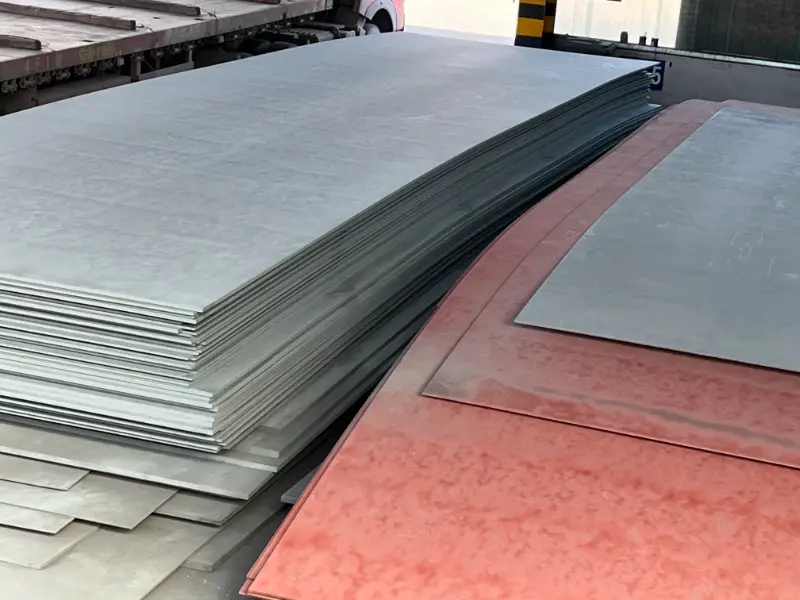
18MnMoNbR Pressure Vessel Steel
18MnMoNbR Pressure Vessel Steel | GB713 Boiler Plate Properties
Detailed analysis of GB713 18MnMoNbR pressure vessel and boiler steel plate including chemical composition, mechanical and physical properties, international equivalents, and applications.
Welding, hot forming, cold forming, machining
- Phone : +8618037372205
- Email : [email protected]
- WhatsApp: Contact via Whtsapp
- WeChat: +8618037372205
18MnMoNbR Pressure Vessel Steel Introduction
18MnMoNbR is a low-alloy high-strength steel plate specified in the Chinese standard GB 713 for pressure vessels and boilers. It belongs to the Mn-Mo-Nb series and is designed for service at elevated temperatures. The steel exhibits superior mechanical properties at both room and high temperatures, excellent weldability, and good toughness after stress relief heat treatment. It is widely used for manufacturing thick-walled pressure equipment such as reactors, heat exchangers, and steam drums in petrochemical and power industries. Key features include:
- High yield strength (>=390 MPa for thickness <=100 mm)
- Good impact energy at low temperature (-20 °C KV2 >=47 J)
- Stable high-temperature strength up to 400 °C
- Controlled levels of niobium for grain refinement
The material is typically supplied in normalized and tempered condition, ensuring uniform microstructure and mechanical stability.
18MnMoNbR Pressure Vessel Steel Chemical Composition
The chemical composition of 18MnMoNbR is regulated by GB 713. It features controlled additions of manganese, molybdenum, and niobium to achieve high strength and high-temperature stability. Phosphorus and sulfur contents are kept low to ensure good toughness and weldability. Residual elements such as chromium, nickel, and copper are limited. Typical values are shown below.
| Element | Standard Value | Remarks |
|---|---|---|
| Carbon (C) | <=0.22 | Maximum, for strength and hardenability control |
| Silicon (Si) | 0.15 - 0.50 | Deoxidizer |
| Manganese (Mn) | 1.20 - 1.60 | Contributes to strength |
| Phosphorus (P) | <=0.020 | Residual element, restricted for toughness |
| Sulfur (S) | <=0.010 | Residual element, restricted for cleanliness |
| Chromium (Cr) | <=0.30 | Residual element |
| Nickel (Ni) | <=0.30 | Residual element |
| Molybdenum (Mo) | 0.45 - 0.65 | Enhances high-temperature strength |
| Niobium (Nb) | 0.025 - 0.050 | Grain refinement element |
| Copper (Cu) | <=0.30 | Residual element |
18MnMoNbR Pressure Vessel Steel Thermal and Electrical Physical Properties
The following physical properties are typical for 18MnMoNbR steel at room temperature unless specified otherwise. These values are not mandatory from the material standard but provide guidance for design calculations. Actual values may vary slightly depending on heat treatment and processing conditions. Data are collected from general engineering references for similar low-alloy steels.
| Property | Typical Value | Unit | Test Condition / Remarks |
|---|---|---|---|
| Density (ρ) | 7850 | kg/m³ | Room temperature |
| Modulus of Elasticity (E) | 205 | GPa | Room temperature |
| Shear Modulus (G) | 80 | GPa | Calculated from E and ν |
| Poisson's Ratio (ν) | 0.3 | - | Within elastic range |
| Thermal Expansion Coefficient (α) | 11.5 | 10⁻⁶/K | 20-100 °C average |
| Thermal Conductivity (λ) | 35 | W/(m·K) | At 20 °C |
| Specific Heat Capacity (c) | 460 | J/(kg·K) | At 20 °C |
| Electrical Resistivity (ρe) | 0.22 | μΩ·m | At 20 °C (approx. 0.22 ×10⁻⁶ Ω·m) |
18MnMoNbR Pressure Vessel Steel Mechanical Properties
Mechanical properties of 18MnMoNbR are defined in GB 713. Room-temperature tensile and impact properties are tested on specimens taken from normalized and tempered plates. High-temperature yield strengths (Rp0.2) are guaranteed up to 400 °C. All values refer to the plate in delivery condition and are valid for thicknesses ≤100 mm unless otherwise noted. Impact test is performed at -20 °C using Charpy V-notch specimens.
| Property | Standard Required Value | Unit | Test Condition / Remarks |
|---|---|---|---|
| Yield Strength (ReH) | >=390 | MPa | Plate thickness 6-100 mm, transverse test |
| Tensile Strength (Rm) | 570 - 720 | MPa | Plate thickness 6-100 mm |
| Elongation after fracture (A) | >=17 | % | Proportional test piece, longitudinal, 5.65√S0 |
| Impact Energy (KV2) | >=47 | J | -20 °C, 10×10×55 mm specimen, longitudinal |
| Bend Test | d = 3a | - | 180° bending, a = specimen thickness, no cracks |
| Yield Strength at 200 °C (Rp0.2) | >=365 | MPa | Elevated temperature tensile, 6-100 mm |
| Yield Strength at 250 °C (Rp0.2) | >=350 | MPa | Elevated temperature tensile, 6-100 mm |
| Yield Strength at 300 °C (Rp0.2) | >=335 | MPa | Elevated temperature tensile, 6-100 mm |
| Yield Strength at 350 °C (Rp0.2) | >=320 | MPa | Elevated temperature tensile, 6-100 mm |
| Yield Strength at 400 °C (Rp0.2) | >=305 | MPa | Elevated temperature tensile, 6-100 mm |
18MnMoNbR Pressure Vessel Steel Equivalent Standards and Substitute Grades
| Country/Region | Standard | Grade | Remarks |
|---|---|---|---|
| China | GB 713 | 18MnMoNbR | Original designation |
| USA | ASME SA-533/SA-533M | Type B Class 1 | Similar Mn-Mo-Ni steel with Nb optional; for pressure vessels |
| European Union | EN 10028-2 | 18MnMo4-5 (1.5414) + Nb | Modified version with intentional Nb addition; comparable strength and weldability |
| Japan | JIS G3119 | SBV3 | Mn-Mo-Ni steel for boilers and pressure vessels, similar high-temperature performance |
18MnMoNbR Pressure Vessel Steel Application Introduction
18MnMoNbR steel plates are designed for demanding pressure equipment operating at moderate to high temperatures. The excellent weldability and high-temperature strength make it suitable for critical components in the following areas:
Product Applications: Hydrocracking reactors, Steam drums and boiler shells, Heat exchangers and condensers, Spherical storage tanks (LPG, ammonia), High-pressure separators
Processed into products: Cylindrical shells and courses, Dished and hemispherical heads, Tube sheets and support plates, Nozzle forgings and flanges, Reinforcement pads and stiffening rings
Application industries: Petrochemical and chemical processing, Thermal power generation (boilers), Oil & gas (refineries, gas processing), Nuclear power (secondary circuit pressure vessels), Fertilizer and coal gasification
18MnMoNbR Pressure Vessel Steel Closely Related Substitute Materials
| Country/Region | Standard | Grade | Remarks |
|---|---|---|---|
| China | GB 713 | 13MnNiMoR | Similar strength with Ni addition, used for heavy pressure vessels |
| China | GB 713 | 15MnNiDR | Low-temperature pressure vessel steel with good toughness, slightly lower strength |
| USA | ASME SA-302 | Grade B / Grade C | Mn-Mo and Mn-Mo-Ni steels; comparable base but without Nb |
| USA | ASME SA-533 | Type A Class 1 | Mn-Mo steel, lower Ni content, often used as alternative in non-sour service |
| European Union | EN 10028-2 | 15MnMoNi5-5 (1.6368) | High-strength Mn-Mo-Ni steel for elevated temperatures, similar application range |
| Japan | JIS G3119 | SBV2 | Mn-Mo steel for boilers and pressure vessels |
Notes:
All data are based on GB 713-2014 standard for 18MnMoNbR steel plates. Mechanical properties are guaranteed for thicknesses up to 100 mm in normalized and tempered condition. For fabrication, preheating before welding (typically 150-200 °C) and post-weld heat treatment are recommended to avoid cold cracking and ensure stress relief. Equivalent materials listed are approximate and should be verified against the latest standards and project specifications before substitution. Physical properties are typical values and may vary with temperature. For detailed design, refer to the relevant design code (e.g., ASME BPVC, EN 13445) and material data sheets.
- Share



